

483
Thermal Cracking
Sufficiently high temperatures convert oils entirely to gases and coke; cracking conditions are
controlled to produce as much as possible of the desired product, which is usually gasoline but may
be cracked gases for petrochemicals or lower viscosity oil for use as a fuel oil. The feedstock, or
cracking stock, may be almost any fraction obtained from crude petroleum, but the greatest amount
of cracking is carried out on gas oils, a term that refers to the portion of crude petroleum boiling
between the fuel oils (kerosene and/or stove oil) and the residuum. Residua are also cracked, but the
processes are somewhat different from those used for gas oils.
Cracking, as carried out to produce gasoline, breaks up high molecular weight species into
fragments of various sizes. The smallest fragments are usually the hydrocarbon gases; the larger
fragments are hydrocarbons that boil in the gasoline range. Some of the intermediate fragments combine to form molecules larger than those in the feedstock, cracked residua, and coke. Consequently,
a series of hydrocarbons with a boiling range similar to that of crude oil is created by cracking, but
this material is quite different from crude oil. It contains much more hydrocarbon material boiling
in the gasoline range but usually no fraction suitable for asphalt. It does contain gas oils and residual
oils suitable for light and heavy fuel oils and a much larger proportion of gases than is associated
with crude petroleum as delivered to a refinery. In addition, olefins will also be present that were
not present in the original crude oil.
Thus, thermal conversion processes are designed to increase the yield of lower boiling products
obtainable from petroleum either directly (by means of the production of gasoline components from
higher boiling feedstocks) or indirectly (by the production of olefins and the like, which are precursors of the gasoline components). These processes may also be characterized by the physical state
(liquid and/or vapor phase) in which the decomposition occurs. The state depends on the nature of
the feedstock as well as conditions of pressure and temperature (Speight and Ozum, 2002).
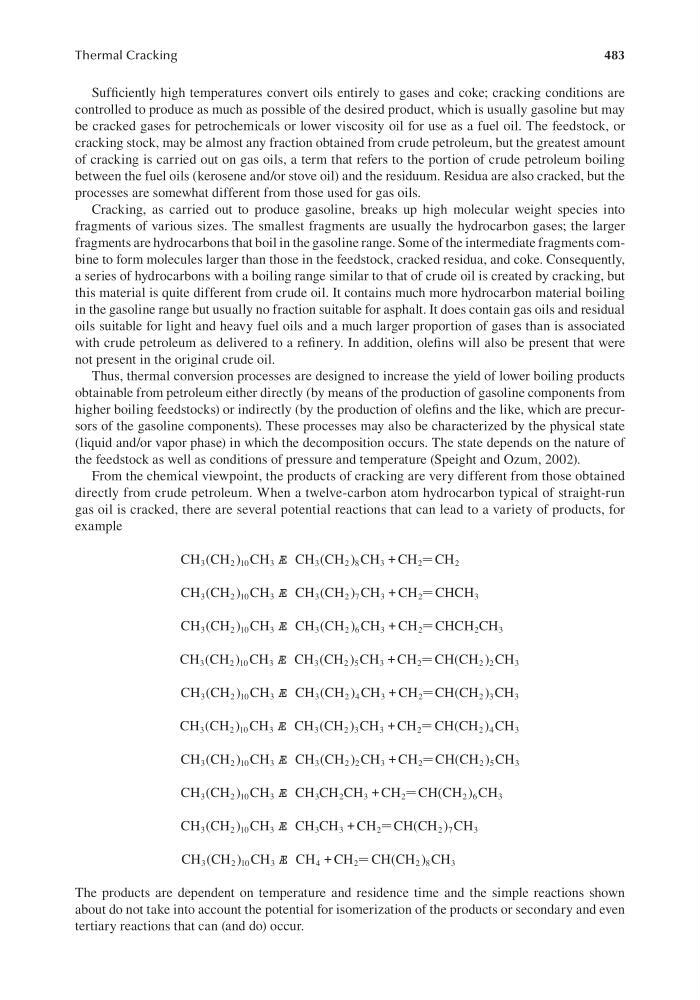
From the chemical viewpoint, the products of cracking are very different from those obtained
directly from crude petroleum. When a twelve-carbon atom hydrocarbon typical of straight-run
gas oil is cracked, there are several potential reactions that can lead to a variety of products, for
example
CH CH CH
CH CH CH CH CH
3
2 10
3
3
2 8
3
2
2
(
)
(
)
Æ
+
CH CH CH
CH CH CH CH CHCH
3
2 10
3
3
2 7
3
2
3
(
)
(
)
Æ
+
CH CH CH
CH CH CH CH CHCH CH
3
2 10
3
2 6
3
2
2
(
)
(
)
3
3
Æ
+
CH CH CH
CH CH CH CH CH CH CH
3
2 10
3
3
2 5
3
2
2 2
3
(
)
(
)
(
)
Æ
+
CH CH CH
CH CH CH CH CH CH CH
3
2 10
3
3
2 4
3
2
2 3
3
(
)
(
)
(
)
Æ
+
CH CH CH
CH CH CH CH CH CH CH
3
2 10
3
3
2 3
3
2
2 4
3
(
)
(
)
(
)
Æ
+
CH CH CH
CH CH CH CH CH CH CH
3
2 10
3
3
2 2
3
2
2 5
3
(
)
(
)
(
)
Æ
+
CH CH CH
CH CH CH CH CH CH CH
3
2 10
3
3
2
3
2
2 6
3
(
)
(
)
Æ
+
CH CH CH
CH CH CH CH CH CH
3
2 10
3
3
3
2
2 7
3
(
)
(
)
Æ
+
CH CH CH
CH CH CH CH CH
3
2 10
3
4
2
2 8
3
(
)
(
)
Æ
+
The products are dependent on temperature and residence time and the simple reactions shown
about do not take into account the potential for isomerization of the products or secondary and even
tertiary reactions that can (and do) occur.