

465
Distillation
on the trays. Vapors continue to pass upward through the tower, whereas the liquid on any particular
trays spills onto the tray below, and so on until the heat at a particular point is too intense for the
material to remain liquid. It then becomes vapor and joins the other vapors passing upward through
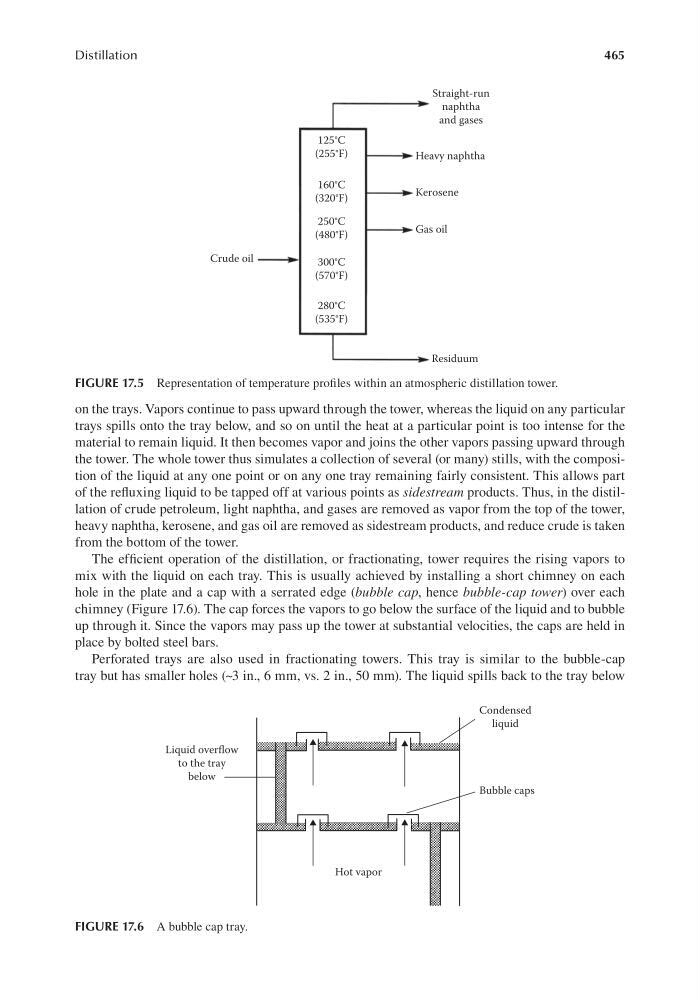
the tower. The whole tower thus simulates a collection of several (or many) stills, with the composition of the liquid at any one point or on any one tray remaining fairly consistent. This allows part
of the refluxing liquid to be tapped off at various points as sidestream products. Thus, in the distillation of crude petroleum, light naphtha, and gases are removed as vapor from the top of the tower,
heavy naphtha, kerosene, and gas oil are removed as sidestream products, and reduce crude is taken
from the bottom of the tower.
The efficient operation of the distillation, or fractionating, tower requires the rising vapors to
mix with the liquid on each tray. This is usually achieved by installing a short chimney on each
hole in the plate and a cap with a serrated edge (bubble cap, hence bubble-cap tower) over each
chimney (Figure 17.6). The cap forces the vapors to go below the surface of the liquid and to bubble
up through it. Since the vapors may pass up the tower at substantial velocities, the caps are held in
place by bolted steel bars.
Perforated trays are also used in fractionating towers. This tray is similar to the bubble-cap
tray but has smaller holes (~3 in., 6 mm, vs. 2 in., 50 mm). The liquid spills back to the tray below
Kerosene
Gas oil
Crude oil
Heavy naphtha
Straight-run
naphtha
and gases
125°C
(255°F)
160°C
(320°F)
250°C
(480°F)
300°C
(570°F)
280°C
(535°F)
Residuum
FIGURE 17.5 Representation of temperature profiles within an atmospheric distillation tower.
Bubble caps
Hot vapor
Liquid overflow
to the tray
below
Condensed
liquid
FIGURE 17.6 A bubble cap tray.