

449
Refining Chemistry
By this means, the solubility parameter of asphaltenes can be estimated to fall in the range 9–12,
which is in keeping with the asphaltenes being composed of a mixture of different compound types
with an accompanying variation in polarity. Removal of alkyl side chains from the asphaltenes
decreases the hydrogen-to-carbon atomic ratio (Wiehe, 1993; Gray, 1994) and increases the solubility parameter, thereby bringing about a concurrent decrease of the asphaltene product in the
hydrocarbon solvent.
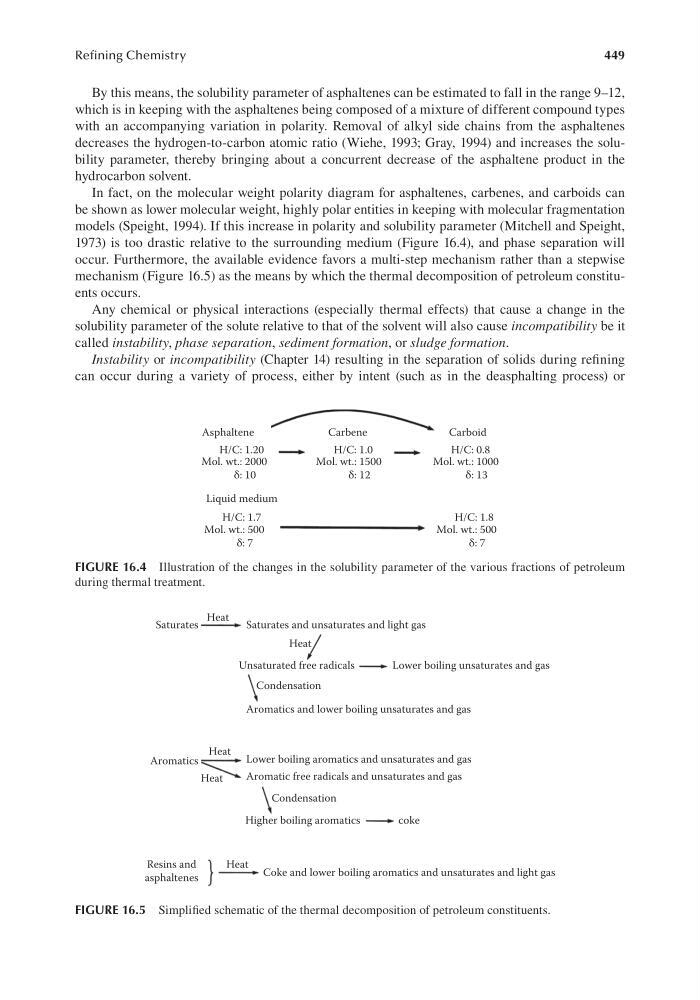
In fact, on the molecular weight polarity diagram for asphaltenes, carbenes, and carboids can
be shown as lower molecular weight, highly polar entities in keeping with molecular fragmentation
models (Speight, 1994). If this increase in polarity and solubility parameter (Mitchell and Speight,
1973) is too drastic relative to the surrounding medium (Figure 16.4), and phase separation will
occur. Furthermore, the available evidence favors a multi-step mechanism rather than a stepwise
mechanism (Figure 16.5) as the means by which the thermal decomposition of petroleum constituents occurs.
Any chemical or physical interactions (especially thermal effects) that cause a change in the
solubility parameter of the solute relative to that of the solvent will also cause incompatibility be it
called instability, phase separation, sediment formation, or sludge formation.
Instability or incompatibility (Chapter 14) resulting in the separation of solids during refining
can occur during a variety of process, either by intent (such as in the deasphalting process) or
Saturates
Heat
Heat
Heat
Heat
Resins and
asphaltenes
Aromatics
Lower boiling aromatics and unsaturates and gas
Aromatic free radicals and unsaturates and gas
Condensation
Higher boiling aromatics
coke
Unsaturated free radicals
Condensation
Lower boiling unsaturates and gas
Heat
Saturates and unsaturates and light gas
Aromatics and lower boiling unsaturates and gas
Coke and lower boiling aromatics and unsaturates and light gas
FIGURE 16.5 Simplified schematic of the thermal decomposition of petroleum constituents.
Liquid medium
H/C: 1.8
H/C: 1.7
Mol. wt.: 500
Mol. wt.: 500
Carbene
Carboid
H/C: 0.8
H/C: 1.20
H/C: 1.0
δ: 13
δ: 12
δ: 10
Mol. wt.: 1000
Mol. wt.: 2000
Mol. wt.: 1500
Asphaltene
δ: 7
δ: 7
FIGURE 16.4 Illustration of the changes in the solubility parameter of the various fractions of petroleum
during thermal treatment.
Refining Chemistry
By this means, the solubility parameter of asphaltenes can be estimated to fall in the range 9–12,
which is in keeping with the asphaltenes being composed of a mixture of different compound types
with an accompanying variation in polarity. Removal of alkyl side chains from the asphaltenes
decreases the hydrogen-to-carbon atomic ratio (Wiehe, 1993; Gray, 1994) and increases the solubility parameter, thereby bringing about a concurrent decrease of the asphaltene product in the
hydrocarbon solvent.
In fact, on the molecular weight polarity diagram for asphaltenes, carbenes, and carboids can
be shown as lower molecular weight, highly polar entities in keeping with molecular fragmentation
models (Speight, 1994). If this increase in polarity and solubility parameter (Mitchell and Speight,
1973) is too drastic relative to the surrounding medium (Figure 16.4), and phase separation will
occur. Furthermore, the available evidence favors a multi-step mechanism rather than a stepwise
mechanism (Figure 16.5) as the means by which the thermal decomposition of petroleum constituents occurs.
Any chemical or physical interactions (especially thermal effects) that cause a change in the
solubility parameter of the solute relative to that of the solvent will also cause incompatibility be it
called instability, phase separation, sediment formation, or sludge formation.
Instability or incompatibility (Chapter 14) resulting in the separation of solids during refining
can occur during a variety of process, either by intent (such as in the deasphalting process) or
Saturates
Heat
Heat
Heat
Heat
Resins and
asphaltenes
Aromatics
Lower boiling aromatics and unsaturates and gas
Aromatic free radicals and unsaturates and gas
Condensation
Higher boiling aromatics
coke
Unsaturated free radicals
Condensation
Lower boiling unsaturates and gas
Heat
Saturates and unsaturates and light gas
Aromatics and lower boiling unsaturates and gas
Coke and lower boiling aromatics and unsaturates and light gas
FIGURE 16.5 Simplified schematic of the thermal decomposition of petroleum constituents.
Liquid medium
H/C: 1.8
H/C: 1.7
Mol. wt.: 500
Mol. wt.: 500
Carbene
Carboid
H/C: 0.8
H/C: 1.20
H/C: 1.0
δ: 13
δ: 12
δ: 10
Mol. wt.: 1000
Mol. wt.: 2000
Mol. wt.: 1500
Asphaltene
δ: 7
δ: 7
FIGURE 16.4 Illustration of the changes in the solubility parameter of the various fractions of petroleum
during thermal treatment.