

20
The Chemistry and Technology of Petroleum
decomposed to yield appreciable amounts of oil, commonly referred to as shale oil. Oil shale does
not yield shale oil without the application of high temperatures and the ensuing thermal decomposition that is necessary to decompose the organic material (kerogen) in the shale.
Sapropel is an unconsolidated sedimentary deposit rich in bituminous substances. It is distinguished from peat in being rich in fatty and waxy substances and poor in cellulosic material. When
consolidated into rock, sapropel becomes oil shale, bituminous shale, or boghead coal. The principal components are certain types of algae that are rich in fats and waxes. Minor constituents are
mineral grains and decomposed fragments of spores, fungi, and bacteria. The organic materials
accumulate in water under reducing conditions.
1.4.10 kerogen
Kerogen is the complex carbonaceous (organic) material that occurs in sedimentary rocks and shale
(Chapter 5). It is for the most part insoluble in the common organic solvents. When the kerogen
occurs in shale, the whole material is often referred to as oil shale. This, like the term oil sand, is a
misnomer insofar as the shale does not contain oil; oil sand (like the more correct term bituminous
sand implies) contains a viscous nonvolatile material that can be isolated without thermal decomposition. A synthetic crude oil is produced from oil shale by the application of heat so that the kerogen
is thermally decomposed (cracked) to produce the lower molecular weight products. Kerogen is also
reputed to be a precursor of petroleum (Chapter 5).
For comparison with tar sand, oil shale is any fine-grained sedimentary rock containing solid
organic matter (kerogen; q.v.) that yields oil when heated (Scouten, 1990). Oil shales vary in their
mineral composition. For example, clay minerals predominate in true shales, while other minerals
(e.g., dolomite and calcite) occur in appreciable but subordinate amounts in the carbonates. In all
shale types, layers of the constituent mineral alternate with layers of kerogen.
1.4.11 nAturAl gAs
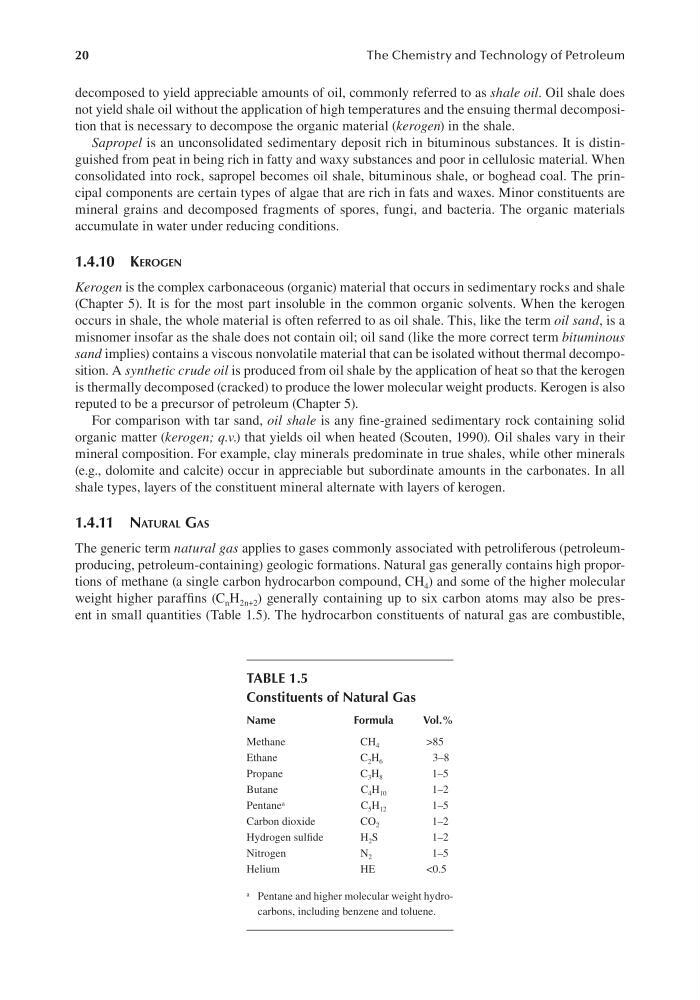
The generic term natural gas applies to gases commonly associated with petroliferous (petroleumproducing, petroleum-containing) geologic formations. Natural gas generally contains high proportions of methane (a single carbon hydrocarbon compound, CH 4 ) and some of the higher molecular
weight higher paraffins (C n H 2n+2 ) generally containing up to six carbon atoms may also be present in small quantities (Table 1.5). The hydrocarbon constituents of natural gas are combustible,
TABLE 1.5
Constituents of Natural Gas
Name
Formula
Vol.%
Methane
CH 4
>85
Ethane
C 2 H 6
3–8
Propane
C 3 H 8
1–5
Butane
C 4 H 10
1–2
Pentane a
C 5 H 12
1–5
Carbon dioxide
CO 2
1–2
Hydrogen sulfide
H 2 S
1–2
Nitrogen
N 2
1–5
Helium
HE
<0.5
a Pentane and higher molecular weight hydrocarbons, including benzene and toluene.
The Chemistry and Technology of Petroleum
decomposed to yield appreciable amounts of oil, commonly referred to as shale oil. Oil shale does
not yield shale oil without the application of high temperatures and the ensuing thermal decomposition that is necessary to decompose the organic material (kerogen) in the shale.
Sapropel is an unconsolidated sedimentary deposit rich in bituminous substances. It is distinguished from peat in being rich in fatty and waxy substances and poor in cellulosic material. When
consolidated into rock, sapropel becomes oil shale, bituminous shale, or boghead coal. The principal components are certain types of algae that are rich in fats and waxes. Minor constituents are
mineral grains and decomposed fragments of spores, fungi, and bacteria. The organic materials
accumulate in water under reducing conditions.
1.4.10 kerogen
Kerogen is the complex carbonaceous (organic) material that occurs in sedimentary rocks and shale
(Chapter 5). It is for the most part insoluble in the common organic solvents. When the kerogen
occurs in shale, the whole material is often referred to as oil shale. This, like the term oil sand, is a
misnomer insofar as the shale does not contain oil; oil sand (like the more correct term bituminous
sand implies) contains a viscous nonvolatile material that can be isolated without thermal decomposition. A synthetic crude oil is produced from oil shale by the application of heat so that the kerogen
is thermally decomposed (cracked) to produce the lower molecular weight products. Kerogen is also
reputed to be a precursor of petroleum (Chapter 5).
For comparison with tar sand, oil shale is any fine-grained sedimentary rock containing solid
organic matter (kerogen; q.v.) that yields oil when heated (Scouten, 1990). Oil shales vary in their
mineral composition. For example, clay minerals predominate in true shales, while other minerals
(e.g., dolomite and calcite) occur in appreciable but subordinate amounts in the carbonates. In all
shale types, layers of the constituent mineral alternate with layers of kerogen.
1.4.11 nAturAl gAs
The generic term natural gas applies to gases commonly associated with petroliferous (petroleumproducing, petroleum-containing) geologic formations. Natural gas generally contains high proportions of methane (a single carbon hydrocarbon compound, CH 4 ) and some of the higher molecular
weight higher paraffins (C n H 2n+2 ) generally containing up to six carbon atoms may also be present in small quantities (Table 1.5). The hydrocarbon constituents of natural gas are combustible,
TABLE 1.5
Constituents of Natural Gas
Name
Formula
Vol.%
Methane
CH 4
>85
Ethane
C 2 H 6
3–8
Propane
C 3 H 8
1–5
Butane
C 4 H 10
1–2
Pentane a
C 5 H 12
1–5
Carbon dioxide
CO 2
1–2
Hydrogen sulfide
H 2 S
1–2
Nitrogen
N 2
1–5
Helium
HE
<0.5
a Pentane and higher molecular weight hydrocarbons, including benzene and toluene.