

435
Refining Chemistry
Or the interference of secondary and tertiary products with the course of a reaction and, hence,
with the formation of primary products may also be cause for concern. Hence, caution is advised
when applying the data from model compound studies to the behavior of petroleum, especially the
molecularly complex heavy oils. These have few, if any, parallels in organic chemistry.
16.2 CRACKING
16.2.1 tHermAl CrACkIng
The term cracking applies to the decomposition of petroleum constituents that is induced by elevated
temperatures (>350°C, >660°F), whereby the higher molecular weight constituents of petroleum are
converted to lower molecular weight products. Cracking reactions involve carbon–carbon bond rupture and are thermodynamically favored at high temperature (Egloff, 1937).
Thus, cracking is a phenomenon by which higher boiling (higher molecular weight) constituents in petroleum are converted into lower boiling (lower molecular weight) products. However,
certain products may interact with one another to yield products having higher molecular weights
than the constituents of the original feedstock. Some of the products are expelled from the system
as, say, gases, gasoline-range materials, kerosene-range materials, and the various intermediates
that produce other products such as coke. Materials that have boiling ranges higher than gasoline
and kerosene may (depending upon the refining options) be referred to as recycle stock, which is
recycled in the cracking equipment until conversion is complete.
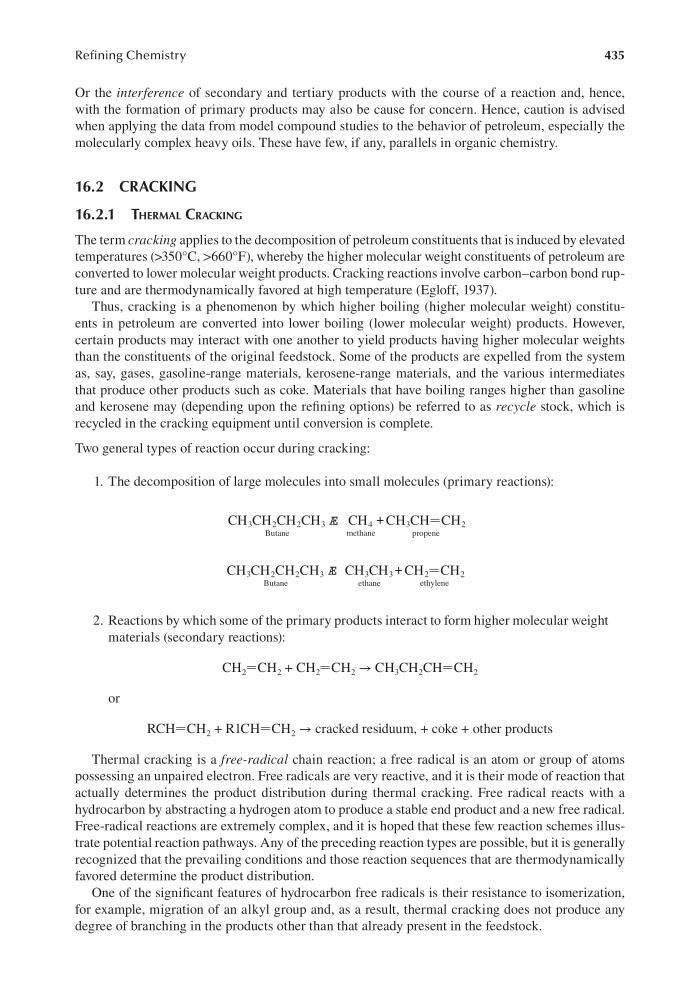
Two general types of reaction occur during cracking:
1. The decomposition of large molecules into small molecules (primary reactions):
CH CH CH CH
CH CH CH CH
3
2
2
3
Butane
4
methane
3
2
propene
Æ
+
CH CH CH CH
CH CH CH CH
3
2
2
3
Butane
3
3
ethane
2
ethylene
Æ
+
2
2. Reactions by which some of the primary products interact to form higher molecular weight
materials (secondary reactions):
CH 2 =CH 2 + CH 2 =CH 2 → CH 3 CH 2 CH=CH 2
or
RCH=CH 2 + R1CH=CH 2 → cracked residuum, + coke + other products
Thermal cracking is a free-radical chain reaction; a free radical is an atom or group of atoms
possessing an unpaired electron. Free radicals are very reactive, and it is their mode of reaction that
actually determines the product distribution during thermal cracking. Free radical reacts with a
hydrocarbon by abstracting a hydrogen atom to produce a stable end product and a new free radical.
Free-radical reactions are extremely complex, and it is hoped that these few reaction schemes illustrate potential reaction pathways. Any of the preceding reaction types are possible, but it is generally
recognized that the prevailing conditions and those reaction sequences that are thermodynamically
favored determine the product distribution.
One of the significant features of hydrocarbon free radicals is their resistance to isomerization,
for example, migration of an alkyl group and, as a result, thermal cracking does not produce any
degree of branching in the products other than that already present in the feedstock.
Refining Chemistry
Or the interference of secondary and tertiary products with the course of a reaction and, hence,
with the formation of primary products may also be cause for concern. Hence, caution is advised
when applying the data from model compound studies to the behavior of petroleum, especially the
molecularly complex heavy oils. These have few, if any, parallels in organic chemistry.
16.2 CRACKING
16.2.1 tHermAl CrACkIng
The term cracking applies to the decomposition of petroleum constituents that is induced by elevated
temperatures (>350°C, >660°F), whereby the higher molecular weight constituents of petroleum are
converted to lower molecular weight products. Cracking reactions involve carbon–carbon bond rupture and are thermodynamically favored at high temperature (Egloff, 1937).
Thus, cracking is a phenomenon by which higher boiling (higher molecular weight) constituents in petroleum are converted into lower boiling (lower molecular weight) products. However,
certain products may interact with one another to yield products having higher molecular weights
than the constituents of the original feedstock. Some of the products are expelled from the system
as, say, gases, gasoline-range materials, kerosene-range materials, and the various intermediates
that produce other products such as coke. Materials that have boiling ranges higher than gasoline
and kerosene may (depending upon the refining options) be referred to as recycle stock, which is
recycled in the cracking equipment until conversion is complete.
Two general types of reaction occur during cracking:
1. The decomposition of large molecules into small molecules (primary reactions):
CH CH CH CH
CH CH CH CH
3
2
2
3
Butane
4
methane
3
2
propene
Æ
+
CH CH CH CH
CH CH CH CH
3
2
2
3
Butane
3
3
ethane
2
ethylene
Æ
+
2
2. Reactions by which some of the primary products interact to form higher molecular weight
materials (secondary reactions):
CH 2 =CH 2 + CH 2 =CH 2 → CH 3 CH 2 CH=CH 2
or
RCH=CH 2 + R1CH=CH 2 → cracked residuum, + coke + other products
Thermal cracking is a free-radical chain reaction; a free radical is an atom or group of atoms
possessing an unpaired electron. Free radicals are very reactive, and it is their mode of reaction that
actually determines the product distribution during thermal cracking. Free radical reacts with a
hydrocarbon by abstracting a hydrogen atom to produce a stable end product and a new free radical.
Free-radical reactions are extremely complex, and it is hoped that these few reaction schemes illustrate potential reaction pathways. Any of the preceding reaction types are possible, but it is generally
recognized that the prevailing conditions and those reaction sequences that are thermodynamically
favored determine the product distribution.
One of the significant features of hydrocarbon free radicals is their resistance to isomerization,
for example, migration of an alkyl group and, as a result, thermal cracking does not produce any
degree of branching in the products other than that already present in the feedstock.