

429
Introduction to Refining Processes
distillation units (i.e., atmospheric distillation unit and the vacuum distillation unit). In the long
term, the major developments are the integration of different distillation columns into one reactor
(e.g., dividing-wall column) or the development of alternative processing routes allowing for combination of conversion and distillation (such as reactive distillation). Alternative processes to distillation will also include membranes and technologies such as freeze concentration.
Thermal processes (Chapter 18) will also evolve and become more efficient. While the current
processes may not see much change in terms of reactor vessel configuration, there will be changes
to the reactor internals and to the nature of the catalysts. For example, the tried-and-true coking
processes will remain the mainstay of refineries coping with an influx of heavy oil and bitumen, but
other process options will be used.
For example, visbreaking (or even hydrovisbreaking, i.e., visbreaking in an atmosphere of
hydrogen or in the presence of a hydrogen donor material) (Chapter 18)—the long-ignored stepchild of the refining industry—may see a surge in use as a pretreatment process. Management of
the process to produce a liquid product that has been freed of the high potential for coke deposition
(by taking the process parameters into the region where sediment forms) either in the absence or
presence of (for example) a metal oxide scavenger could be a valuable ally to catalyst cracking
or hydrocracking units.
In addition, operating the catalytic cracking unit solely as a slurry riser cracker (without the presence of the main reactor) followed by separation of coke (sediment) would save the capital outlay
required for a new catalytic cracker and might even show high conversion to valuable liquids. The
quality (i.e., boiling range) of the distillate would be dependent upon the residence time of the slurry
in the pipe.
Scavenger additives such as metal oxides may also see a surge in use. As a simple example, a metal
oxide (such as calcium oxide) has the ability to react with sulfur-containing feedstock to produce
a hydrocarbon (and calcium sulfide):
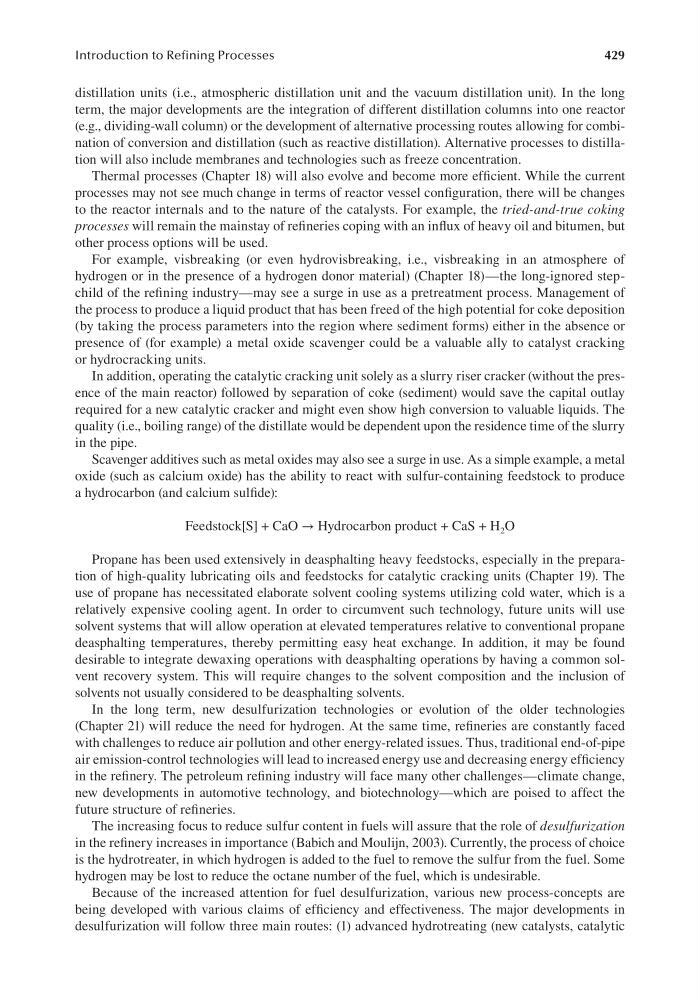
Feedstock[S] + CaO → Hydrocarbon product + CaS + H 2 O
Propane has been used extensively in deasphalting heavy feedstocks, especially in the preparation of high-quality lubricating oils and feedstocks for catalytic cracking units (Chapter 19). The
use of propane has necessitated elaborate solvent cooling systems utilizing cold water, which is a
relatively expensive cooling agent. In order to circumvent such technology, future units will use
solvent systems that will allow operation at elevated temperatures relative to conventional propane
deasphalting temperatures, thereby permitting easy heat exchange. In addition, it may be found
desirable to integrate dewaxing operations with deasphalting operations by having a common solvent recovery system. This will require changes to the solvent composition and the inclusion of
solvents not usually considered to be deasphalting solvents.
In the long term, new desulfurization technologies or evolution of the older technologies
(Chapter 21) will reduce the need for hydrogen. At the same time, refineries are constantly faced
with challenges to reduce air pollution and other energy-related issues. Thus, traditional end-of-pipe
air emission-control technologies will lead to increased energy use and decreasing energy efficiency
in the refinery. The petroleum refining industry will face many other challenges—climate change,
new developments in automotive technology, and biotechnology—which are poised to affect the
future structure of refineries.
The increasing focus to reduce sulfur content in fuels will assure that the role of desulfurization
in the refinery increases in importance (Babich and Moulijn, 2003). Currently, the process of choice
is the hydrotreater, in which hydrogen is added to the fuel to remove the sulfur from the fuel. Some
hydrogen may be lost to reduce the octane number of the fuel, which is undesirable.
Because of the increased attention for fuel desulfurization, various new process-concepts are
being developed with various claims of efficiency and effectiveness. The major developments in
desulfurization will follow three main routes: (1) advanced hydrotreating (new catalysts, catalytic
Introduction to Refining Processes
distillation units (i.e., atmospheric distillation unit and the vacuum distillation unit). In the long
term, the major developments are the integration of different distillation columns into one reactor
(e.g., dividing-wall column) or the development of alternative processing routes allowing for combination of conversion and distillation (such as reactive distillation). Alternative processes to distillation will also include membranes and technologies such as freeze concentration.
Thermal processes (Chapter 18) will also evolve and become more efficient. While the current
processes may not see much change in terms of reactor vessel configuration, there will be changes
to the reactor internals and to the nature of the catalysts. For example, the tried-and-true coking
processes will remain the mainstay of refineries coping with an influx of heavy oil and bitumen, but
other process options will be used.
For example, visbreaking (or even hydrovisbreaking, i.e., visbreaking in an atmosphere of
hydrogen or in the presence of a hydrogen donor material) (Chapter 18)—the long-ignored stepchild of the refining industry—may see a surge in use as a pretreatment process. Management of
the process to produce a liquid product that has been freed of the high potential for coke deposition
(by taking the process parameters into the region where sediment forms) either in the absence or
presence of (for example) a metal oxide scavenger could be a valuable ally to catalyst cracking
or hydrocracking units.
In addition, operating the catalytic cracking unit solely as a slurry riser cracker (without the presence of the main reactor) followed by separation of coke (sediment) would save the capital outlay
required for a new catalytic cracker and might even show high conversion to valuable liquids. The
quality (i.e., boiling range) of the distillate would be dependent upon the residence time of the slurry
in the pipe.
Scavenger additives such as metal oxides may also see a surge in use. As a simple example, a metal
oxide (such as calcium oxide) has the ability to react with sulfur-containing feedstock to produce
a hydrocarbon (and calcium sulfide):
Feedstock[S] + CaO → Hydrocarbon product + CaS + H 2 O
Propane has been used extensively in deasphalting heavy feedstocks, especially in the preparation of high-quality lubricating oils and feedstocks for catalytic cracking units (Chapter 19). The
use of propane has necessitated elaborate solvent cooling systems utilizing cold water, which is a
relatively expensive cooling agent. In order to circumvent such technology, future units will use
solvent systems that will allow operation at elevated temperatures relative to conventional propane
deasphalting temperatures, thereby permitting easy heat exchange. In addition, it may be found
desirable to integrate dewaxing operations with deasphalting operations by having a common solvent recovery system. This will require changes to the solvent composition and the inclusion of
solvents not usually considered to be deasphalting solvents.
In the long term, new desulfurization technologies or evolution of the older technologies
(Chapter 21) will reduce the need for hydrogen. At the same time, refineries are constantly faced
with challenges to reduce air pollution and other energy-related issues. Thus, traditional end-of-pipe
air emission-control technologies will lead to increased energy use and decreasing energy efficiency
in the refinery. The petroleum refining industry will face many other challenges—climate change,
new developments in automotive technology, and biotechnology—which are poised to affect the
future structure of refineries.
The increasing focus to reduce sulfur content in fuels will assure that the role of desulfurization
in the refinery increases in importance (Babich and Moulijn, 2003). Currently, the process of choice
is the hydrotreater, in which hydrogen is added to the fuel to remove the sulfur from the fuel. Some
hydrogen may be lost to reduce the octane number of the fuel, which is undesirable.
Because of the increased attention for fuel desulfurization, various new process-concepts are
being developed with various claims of efficiency and effectiveness. The major developments in
desulfurization will follow three main routes: (1) advanced hydrotreating (new catalysts, catalytic