

394
The Chemistry and Technology of Petroleum
The configuration of refineries may vary from refinery to refinery. Some refineries may be more
oriented toward the production of gasoline (large reforming and/or catalytic cracking), whereas the
configuration of other refineries may be more oriented toward the production of middle distillates
such as jet fuel and gas oil.
This chapter presents an introduction to petroleum refining in order for the reader to place each
process in the correct context of the refinery.
15.2 DEWATERING AND DESALTING
Before proceeding with the separation of petroleum into its various constituents, there is the need
to clean the petroleum. This is often referred to as desalting and dewatering in which the goal is to
remove water and the constituents of the brine that accompany the crude oil from the reservoir to
the wellhead during recovery operations.
Petroleum is recovered from the reservoir mixed with a variety of substances: gases, water, and
dirt (minerals). Thus, refining actually commences with the production of fluids from the well or
reservoir and is followed by pretreatment operations that are applied to the crude oil either at the
refinery or prior to transportation. Pipeline operators, for instance, are insistent upon the quality of
the fluids put into the pipelines; therefore, any crude oil to be shipped by pipeline or, for that matter, by any other form of transportation must meet rigid specifications in regard to water and salt
content. In some instances, sulfur content, nitrogen content, and viscosity may also be specified.
Field separation, which occurs at a field site near the recovery operation, is the first attempt to
remove the gases, water, and dirt that accompany crude oil coming from the ground. The separator may be no more than a large vessel that gives a quieting zone for gravity separation into three
phases: gases, crude oil, and water containing entrained dirt.
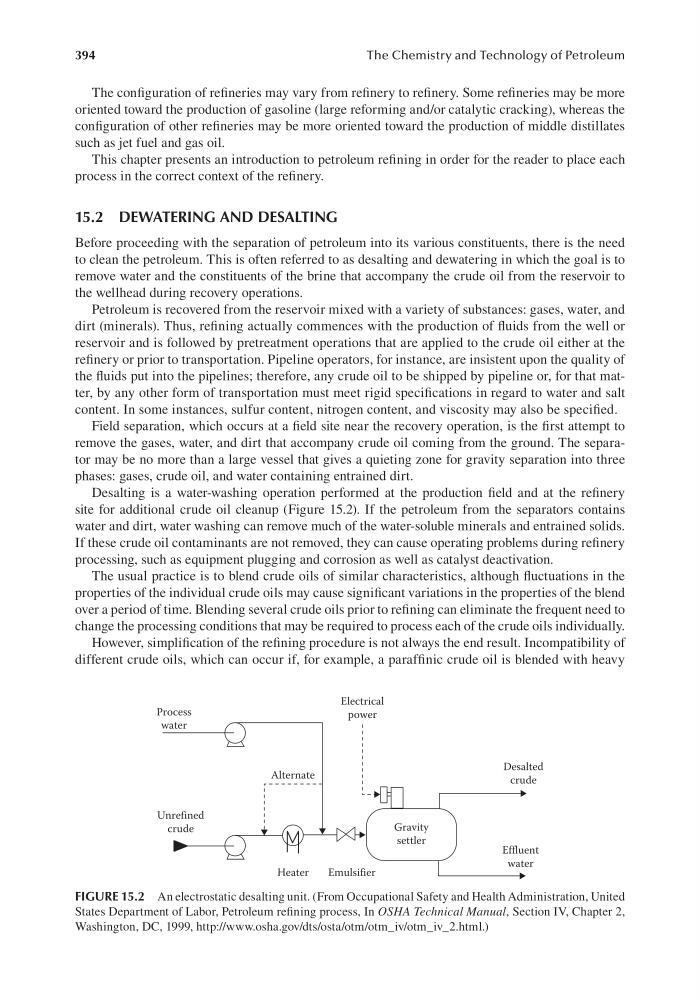
Desalting is a water-washing operation performed at the production field and at the refinery
site for additional crude oil cleanup (Figure 15.2). If the petroleum from the separators contains
water and dirt, water washing can remove much of the water-soluble minerals and entrained solids.
If these crude oil contaminants are not removed, they can cause operating problems during refinery
processing, such as equipment plugging and corrosion as well as catalyst deactivation.
The usual practice is to blend crude oils of similar characteristics, although fluctuations in the
properties of the individual crude oils may cause significant variations in the properties of the blend
over a period of time. Blending several crude oils prior to refining can eliminate the frequent need to
change the processing conditions that may be required to process each of the crude oils individually.
However, simplification of the refining procedure is not always the end result. Incompatibility of
different crude oils, which can occur if, for example, a paraffinic crude oil is blended with heavy
Process
water
Unrefined
crude
Alternate
Electrical
power
Gravity
settler
Effluent
water
Desalted
crude
Heater
Emulsifier
FIGURE 15.2 An electrostatic desalting unit. (From Occupational Safety and Health Administration, United
States Department of Labor, Petroleum refining process, In OSHA Technical Manual, Section IV, Chapter 2,
Washington, DC, 1999, http://www.osha.gov/dts/osta/otm/otm_iv/otm_iv_2.html.)
The Chemistry and Technology of Petroleum
The configuration of refineries may vary from refinery to refinery. Some refineries may be more
oriented toward the production of gasoline (large reforming and/or catalytic cracking), whereas the
configuration of other refineries may be more oriented toward the production of middle distillates
such as jet fuel and gas oil.
This chapter presents an introduction to petroleum refining in order for the reader to place each
process in the correct context of the refinery.
15.2 DEWATERING AND DESALTING
Before proceeding with the separation of petroleum into its various constituents, there is the need
to clean the petroleum. This is often referred to as desalting and dewatering in which the goal is to
remove water and the constituents of the brine that accompany the crude oil from the reservoir to
the wellhead during recovery operations.
Petroleum is recovered from the reservoir mixed with a variety of substances: gases, water, and
dirt (minerals). Thus, refining actually commences with the production of fluids from the well or
reservoir and is followed by pretreatment operations that are applied to the crude oil either at the
refinery or prior to transportation. Pipeline operators, for instance, are insistent upon the quality of
the fluids put into the pipelines; therefore, any crude oil to be shipped by pipeline or, for that matter, by any other form of transportation must meet rigid specifications in regard to water and salt
content. In some instances, sulfur content, nitrogen content, and viscosity may also be specified.
Field separation, which occurs at a field site near the recovery operation, is the first attempt to
remove the gases, water, and dirt that accompany crude oil coming from the ground. The separator may be no more than a large vessel that gives a quieting zone for gravity separation into three
phases: gases, crude oil, and water containing entrained dirt.
Desalting is a water-washing operation performed at the production field and at the refinery
site for additional crude oil cleanup (Figure 15.2). If the petroleum from the separators contains
water and dirt, water washing can remove much of the water-soluble minerals and entrained solids.
If these crude oil contaminants are not removed, they can cause operating problems during refinery
processing, such as equipment plugging and corrosion as well as catalyst deactivation.
The usual practice is to blend crude oils of similar characteristics, although fluctuations in the
properties of the individual crude oils may cause significant variations in the properties of the blend
over a period of time. Blending several crude oils prior to refining can eliminate the frequent need to
change the processing conditions that may be required to process each of the crude oils individually.
However, simplification of the refining procedure is not always the end result. Incompatibility of
different crude oils, which can occur if, for example, a paraffinic crude oil is blended with heavy
Process
water
Unrefined
crude
Alternate
Electrical
power
Gravity
settler
Effluent
water
Desalted
crude
Heater
Emulsifier
FIGURE 15.2 An electrostatic desalting unit. (From Occupational Safety and Health Administration, United
States Department of Labor, Petroleum refining process, In OSHA Technical Manual, Section IV, Chapter 2,
Washington, DC, 1999, http://www.osha.gov/dts/osta/otm/otm_iv/otm_iv_2.html.)