

384
The Chemistry and Technology of Petroleum
In petroleum, the asphaltenes and resins have strong interactions to the extent that the asphaltenes are
immiscible (insoluble/incompatible) with the remaining constituents in the absence of the resins (Koots
and Speight, 1975). And there appears to be points of structural similarity (for a crude oil) between the
asphaltene and the resin constituents thereby setting the stage for a more-than-is-generally-appreciated
complex relationship but confirming the hypothesis that petroleum is a continuum of chemical species,
including the asphaltene constituents (Chapter 12).
This sets the stage for the incompatibility of the asphaltenes in any operation in which the asphaltene or resin constituents are physically or chemically altered. Disturbance of the asphaltene–resin
relationships can be the stimulation by which, for example, some or all of the asphaltene constituents form a separate insoluble phase, leading to such phenomena as coke formation (in thermal
processes) or asphalt instability during use.
There is a series of characterization indices that can also present indications of whether or not
a petroleum product is stable or unstable. For example, the characterization factor indicates the
chemical character of the crude oil and has been used to indicate whether a crude oil was paraffinic
in nature or whether it was a naphthenic/aromatic crude oil.
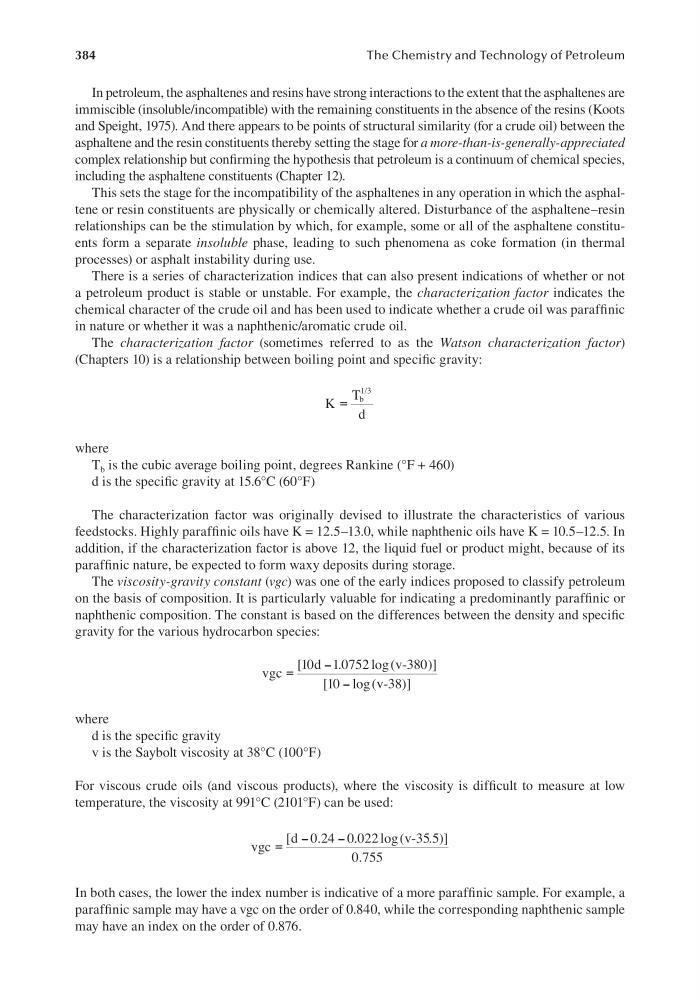
The characterization factor (sometimes referred to as the Watson characterization factor)
(Chapters 10) is a relationship between boiling point and specific gravity:
K
T
d
b
1/3
=
where
T b is the cubic average boiling point, degrees Rankine (°F + 460)
d is the specific gravity at 15.6°C (60°F)
The characterization factor was originally devised to illustrate the characteristics of various
feedstocks. Highly paraffinic oils have K = 12.5–13.0, while naphthenic oils have K = 10.5–12.5. In
addition, if the characterization factor is above 12, the liquid fuel or product might, because of its
paraffinic nature, be expected to form waxy deposits during storage.
The viscosity-gravity constant (vgc) was one of the early indices proposed to classify petroleum
on the basis of composition. It is particularly valuable for indicating a predominantly paraffinic or
naphthenic composition. The constant is based on the differences between the density and specific
gravity for the various hydrocarbon species:
vgc
1 d 1 752 log v-38
1 log v-38
=
-
-
[
.
(
)]
[
(
)]
0
0
0
0
where
d is the specific gravity
v is the Saybolt viscosity at 38°C (100°F)
For viscous crude oils (and viscous products), where the viscosity is difficult to measure at low
temperature, the viscosity at 991°C (2101°F) can be used:
vgc
d
24
22 log v-35 5
755
=
-
-
[
.
.
(
. )]
.
0
00
0
In both cases, the lower the index number is indicative of a more paraffinic sample. For example, a
paraffinic sample may have a vgc on the order of 0.840, while the corresponding naphthenic sample
may have an index on the order of 0.876.
The Chemistry and Technology of Petroleum
In petroleum, the asphaltenes and resins have strong interactions to the extent that the asphaltenes are
immiscible (insoluble/incompatible) with the remaining constituents in the absence of the resins (Koots
and Speight, 1975). And there appears to be points of structural similarity (for a crude oil) between the
asphaltene and the resin constituents thereby setting the stage for a more-than-is-generally-appreciated
complex relationship but confirming the hypothesis that petroleum is a continuum of chemical species,
including the asphaltene constituents (Chapter 12).
This sets the stage for the incompatibility of the asphaltenes in any operation in which the asphaltene or resin constituents are physically or chemically altered. Disturbance of the asphaltene–resin
relationships can be the stimulation by which, for example, some or all of the asphaltene constituents form a separate insoluble phase, leading to such phenomena as coke formation (in thermal
processes) or asphalt instability during use.
There is a series of characterization indices that can also present indications of whether or not
a petroleum product is stable or unstable. For example, the characterization factor indicates the
chemical character of the crude oil and has been used to indicate whether a crude oil was paraffinic
in nature or whether it was a naphthenic/aromatic crude oil.
The characterization factor (sometimes referred to as the Watson characterization factor)
(Chapters 10) is a relationship between boiling point and specific gravity:
K
T
d
b
1/3
=
where
T b is the cubic average boiling point, degrees Rankine (°F + 460)
d is the specific gravity at 15.6°C (60°F)
The characterization factor was originally devised to illustrate the characteristics of various
feedstocks. Highly paraffinic oils have K = 12.5–13.0, while naphthenic oils have K = 10.5–12.5. In
addition, if the characterization factor is above 12, the liquid fuel or product might, because of its
paraffinic nature, be expected to form waxy deposits during storage.
The viscosity-gravity constant (vgc) was one of the early indices proposed to classify petroleum
on the basis of composition. It is particularly valuable for indicating a predominantly paraffinic or
naphthenic composition. The constant is based on the differences between the density and specific
gravity for the various hydrocarbon species:
vgc
1 d 1 752 log v-38
1 log v-38
=
-
-
[
.
(
)]
[
(
)]
0
0
0
0
where
d is the specific gravity
v is the Saybolt viscosity at 38°C (100°F)
For viscous crude oils (and viscous products), where the viscosity is difficult to measure at low
temperature, the viscosity at 991°C (2101°F) can be used:
vgc
d
24
22 log v-35 5
755
=
-
-
[
.
.
(
. )]
.
0
00
0
In both cases, the lower the index number is indicative of a more paraffinic sample. For example, a
paraffinic sample may have a vgc on the order of 0.840, while the corresponding naphthenic sample
may have an index on the order of 0.876.