

372
The Chemistry and Technology of Petroleum
Hardy and Wechter, 1990; Ruzicka and Nordenson, 1990; Power and Mathys, 1992). Hence, there
are different ways of defining each of these terms, but the terms are often used interchangeably.
Gum formation (ASTM D525; IP 40) alludes to the formation of soluble organic material,
whereas sediment is the insoluble organic material. Storage stability (or storage instability) (ASTM
D381; ASTM D4625; IP 131; IP 378) is a term used to describe the ability of the liquid to remain in
storage over extended periods of time without appreciable deterioration as measured by gum formation and/or the formation sediment. Thermal stability is also defined as the ability of the liquid to
withstand relatively high temperatures for short periods of time without the formation of sediment
(i.e., carbonaceous deposits and/or coke). Thermal oxidative stability is the ability of the liquid to
withstand relatively high temperatures for short periods of time in the presence of oxidation and
without the formation of sediment or deterioration of properties (ASTM D3241), and there is standard equipment for various oxidation tests (ASTM D4871). Stability is also defined as the ability
of the liquid to withstand long periods at temperatures up to 100°C (212°F) without degradation.
Determination of the reaction threshold temperature for various liquid and solid materials might
be beneficial (ASTM D2883).
Existent gum is the name given to the nonvolatile residue present in the fuel as received for test
(ASTM D381; IP 131). In this test, the sample is evaporated from a beaker maintained at a temperature of 160°C–166°C (320°F–331°F) with the aid of a similarly heated jet of air. This material is
distinguished from the potential gum that is obtained by aging the sample at an elevated temperature.
Thus, potential gum is determined by the accelerated gum test (ASTM D873; IP 138) that is used
as a safeguard of storage stability and can be used to predict the potential for gum formation during prolonged storage. In this test, the fuel is heated for 16 h with oxygen under pressure in a bomb
at 100°C (212°F). After this time, both the gum content and the solids precipitate are measured.
A similar test, using an accelerated oxidation procedure, is also in use for determining the oxidative
stability of diesel fuel (ASTM D2274), steam turbine oil (ASTM D2272), distillate fuel oil (ASTM
D2274), and lubricating grease (ASTM D942).
Dry sludge is defined as the material separated from petroleum and petroleum products by filtration and which is insoluble in heptane. Existent dry sludge is the dry sludge in the original sample
as received and is distinguished from the accelerated dry sludge obtained after aging the sample by
chemical addition or heat. The existent dry sludge is distinguished from the potential dry sludge
that is obtained by aging the sample at an elevated temperature.
The existent dry sludge is operationally defined as the material separated from the bulk of a
crude oil or crude oil product by filtration and which is insoluble in heptane. The test is used as an
indicator of process operability and as a measure of potential downstream fouling.
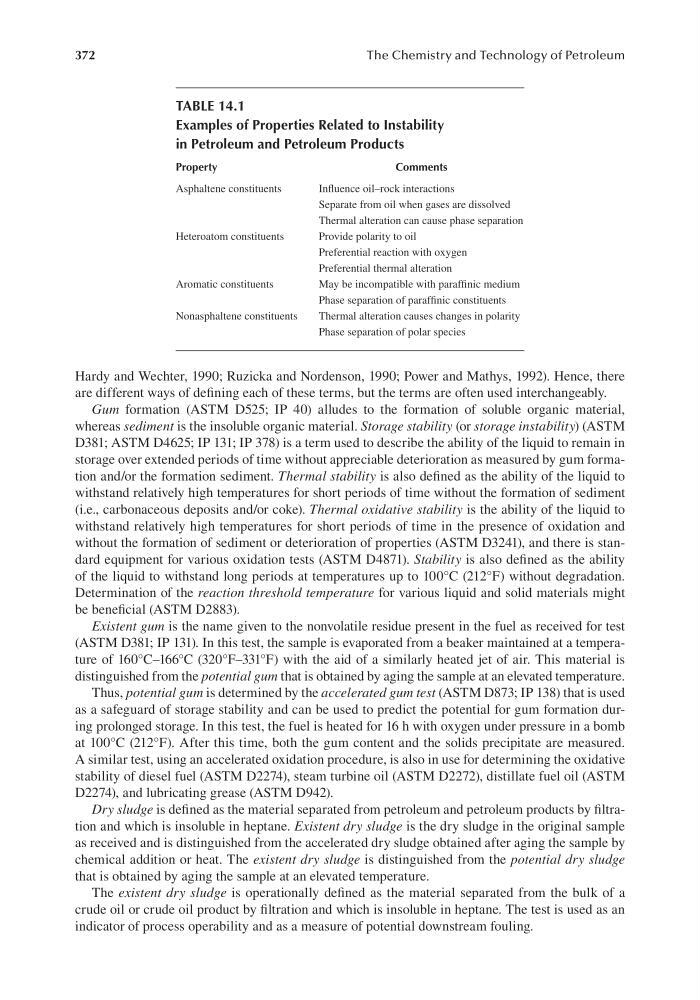
TABLE 14.1
Examples of Properties Related to Instability
in Petroleum and Petroleum Products
Property
Comments
Asphaltene constituents
Influence oil–rock interactions
Separate from oil when gases are dissolved
Thermal alteration can cause phase separation
Heteroatom constituents
Provide polarity to oil
Preferential reaction with oxygen
Preferential thermal alteration
Aromatic constituents
May be incompatible with paraffinic medium
Phase separation of paraffinic constituents
Nonasphaltene constituents
Thermal alteration causes changes in polarity
Phase separation of polar species
The Chemistry and Technology of Petroleum
Hardy and Wechter, 1990; Ruzicka and Nordenson, 1990; Power and Mathys, 1992). Hence, there
are different ways of defining each of these terms, but the terms are often used interchangeably.
Gum formation (ASTM D525; IP 40) alludes to the formation of soluble organic material,
whereas sediment is the insoluble organic material. Storage stability (or storage instability) (ASTM
D381; ASTM D4625; IP 131; IP 378) is a term used to describe the ability of the liquid to remain in
storage over extended periods of time without appreciable deterioration as measured by gum formation and/or the formation sediment. Thermal stability is also defined as the ability of the liquid to
withstand relatively high temperatures for short periods of time without the formation of sediment
(i.e., carbonaceous deposits and/or coke). Thermal oxidative stability is the ability of the liquid to
withstand relatively high temperatures for short periods of time in the presence of oxidation and
without the formation of sediment or deterioration of properties (ASTM D3241), and there is standard equipment for various oxidation tests (ASTM D4871). Stability is also defined as the ability
of the liquid to withstand long periods at temperatures up to 100°C (212°F) without degradation.
Determination of the reaction threshold temperature for various liquid and solid materials might
be beneficial (ASTM D2883).
Existent gum is the name given to the nonvolatile residue present in the fuel as received for test
(ASTM D381; IP 131). In this test, the sample is evaporated from a beaker maintained at a temperature of 160°C–166°C (320°F–331°F) with the aid of a similarly heated jet of air. This material is
distinguished from the potential gum that is obtained by aging the sample at an elevated temperature.
Thus, potential gum is determined by the accelerated gum test (ASTM D873; IP 138) that is used
as a safeguard of storage stability and can be used to predict the potential for gum formation during prolonged storage. In this test, the fuel is heated for 16 h with oxygen under pressure in a bomb
at 100°C (212°F). After this time, both the gum content and the solids precipitate are measured.
A similar test, using an accelerated oxidation procedure, is also in use for determining the oxidative
stability of diesel fuel (ASTM D2274), steam turbine oil (ASTM D2272), distillate fuel oil (ASTM
D2274), and lubricating grease (ASTM D942).
Dry sludge is defined as the material separated from petroleum and petroleum products by filtration and which is insoluble in heptane. Existent dry sludge is the dry sludge in the original sample
as received and is distinguished from the accelerated dry sludge obtained after aging the sample by
chemical addition or heat. The existent dry sludge is distinguished from the potential dry sludge
that is obtained by aging the sample at an elevated temperature.
The existent dry sludge is operationally defined as the material separated from the bulk of a
crude oil or crude oil product by filtration and which is insoluble in heptane. The test is used as an
indicator of process operability and as a measure of potential downstream fouling.
TABLE 14.1
Examples of Properties Related to Instability
in Petroleum and Petroleum Products
Property
Comments
Asphaltene constituents
Influence oil–rock interactions
Separate from oil when gases are dissolved
Thermal alteration can cause phase separation
Heteroatom constituents
Provide polarity to oil
Preferential reaction with oxygen
Preferential thermal alteration
Aromatic constituents
May be incompatible with paraffinic medium
Phase separation of paraffinic constituents
Nonasphaltene constituents
Thermal alteration causes changes in polarity
Phase separation of polar species