

357
Structure of Petroleum
particular assistance in developing methods of coke mitigation as well as understanding the behavior of asphalt (Speight, 1992).
The CMCs of asphaltene-type materials have been determined more recently using a variety of
different methods such as surface tension (Rogacheva et al., 1980; Menon and Wasan, 1986) and
calorimetric titration (Andersen and Birdi, 1991a,b). The data for the values of the CMC for the
asphaltenes found by these methods were in the range of 1–5 g/L in toluene.
A very recent publication (Sheu et al., 1992) confirmed that the self-association of asphaltenes
occurred in organic solvents using surface tension measurements. The data were also used to show
that a critical concentration exists in organic solvents above which asphaltene self-association will
occur, in a manner similar to surfactant systems. The reported magnitude of the CMC and effects
of differences in solvent are in agreement with previous works.
However, it is considered doubtful that a well-defined CMC can be determined for the resin
(or pentane soluble) fraction of petroleum, especially from surface tension–concentration data. In
fact, inflection points noted in the surface tension–concentration curves (Sheu et al., 1992) may
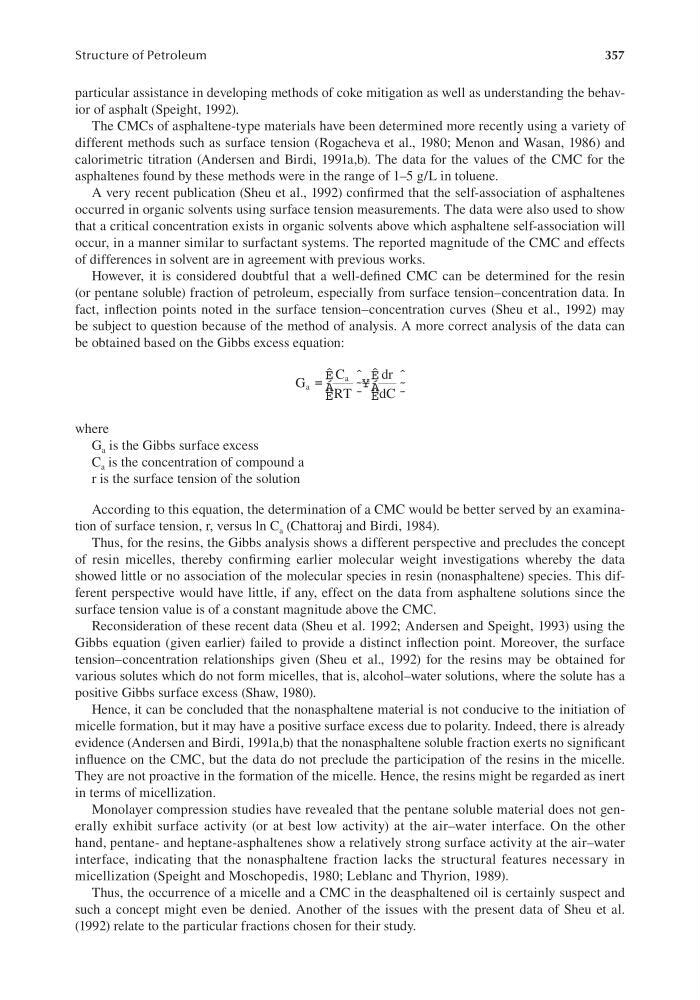
be subject to question because of the method of analysis. A more correct analysis of the data can
be obtained based on the Gibbs excess equation:
G
C
RT
dr
dC
a
a
=
Ê
Ë
Á
ˆ
¯
˜ ¥
Ê
Ë
Á
ˆ
¯
˜
where
G a is the Gibbs surface excess
C a is the concentration of compound a
r is the surface tension of the solution
According to this equation, the determination of a CMC would be better served by an examination of surface tension, r, versus ln C a (Chattoraj and Birdi, 1984).
Thus, for the resins, the Gibbs analysis shows a different perspective and precludes the concept
of resin micelles, thereby confirming earlier molecular weight investigations whereby the data
showed little or no association of the molecular species in resin (nonasphaltene) species. This different perspective would have little, if any, effect on the data from asphaltene solutions since the
surface tension value is of a constant magnitude above the CMC.
Reconsideration of these recent data (Sheu et al. 1992; Andersen and Speight, 1993) using the
Gibbs equation (given earlier) failed to provide a distinct inflection point. Moreover, the surface
tension–concentration relationships given (Sheu et al., 1992) for the resins may be obtained for
various solutes which do not form micelles, that is, alcohol–water solutions, where the solute has a
positive Gibbs surface excess (Shaw, 1980).
Hence, it can be concluded that the nonasphaltene material is not conducive to the initiation of
micelle formation, but it may have a positive surface excess due to polarity. Indeed, there is already
evidence (Andersen and Birdi, 1991a,b) that the nonasphaltene soluble fraction exerts no significant
influence on the CMC, but the data do not preclude the participation of the resins in the micelle.
They are not proactive in the formation of the micelle. Hence, the resins might be regarded as inert
in terms of micellization.
Monolayer compression studies have revealed that the pentane soluble material does not generally exhibit surface activity (or at best low activity) at the air–water interface. On the other
hand, pentane- and heptane-asphaltenes show a relatively strong surface activity at the air–water
interface, indicating that the nonasphaltene fraction lacks the structural features necessary in
micellization (Speight and Moschopedis, 1980; Leblanc and Thyrion, 1989).
Thus, the occurrence of a micelle and a CMC in the deasphaltened oil is certainly suspect and
such a concept might even be denied. Another of the issues with the present data of Sheu et al.
(1992) relate to the particular fractions chosen for their study.
Structure of Petroleum
particular assistance in developing methods of coke mitigation as well as understanding the behavior of asphalt (Speight, 1992).
The CMCs of asphaltene-type materials have been determined more recently using a variety of
different methods such as surface tension (Rogacheva et al., 1980; Menon and Wasan, 1986) and
calorimetric titration (Andersen and Birdi, 1991a,b). The data for the values of the CMC for the
asphaltenes found by these methods were in the range of 1–5 g/L in toluene.
A very recent publication (Sheu et al., 1992) confirmed that the self-association of asphaltenes
occurred in organic solvents using surface tension measurements. The data were also used to show
that a critical concentration exists in organic solvents above which asphaltene self-association will
occur, in a manner similar to surfactant systems. The reported magnitude of the CMC and effects
of differences in solvent are in agreement with previous works.
However, it is considered doubtful that a well-defined CMC can be determined for the resin
(or pentane soluble) fraction of petroleum, especially from surface tension–concentration data. In
fact, inflection points noted in the surface tension–concentration curves (Sheu et al., 1992) may
be subject to question because of the method of analysis. A more correct analysis of the data can
be obtained based on the Gibbs excess equation:
G
C
RT
dr
dC
a
a
=
Ê
Ë
Á
ˆ
¯
˜ ¥
Ê
Ë
Á
ˆ
¯
˜
where
G a is the Gibbs surface excess
C a is the concentration of compound a
r is the surface tension of the solution
According to this equation, the determination of a CMC would be better served by an examination of surface tension, r, versus ln C a (Chattoraj and Birdi, 1984).
Thus, for the resins, the Gibbs analysis shows a different perspective and precludes the concept
of resin micelles, thereby confirming earlier molecular weight investigations whereby the data
showed little or no association of the molecular species in resin (nonasphaltene) species. This different perspective would have little, if any, effect on the data from asphaltene solutions since the
surface tension value is of a constant magnitude above the CMC.
Reconsideration of these recent data (Sheu et al. 1992; Andersen and Speight, 1993) using the
Gibbs equation (given earlier) failed to provide a distinct inflection point. Moreover, the surface
tension–concentration relationships given (Sheu et al., 1992) for the resins may be obtained for
various solutes which do not form micelles, that is, alcohol–water solutions, where the solute has a
positive Gibbs surface excess (Shaw, 1980).
Hence, it can be concluded that the nonasphaltene material is not conducive to the initiation of
micelle formation, but it may have a positive surface excess due to polarity. Indeed, there is already
evidence (Andersen and Birdi, 1991a,b) that the nonasphaltene soluble fraction exerts no significant
influence on the CMC, but the data do not preclude the participation of the resins in the micelle.
They are not proactive in the formation of the micelle. Hence, the resins might be regarded as inert
in terms of micellization.
Monolayer compression studies have revealed that the pentane soluble material does not generally exhibit surface activity (or at best low activity) at the air–water interface. On the other
hand, pentane- and heptane-asphaltenes show a relatively strong surface activity at the air–water
interface, indicating that the nonasphaltene fraction lacks the structural features necessary in
micellization (Speight and Moschopedis, 1980; Leblanc and Thyrion, 1989).
Thus, the occurrence of a micelle and a CMC in the deasphaltened oil is certainly suspect and
such a concept might even be denied. Another of the issues with the present data of Sheu et al.
(1992) relate to the particular fractions chosen for their study.