

322
The Chemistry and Technology of Petroleum
conventional (from the organic chemist’s viewpoint) nitrogen species, that is, primary, secondary, and tertiary aromatic amines, have not been established as present in petroleum asphaltenes.
There are also reports in which the organic nitrogen in petroleum asphaltenes has been defined in
terms of basic and nonbasic types (Nicksic and Jeffries-Harris, 1968). Spectroscopic investigations
(Moschopedis and Speight, 1979) suggest that carbazoles occur in asphaltenes that supports earlier
mass spectroscopic evidence (Clerc and O’Neal, 1961) for the occurrence of carbazole nitrogen in
asphaltenes. The application of x-ray absorption near-edge structure (XANES) spectroscopy to the
study of asphaltenes has led to the conclusion that a large portion of the nitrogen present is aromatic,
in pyrrolic rather than pyridinic form (Mitra-Kirtley et al., 1993).
Thermal studies have shown that only 1% of the nitrogen is lost during the thermal treatment, but
substantially more sulfur (23%) and almost all the oxygen (81%) is lost as a result of this treatment.
The tendency of nitrogen and sulfur to remain in the nonvolatile residue produced during thermal
decomposition supports the concept that nitrogen and sulfur—as opposed to the relatively facile
elimination of oxygen—are stable because of their location in ring systems.
Oxygen has been identified in carboxylic, phenol, and ketone functions (Nicksic and JeffriesHarris, 1968; Petersen et al., 1974; Moschopedis and Speight, 1976a,b; Ritchie et al., 1979; Speight
and Moschopedis, 1981b; Rose and Francisco, 1987) locations but is not usually regarded as located
primarily in heteroaromatic ring systems.
Some evidence for the location of oxygen within the asphaltene fraction has been obtained by
infrared spectroscopy. Examination of dilute solutions of the asphaltenes in carbon tetrachloride
shows that at low concentration (0.01% w/w) of asphaltenes, a band occurs at 3585 cm −1 , which is
n-Heptane
Precipitating liquid
Cyclohexane
Petroleum
asphaltenes
Molecular weight
Carbenes
carboids
Relative polarity
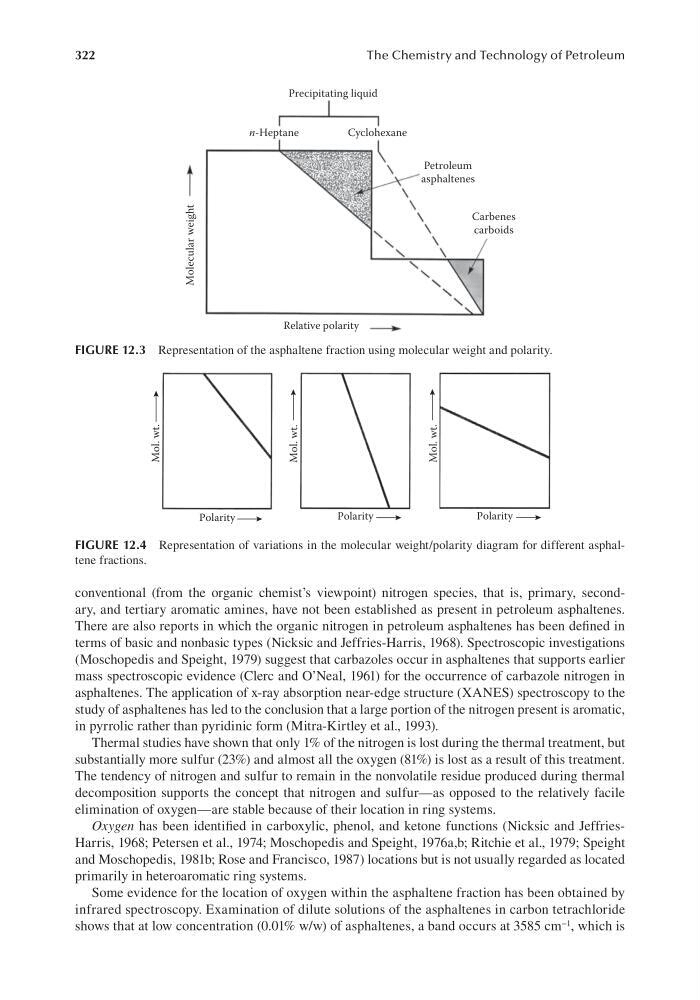
FIGURE 12.3 Representation of the asphaltene fraction using molecular weight and polarity.
Polarity
Mol. wt.
Mol. wt.
Mol. wt.
Polarity
Polarity
FIGURE 12.4 Representation of variations in the molecular weight/polarity diagram for different asphaltene fractions.
The Chemistry and Technology of Petroleum
conventional (from the organic chemist’s viewpoint) nitrogen species, that is, primary, secondary, and tertiary aromatic amines, have not been established as present in petroleum asphaltenes.
There are also reports in which the organic nitrogen in petroleum asphaltenes has been defined in
terms of basic and nonbasic types (Nicksic and Jeffries-Harris, 1968). Spectroscopic investigations
(Moschopedis and Speight, 1979) suggest that carbazoles occur in asphaltenes that supports earlier
mass spectroscopic evidence (Clerc and O’Neal, 1961) for the occurrence of carbazole nitrogen in
asphaltenes. The application of x-ray absorption near-edge structure (XANES) spectroscopy to the
study of asphaltenes has led to the conclusion that a large portion of the nitrogen present is aromatic,
in pyrrolic rather than pyridinic form (Mitra-Kirtley et al., 1993).
Thermal studies have shown that only 1% of the nitrogen is lost during the thermal treatment, but
substantially more sulfur (23%) and almost all the oxygen (81%) is lost as a result of this treatment.
The tendency of nitrogen and sulfur to remain in the nonvolatile residue produced during thermal
decomposition supports the concept that nitrogen and sulfur—as opposed to the relatively facile
elimination of oxygen—are stable because of their location in ring systems.
Oxygen has been identified in carboxylic, phenol, and ketone functions (Nicksic and JeffriesHarris, 1968; Petersen et al., 1974; Moschopedis and Speight, 1976a,b; Ritchie et al., 1979; Speight
and Moschopedis, 1981b; Rose and Francisco, 1987) locations but is not usually regarded as located
primarily in heteroaromatic ring systems.
Some evidence for the location of oxygen within the asphaltene fraction has been obtained by
infrared spectroscopy. Examination of dilute solutions of the asphaltenes in carbon tetrachloride
shows that at low concentration (0.01% w/w) of asphaltenes, a band occurs at 3585 cm −1 , which is
n-Heptane
Precipitating liquid
Cyclohexane
Petroleum
asphaltenes
Molecular weight
Carbenes
carboids
Relative polarity
FIGURE 12.3 Representation of the asphaltene fraction using molecular weight and polarity.
Polarity
Mol. wt.
Mol. wt.
Mol. wt.
Polarity
Polarity
FIGURE 12.4 Representation of variations in the molecular weight/polarity diagram for different asphaltene fractions.