

320
The Chemistry and Technology of Petroleum
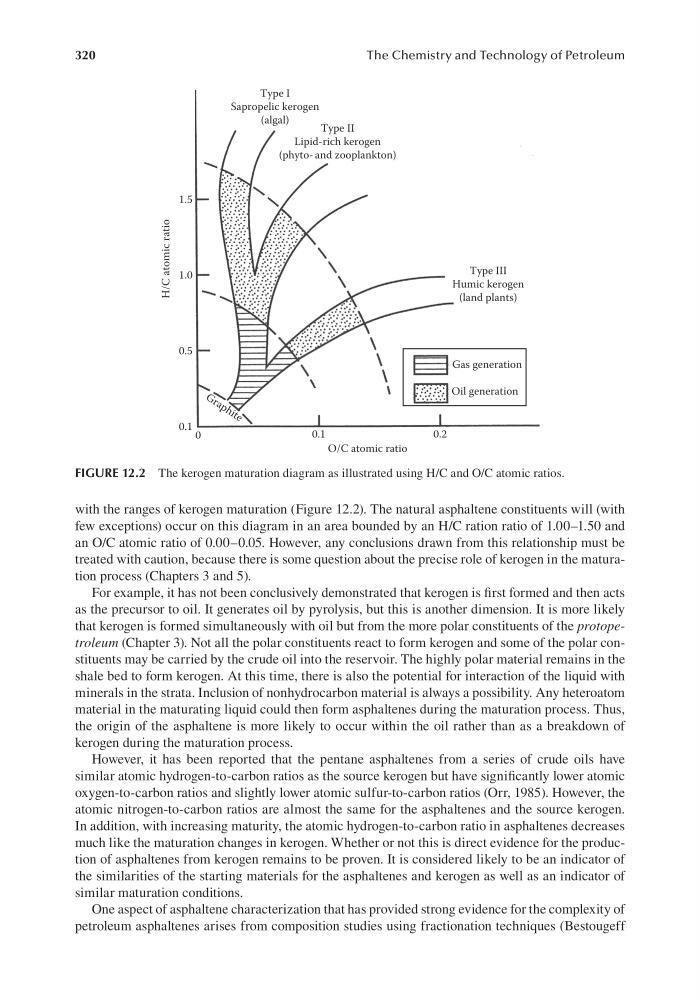
with the ranges of kerogen maturation (Figure 12.2). The natural asphaltene constituents will (with
few exceptions) occur on this diagram in an area bounded by an H/C ration ratio of 1.00–1.50 and
an O/C atomic ratio of 0.00–0.05. However, any conclusions drawn from this relationship must be
treated with caution, because there is some question about the precise role of kerogen in the maturation process (Chapters 3 and 5).
For example, it has not been conclusively demonstrated that kerogen is first formed and then acts
as the precursor to oil. It generates oil by pyrolysis, but this is another dimension. It is more likely
that kerogen is formed simultaneously with oil but from the more polar constituents of the protopetroleum (Chapter 3). Not all the polar constituents react to form kerogen and some of the polar constituents may be carried by the crude oil into the reservoir. The highly polar material remains in the
shale bed to form kerogen. At this time, there is also the potential for interaction of the liquid with
minerals in the strata. Inclusion of nonhydrocarbon material is always a possibility. Any heteroatom
material in the maturating liquid could then form asphaltenes during the maturation process. Thus,
the origin of the asphaltene is more likely to occur within the oil rather than as a breakdown of
kerogen during the maturation process.
However, it has been reported that the pentane asphaltenes from a series of crude oils have
similar atomic hydrogen-to-carbon ratios as the source kerogen but have significantly lower atomic
oxygen-to-carbon ratios and slightly lower atomic sulfur-to-carbon ratios (Orr, 1985). However, the
atomic nitrogen-to-carbon ratios are almost the same for the asphaltenes and the source kerogen.
In addition, with increasing maturity, the atomic hydrogen-to-carbon ratio in asphaltenes decreases
much like the maturation changes in kerogen. Whether or not this is direct evidence for the production of asphaltenes from kerogen remains to be proven. It is considered likely to be an indicator of
the similarities of the starting materials for the asphaltenes and kerogen as well as an indicator of
similar maturation conditions.
One aspect of asphaltene characterization that has provided strong evidence for the complexity of
petroleum asphaltenes arises from composition studies using fractionation techniques (Bestougeff
Type III
Humic kerogen
(land plants)
Type II
Lipid-rich kerogen
(phyto- and zooplankton)
Type I
Sapropelic kerogen
(algal)
Gas generation
Oil generation
G r a p h i t e
0.2
H/C atomic ratio
0.1
0.1
1.0
1.5
0.5
0
O/C atomic ratio
FIGURE 12.2 The kerogen maturation diagram as illustrated using H/C and O/C atomic ratios.
The Chemistry and Technology of Petroleum
with the ranges of kerogen maturation (Figure 12.2). The natural asphaltene constituents will (with
few exceptions) occur on this diagram in an area bounded by an H/C ration ratio of 1.00–1.50 and
an O/C atomic ratio of 0.00–0.05. However, any conclusions drawn from this relationship must be
treated with caution, because there is some question about the precise role of kerogen in the maturation process (Chapters 3 and 5).
For example, it has not been conclusively demonstrated that kerogen is first formed and then acts
as the precursor to oil. It generates oil by pyrolysis, but this is another dimension. It is more likely
that kerogen is formed simultaneously with oil but from the more polar constituents of the protopetroleum (Chapter 3). Not all the polar constituents react to form kerogen and some of the polar constituents may be carried by the crude oil into the reservoir. The highly polar material remains in the
shale bed to form kerogen. At this time, there is also the potential for interaction of the liquid with
minerals in the strata. Inclusion of nonhydrocarbon material is always a possibility. Any heteroatom
material in the maturating liquid could then form asphaltenes during the maturation process. Thus,
the origin of the asphaltene is more likely to occur within the oil rather than as a breakdown of
kerogen during the maturation process.
However, it has been reported that the pentane asphaltenes from a series of crude oils have
similar atomic hydrogen-to-carbon ratios as the source kerogen but have significantly lower atomic
oxygen-to-carbon ratios and slightly lower atomic sulfur-to-carbon ratios (Orr, 1985). However, the
atomic nitrogen-to-carbon ratios are almost the same for the asphaltenes and the source kerogen.
In addition, with increasing maturity, the atomic hydrogen-to-carbon ratio in asphaltenes decreases
much like the maturation changes in kerogen. Whether or not this is direct evidence for the production of asphaltenes from kerogen remains to be proven. It is considered likely to be an indicator of
the similarities of the starting materials for the asphaltenes and kerogen as well as an indicator of
similar maturation conditions.
One aspect of asphaltene characterization that has provided strong evidence for the complexity of
petroleum asphaltenes arises from composition studies using fractionation techniques (Bestougeff
Type III
Humic kerogen
(land plants)
Type II
Lipid-rich kerogen
(phyto- and zooplankton)
Type I
Sapropelic kerogen
(algal)
Gas generation
Oil generation
G r a p h i t e
0.2
H/C atomic ratio
0.1
0.1
1.0
1.5
0.5
0
O/C atomic ratio
FIGURE 12.2 The kerogen maturation diagram as illustrated using H/C and O/C atomic ratios.