

317
Asphaltene Constituents
for asphalt production (Chapter 26). On the other hand, the asphaltene constituents are soluble in
liquids with a surface tension above 25 dyne/cm, such as pyridine, carbon disulfide, carbon tetrachloride, and benzene.
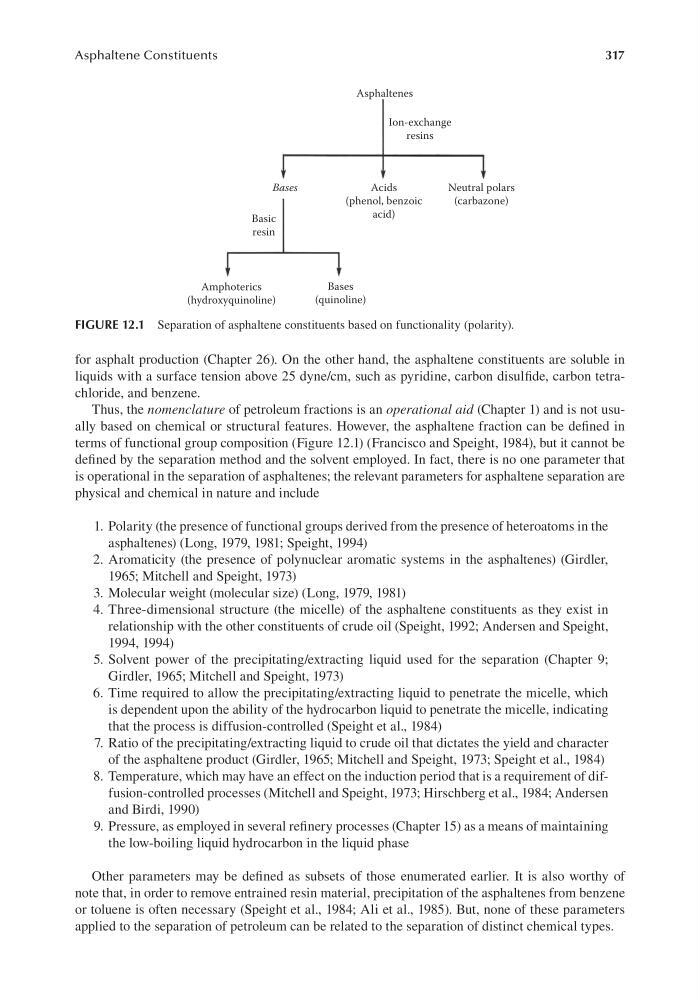
Thus, the nomenclature of petroleum fractions is an operational aid (Chapter 1) and is not usually based on chemical or structural features. However, the asphaltene fraction can be defined in
terms of functional group composition (Figure 12.1) (Francisco and Speight, 1984), but it cannot be
defined by the separation method and the solvent employed. In fact, there is no one parameter that
is operational in the separation of asphaltenes; the relevant parameters for asphaltene separation are
physical and chemical in nature and include
1. Polarity (the presence of functional groups derived from the presence of heteroatoms in the
asphaltenes) (Long, 1979, 1981; Speight, 1994)
2. Aromaticity (the presence of polynuclear aromatic systems in the asphaltenes) (Girdler,
1965; Mitchell and Speight, 1973)
3. Molecular weight (molecular size) (Long, 1979, 1981)
4. Three-dimensional structure (the micelle) of the asphaltene constituents as they exist in
relationship with the other constituents of crude oil (Speight, 1992; Andersen and Speight,
1994, 1994)
5. Solvent power of the precipitating/extracting liquid used for the separation (Chapter 9;
Girdler, 1965; Mitchell and Speight, 1973)
6. Time required to allow the precipitating/extracting liquid to penetrate the micelle, which
is dependent upon the ability of the hydrocarbon liquid to penetrate the micelle, indicating
that the process is diffusion-controlled (Speight et al., 1984)
7. Ratio of the precipitating/extracting liquid to crude oil that dictates the yield and character
of the asphaltene product (Girdler, 1965; Mitchell and Speight, 1973; Speight et al., 1984)
8. Temperature, which may have an effect on the induction period that is a requirement of diffusion-controlled processes (Mitchell and Speight, 1973; Hirschberg et al., 1984; Andersen
and Birdi, 1990)
9. Pressure, as employed in several refinery processes (Chapter 15) as a means of maintaining
the low-boiling liquid hydrocarbon in the liquid phase
Other parameters may be defined as subsets of those enumerated earlier. It is also worthy of
note that, in order to remove entrained resin material, precipitation of the asphaltenes from benzene
or toluene is often necessary (Speight et al., 1984; Ali et al., 1985). But, none of these parameters
applied to the separation of petroleum can be related to the separation of distinct chemical types.
Bases
Acids
(phenol, benzoic
acid)
Neutral polars
(carbazone)
Ion-exchange
resins
Asphaltenes
Basic
resin
Bases
(quinoline)
Amphoterics
(hydroxyquinoline)
FIGURE 12.1 Separation of asphaltene constituents based on functionality (polarity).
Asphaltene Constituents
for asphalt production (Chapter 26). On the other hand, the asphaltene constituents are soluble in
liquids with a surface tension above 25 dyne/cm, such as pyridine, carbon disulfide, carbon tetrachloride, and benzene.
Thus, the nomenclature of petroleum fractions is an operational aid (Chapter 1) and is not usually based on chemical or structural features. However, the asphaltene fraction can be defined in
terms of functional group composition (Figure 12.1) (Francisco and Speight, 1984), but it cannot be
defined by the separation method and the solvent employed. In fact, there is no one parameter that
is operational in the separation of asphaltenes; the relevant parameters for asphaltene separation are
physical and chemical in nature and include
1. Polarity (the presence of functional groups derived from the presence of heteroatoms in the
asphaltenes) (Long, 1979, 1981; Speight, 1994)
2. Aromaticity (the presence of polynuclear aromatic systems in the asphaltenes) (Girdler,
1965; Mitchell and Speight, 1973)
3. Molecular weight (molecular size) (Long, 1979, 1981)
4. Three-dimensional structure (the micelle) of the asphaltene constituents as they exist in
relationship with the other constituents of crude oil (Speight, 1992; Andersen and Speight,
1994, 1994)
5. Solvent power of the precipitating/extracting liquid used for the separation (Chapter 9;
Girdler, 1965; Mitchell and Speight, 1973)
6. Time required to allow the precipitating/extracting liquid to penetrate the micelle, which
is dependent upon the ability of the hydrocarbon liquid to penetrate the micelle, indicating
that the process is diffusion-controlled (Speight et al., 1984)
7. Ratio of the precipitating/extracting liquid to crude oil that dictates the yield and character
of the asphaltene product (Girdler, 1965; Mitchell and Speight, 1973; Speight et al., 1984)
8. Temperature, which may have an effect on the induction period that is a requirement of diffusion-controlled processes (Mitchell and Speight, 1973; Hirschberg et al., 1984; Andersen
and Birdi, 1990)
9. Pressure, as employed in several refinery processes (Chapter 15) as a means of maintaining
the low-boiling liquid hydrocarbon in the liquid phase
Other parameters may be defined as subsets of those enumerated earlier. It is also worthy of
note that, in order to remove entrained resin material, precipitation of the asphaltenes from benzene
or toluene is often necessary (Speight et al., 1984; Ali et al., 1985). But, none of these parameters
applied to the separation of petroleum can be related to the separation of distinct chemical types.
Bases
Acids
(phenol, benzoic
acid)
Neutral polars
(carbazone)
Ion-exchange
resins
Asphaltenes
Basic
resin
Bases
(quinoline)
Amphoterics
(hydroxyquinoline)
FIGURE 12.1 Separation of asphaltene constituents based on functionality (polarity).