

305
Structural Group Analysis
Pelet, 1983; Felix et al., 1985; Killops and Readman, 1985; Yokota et al., 1986; Verhasselt, 1992; Ali
and Nofal, 1994). Indeed, when this approach is taken the technique not only confirms the complex
nature of the asphaltene fraction and also allows further detailed identifications to be made of the
individual functional constituents of asphaltenes.
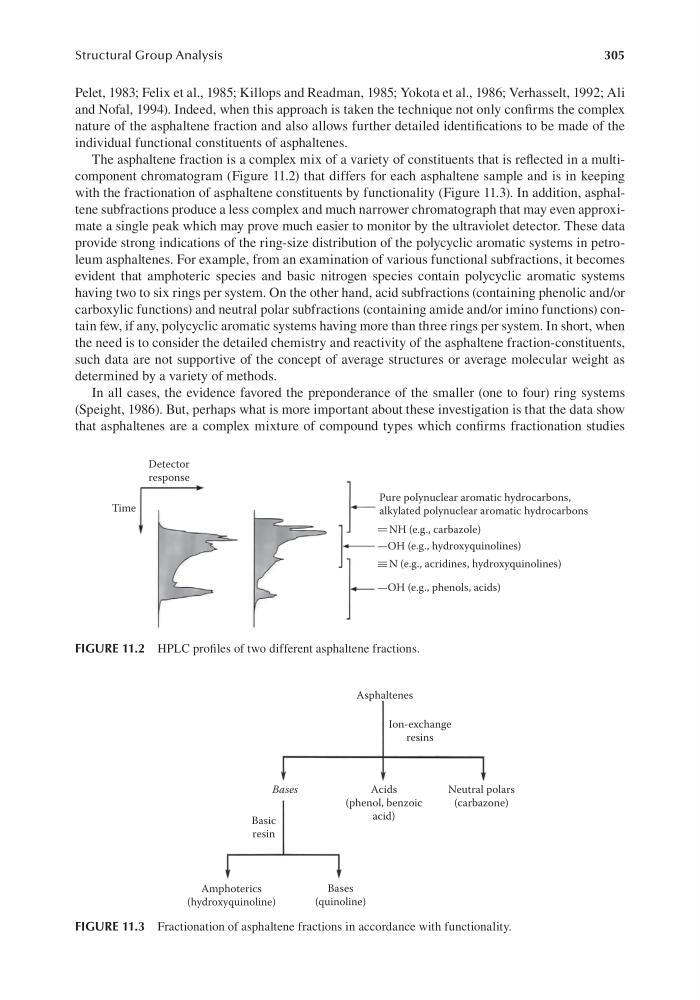
The asphaltene fraction is a complex mix of a variety of constituents that is reflected in a multicomponent chromatogram (Figure 11.2) that differs for each asphaltene sample and is in keeping
with the fractionation of asphaltene constituents by functionality (Figure 11.3). In addition, asphaltene subfractions produce a less complex and much narrower chromatograph that may even approximate a single peak which may prove much easier to monitor by the ultraviolet detector. These data
provide strong indications of the ring-size distribution of the polycyclic aromatic systems in petroleum asphaltenes. For example, from an examination of various functional subfractions, it becomes
evident that amphoteric species and basic nitrogen species contain polycyclic aromatic systems
having two to six rings per system. On the other hand, acid subfractions (containing phenolic and/or
carboxylic functions) and neutral polar subfractions (containing amide and/or imino functions) contain few, if any, polycyclic aromatic systems having more than three rings per system. In short, when
the need is to consider the detailed chemistry and reactivity of the asphaltene fraction-constituents,
such data are not supportive of the concept of average structures or average molecular weight as
determined by a variety of methods.
In all cases, the evidence favored the preponderance of the smaller (one to four) ring systems
(Speight, 1986). But, perhaps what is more important about these investigation is that the data show
that asphaltenes are a complex mixture of compound types which confirms fractionation studies
Detector
response
Pure polynuclear aromatic hydrocarbons,
alkylated polynuclear aromatic hydrocarbons
—OH (e.g., hydroxyquinolines)
—OH (e.g., phenols, acids)
N (e.g., acridines, hydroxyquinolines)
NH (e.g., carbazole)
— —
— — —
Time
FIGURE 11.2 HPLC profiles of two different asphaltene fractions.
Bases
Acids
(phenol, benzoic
acid)
Neutral polars
(carbazone)
Ion-exchange
resins
Asphaltenes
Basic
resin
Bases
(quinoline)
Amphoterics
(hydroxyquinoline)
FIGURE 11.3 Fractionation of asphaltene fractions in accordance with functionality.
Structural Group Analysis
Pelet, 1983; Felix et al., 1985; Killops and Readman, 1985; Yokota et al., 1986; Verhasselt, 1992; Ali
and Nofal, 1994). Indeed, when this approach is taken the technique not only confirms the complex
nature of the asphaltene fraction and also allows further detailed identifications to be made of the
individual functional constituents of asphaltenes.
The asphaltene fraction is a complex mix of a variety of constituents that is reflected in a multicomponent chromatogram (Figure 11.2) that differs for each asphaltene sample and is in keeping
with the fractionation of asphaltene constituents by functionality (Figure 11.3). In addition, asphaltene subfractions produce a less complex and much narrower chromatograph that may even approximate a single peak which may prove much easier to monitor by the ultraviolet detector. These data
provide strong indications of the ring-size distribution of the polycyclic aromatic systems in petroleum asphaltenes. For example, from an examination of various functional subfractions, it becomes
evident that amphoteric species and basic nitrogen species contain polycyclic aromatic systems
having two to six rings per system. On the other hand, acid subfractions (containing phenolic and/or
carboxylic functions) and neutral polar subfractions (containing amide and/or imino functions) contain few, if any, polycyclic aromatic systems having more than three rings per system. In short, when
the need is to consider the detailed chemistry and reactivity of the asphaltene fraction-constituents,
such data are not supportive of the concept of average structures or average molecular weight as
determined by a variety of methods.
In all cases, the evidence favored the preponderance of the smaller (one to four) ring systems
(Speight, 1986). But, perhaps what is more important about these investigation is that the data show
that asphaltenes are a complex mixture of compound types which confirms fractionation studies
Detector
response
Pure polynuclear aromatic hydrocarbons,
alkylated polynuclear aromatic hydrocarbons
—OH (e.g., hydroxyquinolines)
—OH (e.g., phenols, acids)
N (e.g., acridines, hydroxyquinolines)
NH (e.g., carbazole)
— —
— — —
Time
FIGURE 11.2 HPLC profiles of two different asphaltene fractions.
Bases
Acids
(phenol, benzoic
acid)
Neutral polars
(carbazone)
Ion-exchange
resins
Asphaltenes
Basic
resin
Bases
(quinoline)
Amphoterics
(hydroxyquinoline)
FIGURE 11.3 Fractionation of asphaltene fractions in accordance with functionality.