

300
The Chemistry and Technology of Petroleum
proton magnetic resonance (PMR) studies (along with infrared spectroscopic studies) were perhaps
the first studies of the modem era that allowed structural inferences to be made about the polynuclear aromatic systems that occur in the high-molecular-weight constituents of petroleum.
In general, the proton (hydrogen) types in petroleum fractions can be subdivided into three types
(Brown and Ladner, 1960) or into five types (Yen and Erdman, 1962). The first approach classifies
the hydrogen types into H* ar , aromatic ring hydrogen; H*″, aliphatic hydrogen adjacent to aromatic
rings; and H* o , aliphatic hydrogen not adjacent to aromatic rings. The second approach subdivided
the hydrogen distribution into aromatic hydrogen H A (H A /H = H* ar = h a ), ″-substituted hydrogen next
to aromatics (H″/H = H*″), H″, naphthenic hydrogen H N , methylene hydrogen H R , and terminal
methyl hydrogen not close to aromatic system H Sme (H* o = H N /H + H R /H + H Sme /H).
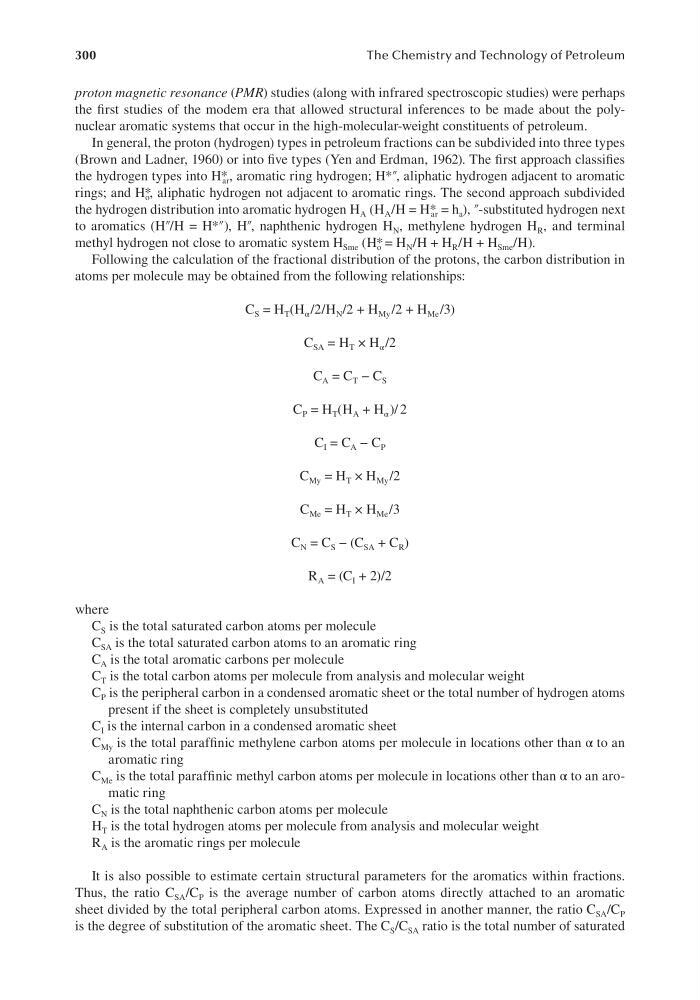
Following the calculation of the fractional distribution of the protons, the carbon distribution in
atoms per molecule may be obtained from the following relationships:
C S = H T (H α /2/H N /2 + H My /2 + H Me /3)
C SA = H T × H α /2
C A = C T − C S
C P = H T (H A + H α )/ 2
C I = C A − C P
C My = H T × H My /2
C Me = H T × H Me /3
C N = C S − (C SA + C R )
R A = (C I + 2)/2
where
C S is the total saturated carbon atoms per molecule
C SA is the total saturated carbon atoms to an aromatic ring
C A is the total aromatic carbons per molecule
C T is the total carbon atoms per molecule from analysis and molecular weight
C P is the peripheral carbon in a condensed aromatic sheet or the total number of hydrogen atoms
present if the sheet is completely unsubstituted
C I is the internal carbon in a condensed aromatic sheet
C My is the total paraffinic methylene carbon atoms per molecule in locations other than α to an
aromatic ring
C Me is the total paraffinic methyl carbon atoms per molecule in locations other than α to an aromatic ring
C N is the total naphthenic carbon atoms per molecule
H T is the total hydrogen atoms per molecule from analysis and molecular weight
R A is the aromatic rings per molecule
It is also possible to estimate certain structural parameters for the aromatics within fractions.
Thus, the ratio C SA /C P is the average number of carbon atoms directly attached to an aromatic
sheet divided by the total peripheral carbon atoms. Expressed in another manner, the ratio C SA /C P
is the degree of substitution of the aromatic sheet. The C S /C SA ratio is the total number of saturated
The Chemistry and Technology of Petroleum
proton magnetic resonance (PMR) studies (along with infrared spectroscopic studies) were perhaps
the first studies of the modem era that allowed structural inferences to be made about the polynuclear aromatic systems that occur in the high-molecular-weight constituents of petroleum.
In general, the proton (hydrogen) types in petroleum fractions can be subdivided into three types
(Brown and Ladner, 1960) or into five types (Yen and Erdman, 1962). The first approach classifies
the hydrogen types into H* ar , aromatic ring hydrogen; H*″, aliphatic hydrogen adjacent to aromatic
rings; and H* o , aliphatic hydrogen not adjacent to aromatic rings. The second approach subdivided
the hydrogen distribution into aromatic hydrogen H A (H A /H = H* ar = h a ), ″-substituted hydrogen next
to aromatics (H″/H = H*″), H″, naphthenic hydrogen H N , methylene hydrogen H R , and terminal
methyl hydrogen not close to aromatic system H Sme (H* o = H N /H + H R /H + H Sme /H).
Following the calculation of the fractional distribution of the protons, the carbon distribution in
atoms per molecule may be obtained from the following relationships:
C S = H T (H α /2/H N /2 + H My /2 + H Me /3)
C SA = H T × H α /2
C A = C T − C S
C P = H T (H A + H α )/ 2
C I = C A − C P
C My = H T × H My /2
C Me = H T × H Me /3
C N = C S − (C SA + C R )
R A = (C I + 2)/2
where
C S is the total saturated carbon atoms per molecule
C SA is the total saturated carbon atoms to an aromatic ring
C A is the total aromatic carbons per molecule
C T is the total carbon atoms per molecule from analysis and molecular weight
C P is the peripheral carbon in a condensed aromatic sheet or the total number of hydrogen atoms
present if the sheet is completely unsubstituted
C I is the internal carbon in a condensed aromatic sheet
C My is the total paraffinic methylene carbon atoms per molecule in locations other than α to an
aromatic ring
C Me is the total paraffinic methyl carbon atoms per molecule in locations other than α to an aromatic ring
C N is the total naphthenic carbon atoms per molecule
H T is the total hydrogen atoms per molecule from analysis and molecular weight
R A is the aromatic rings per molecule
It is also possible to estimate certain structural parameters for the aromatics within fractions.
Thus, the ratio C SA /C P is the average number of carbon atoms directly attached to an aromatic
sheet divided by the total peripheral carbon atoms. Expressed in another manner, the ratio C SA /C P
is the degree of substitution of the aromatic sheet. The C S /C SA ratio is the total number of saturated