

290
The Chemistry and Technology of Petroleum
It is perhaps unfortunate that the direct method is based on the assumption that heteroelements
(e.g., nitrogen, oxygen, and sulfur) are not present in the petroleum sample. However, if these elements are present, corrections can be applied but this detracts from the basis of the method since
rings containing heteroelements may be cleaved during the hydrogenation process. Nevertheless,
the method provides a means whereby %C A and R T can be determined and has been considered one
of the more reliable methods for structural group analysis.
11.2.1.2 Waterman Ring Analysis
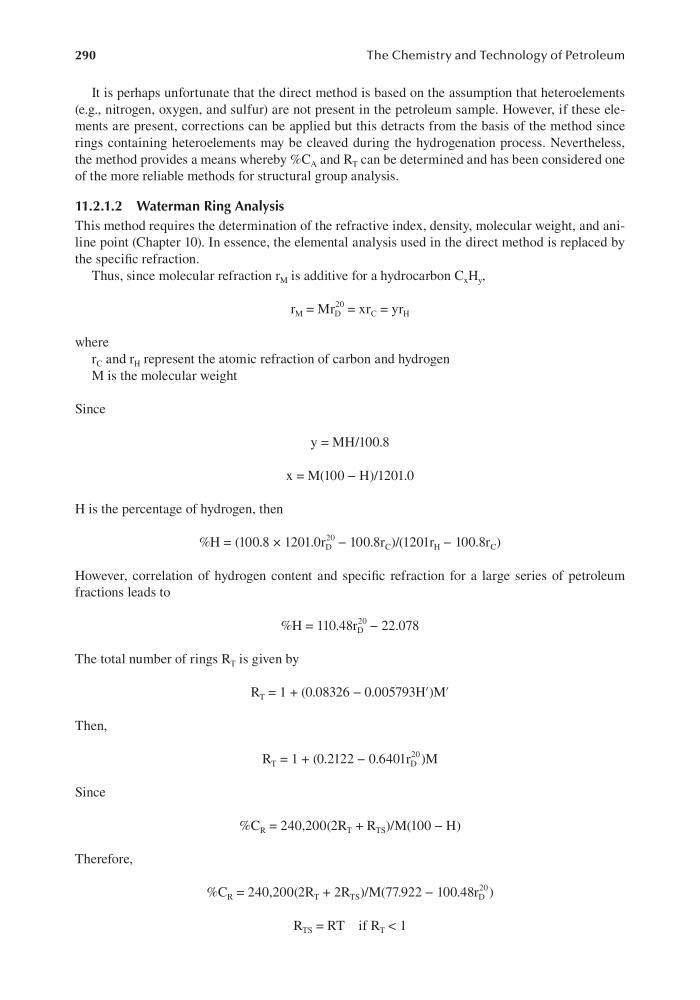
This method requires the determination of the refractive index, density, molecular weight, and aniline point (Chapter 10). In essence, the elemental analysis used in the direct method is replaced by
the specific refraction.
Thus, since molecular refraction r M is additive for a hydrocarbon C x H y ,
r M = Mr D
20 = xr C = yr H
where
r C and r H represent the atomic refraction of carbon and hydrogen
M is the molecular weight
Since
y = MH/100.8
x = M(100 − H)/1201.0
H is the percentage of hydrogen, then
%H = (100.8 × 1201.0r D
20 − 100.8r C )/(1201r H − 100.8r C )
However, correlation of hydrogen content and specific refraction for a large series of petroleum
fractions leads to
%H = 110.48r D
20 − 22.078
The total number of rings R T is given by
R T = 1 + (0.08326 − 0.005793H′)M′
Then,
R T = 1 + (0.2122 − 0.6401r D
20 )M
Since
%C R = 240,200(2R T + R TS )/M(100 − H)
Therefore,
%C R = 240,200(2R T + 2R TS )/M(77.922 − 100.48r D
20 )
R TS = RT if R T < 1
The Chemistry and Technology of Petroleum
It is perhaps unfortunate that the direct method is based on the assumption that heteroelements
(e.g., nitrogen, oxygen, and sulfur) are not present in the petroleum sample. However, if these elements are present, corrections can be applied but this detracts from the basis of the method since
rings containing heteroelements may be cleaved during the hydrogenation process. Nevertheless,
the method provides a means whereby %C A and R T can be determined and has been considered one
of the more reliable methods for structural group analysis.
11.2.1.2 Waterman Ring Analysis
This method requires the determination of the refractive index, density, molecular weight, and aniline point (Chapter 10). In essence, the elemental analysis used in the direct method is replaced by
the specific refraction.
Thus, since molecular refraction r M is additive for a hydrocarbon C x H y ,
r M = Mr D
20 = xr C = yr H
where
r C and r H represent the atomic refraction of carbon and hydrogen
M is the molecular weight
Since
y = MH/100.8
x = M(100 − H)/1201.0
H is the percentage of hydrogen, then
%H = (100.8 × 1201.0r D
20 − 100.8r C )/(1201r H − 100.8r C )
However, correlation of hydrogen content and specific refraction for a large series of petroleum
fractions leads to
%H = 110.48r D
20 − 22.078
The total number of rings R T is given by
R T = 1 + (0.08326 − 0.005793H′)M′
Then,
R T = 1 + (0.2122 − 0.6401r D
20 )M
Since
%C R = 240,200(2R T + R TS )/M(100 − H)
Therefore,
%C R = 240,200(2R T + 2R TS )/M(77.922 − 100.48r D
20 )
R TS = RT if R T < 1