

288
The Chemistry and Technology of Petroleum
Identification of the constituents of petroleum by molecular type may proceed in a variety of
ways but generally can be classified into three methods: (1) spectroscopic techniques, (2) chemical
techniques, and (3) physical property methods. Various structural parameters are derived from a
particular property by a sequence of mathematical manipulations. It is difficult to completely separate these three methods of structural elucidation and there must, by virtue of need and relationship, be some overlap. Thus, although this review is more concerned with the use of spectroscopic
methods applied to the issues of petroleum structure, there will also be reference to the other two
related methods.
The end results of these methods are, at best, indications of the structural types present in the
material. These indications are, in turn, dependent on the assumptions used to develop the method.
However, there is the unfortunate tendency of researchers to then attempt to interrelate these structural types into a so-called average structure.
It is always the case that when mathematical manipulations are employed to derive average
structures, the structures will only be as reliable as the assumptions used for the mathematical
procedure. Then the literal interpretation that leads to the conclusion, and the insistence, that such
structures exist in coal only leads to more confusion. Representation is one matter, adherent belief is
another! Indeed, the complexity of the nonvolatile constituents of petroleum makes the construction
of average structures extremely futile and, perhaps, misleading.
In fact, the heterogeneous chemical structures of the wide range of plant chemicals that formed
the starting material for coal promise, but do not guarantee an almost unlimited range of chemical
structures within the various types of coal. Thus, it is perhaps best to consider the nonvolatile constituents of petroleum as a variety of chemical entities that dictate reactivity under specific conditions.
Nevertheless, indications of the methods that allow petroleum, specifically nonvolatile constituents of petroleum, to be defined in terms of structural entities are presented here.
11.2.1 PHysICAl ProPerty metHods
There have been many proposals for the structural group analysis of petroleum and petroleum products, which are usually based on inspection of the elemental analyses and physical properties of the
material. The overall result has been the acceptance of several of these methods on the basis of their
convenience and/or relative simplicity, and these methods are described here.
11.2.1.1 Direct Method
This method involves direct determination of the required physical properties of the petroleum
sample or petroleum product and, unlike other methods, does not usually require prior separation of
the oil into aromatic and saturated fractions.
Thus, by means of elemental analysis (Chapter 8) and molecular weight determination
(Chapter 10) before and after hydrogenation of the sample, the percentage carbon in aromatic structure
(%C A ) and the average number of rings R T can be estimated. If petroleum or a petroleum fraction is
hydrogenated so that only aromatic rings are converted into naphthene rings, each aromatic carbon
atom takes up one hydrogen atom. Therefore,
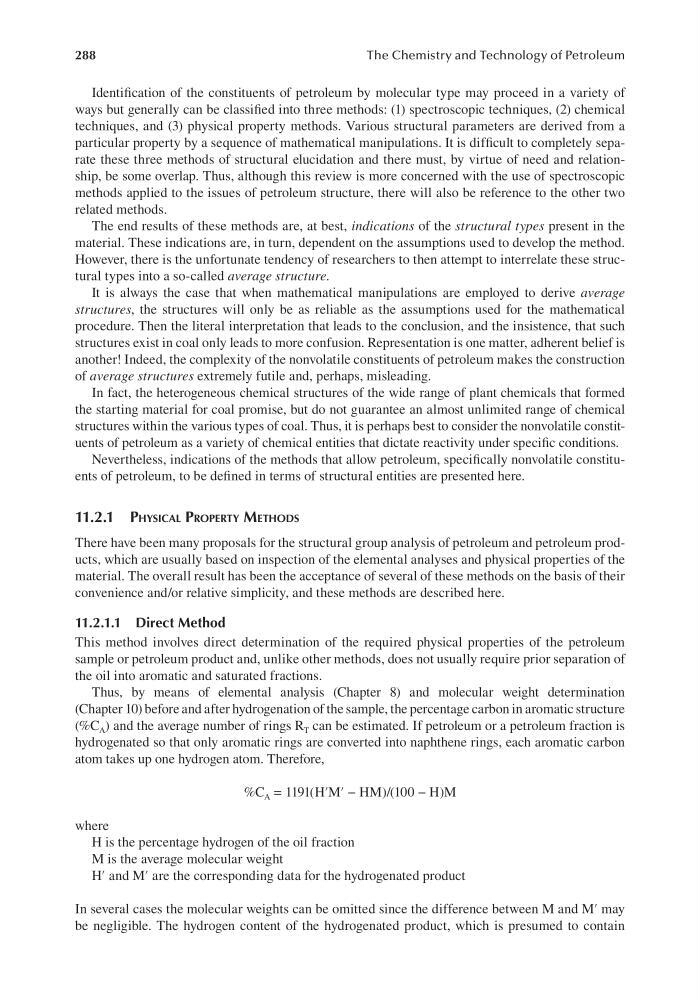
%C A = 1191(H′M′ − HM)/(100 − H)M
where
H is the percentage hydrogen of the oil fraction
M is the average molecular weight
H′ and M′ are the corresponding data for the hydrogenated product
In several cases the molecular weights can be omitted since the difference between M and M′ may
be negligible. The hydrogen content of the hydrogenated product, which is presumed to contain
The Chemistry and Technology of Petroleum
Identification of the constituents of petroleum by molecular type may proceed in a variety of
ways but generally can be classified into three methods: (1) spectroscopic techniques, (2) chemical
techniques, and (3) physical property methods. Various structural parameters are derived from a
particular property by a sequence of mathematical manipulations. It is difficult to completely separate these three methods of structural elucidation and there must, by virtue of need and relationship, be some overlap. Thus, although this review is more concerned with the use of spectroscopic
methods applied to the issues of petroleum structure, there will also be reference to the other two
related methods.
The end results of these methods are, at best, indications of the structural types present in the
material. These indications are, in turn, dependent on the assumptions used to develop the method.
However, there is the unfortunate tendency of researchers to then attempt to interrelate these structural types into a so-called average structure.
It is always the case that when mathematical manipulations are employed to derive average
structures, the structures will only be as reliable as the assumptions used for the mathematical
procedure. Then the literal interpretation that leads to the conclusion, and the insistence, that such
structures exist in coal only leads to more confusion. Representation is one matter, adherent belief is
another! Indeed, the complexity of the nonvolatile constituents of petroleum makes the construction
of average structures extremely futile and, perhaps, misleading.
In fact, the heterogeneous chemical structures of the wide range of plant chemicals that formed
the starting material for coal promise, but do not guarantee an almost unlimited range of chemical
structures within the various types of coal. Thus, it is perhaps best to consider the nonvolatile constituents of petroleum as a variety of chemical entities that dictate reactivity under specific conditions.
Nevertheless, indications of the methods that allow petroleum, specifically nonvolatile constituents of petroleum, to be defined in terms of structural entities are presented here.
11.2.1 PHysICAl ProPerty metHods
There have been many proposals for the structural group analysis of petroleum and petroleum products, which are usually based on inspection of the elemental analyses and physical properties of the
material. The overall result has been the acceptance of several of these methods on the basis of their
convenience and/or relative simplicity, and these methods are described here.
11.2.1.1 Direct Method
This method involves direct determination of the required physical properties of the petroleum
sample or petroleum product and, unlike other methods, does not usually require prior separation of
the oil into aromatic and saturated fractions.
Thus, by means of elemental analysis (Chapter 8) and molecular weight determination
(Chapter 10) before and after hydrogenation of the sample, the percentage carbon in aromatic structure
(%C A ) and the average number of rings R T can be estimated. If petroleum or a petroleum fraction is
hydrogenated so that only aromatic rings are converted into naphthene rings, each aromatic carbon
atom takes up one hydrogen atom. Therefore,
%C A = 1191(H′M′ − HM)/(100 − H)M
where
H is the percentage hydrogen of the oil fraction
M is the average molecular weight
H′ and M′ are the corresponding data for the hydrogenated product
In several cases the molecular weights can be omitted since the difference between M and M′ may
be negligible. The hydrogen content of the hydrogenated product, which is presumed to contain