

267
Petroleum Analysis
Thus the RI can be used to provide valuable information about the composition of hydrocarbon
(petroleum) mixtures; as with density, low values indicate paraffinic materials and higher values
indicate the presence of aromatic compounds. However, the combination of RI and density may
be used to provide even more definite information about the nature of a hydrocarbon mixture and,
hence, the use of the refractivity intercept (n − d/2; ASTM D2159).
The refractive and specific dispersion as well as the molecular and specific refraction have all
been advocated for use in the characterization of petroleum and petroleum products.
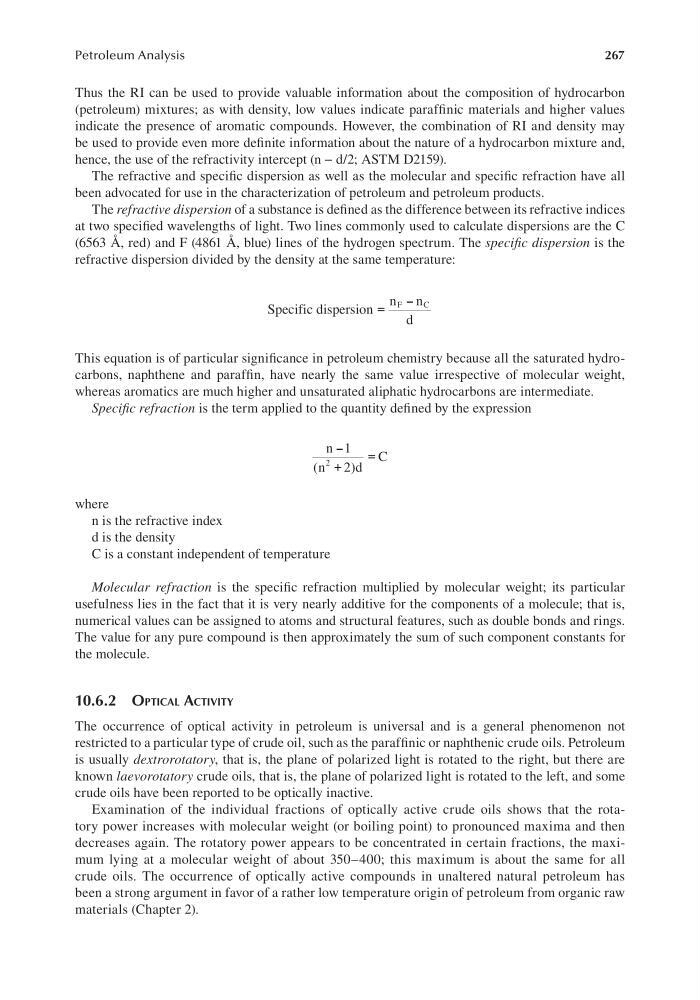
The refractive dispersion of a substance is defined as the difference between its refractive indices
at two specified wavelengths of light. Two lines commonly used to calculate dispersions are the C
(6563 Å, red) and F (4861 Å, blue) lines of the hydrogen spectrum. The specific dispersion is the
refractive dispersion divided by the density at the same temperature:
Specific dispersion
n n
d
F
C
=
-
This equation is of particular significance in petroleum chemistry because all the saturated hydrocarbons, naphthene and paraffin, have nearly the same value irrespective of molecular weight,
whereas aromatics are much higher and unsaturated aliphatic hydrocarbons are intermediate.
Specific refraction is the term applied to the quantity defined by the expression
n 1
n
d
C
2
-
+
=
(
)
2
where
n is the refractive index
d is the density
C is a constant independent of temperature
Molecular refraction is the specific refraction multiplied by molecular weight; its particular
usefulness lies in the fact that it is very nearly additive for the components of a molecule; that is,
numerical values can be assigned to atoms and structural features, such as double bonds and rings.
The value for any pure compound is then approximately the sum of such component constants for
the molecule.
10.6.2 oPtICAl ACtIvIty
The occurrence of optical activity in petroleum is universal and is a general phenomenon not
restricted to a particular type of crude oil, such as the paraffinic or naphthenic crude oils. Petroleum
is usually dextrorotatory, that is, the plane of polarized light is rotated to the right, but there are
known laevorotatory crude oils, that is, the plane of polarized light is rotated to the left, and some
crude oils have been reported to be optically inactive.
Examination of the individual fractions of optically active crude oils shows that the rotatory power increases with molecular weight (or boiling point) to pronounced maxima and then
decreases again. The rotatory power appears to be concentrated in certain fractions, the maximum lying at a molecular weight of about 350–400; this maximum is about the same for all
crude oils. The occurrence of optically active compounds in unaltered natural petroleum has
been a strong argument in favor of a rather low temperature origin of petroleum from organic raw
materials (Chapter 2).
Petroleum Analysis
Thus the RI can be used to provide valuable information about the composition of hydrocarbon
(petroleum) mixtures; as with density, low values indicate paraffinic materials and higher values
indicate the presence of aromatic compounds. However, the combination of RI and density may
be used to provide even more definite information about the nature of a hydrocarbon mixture and,
hence, the use of the refractivity intercept (n − d/2; ASTM D2159).
The refractive and specific dispersion as well as the molecular and specific refraction have all
been advocated for use in the characterization of petroleum and petroleum products.
The refractive dispersion of a substance is defined as the difference between its refractive indices
at two specified wavelengths of light. Two lines commonly used to calculate dispersions are the C
(6563 Å, red) and F (4861 Å, blue) lines of the hydrogen spectrum. The specific dispersion is the
refractive dispersion divided by the density at the same temperature:
Specific dispersion
n n
d
F
C
=
-
This equation is of particular significance in petroleum chemistry because all the saturated hydrocarbons, naphthene and paraffin, have nearly the same value irrespective of molecular weight,
whereas aromatics are much higher and unsaturated aliphatic hydrocarbons are intermediate.
Specific refraction is the term applied to the quantity defined by the expression
n 1
n
d
C
2
-
+
=
(
)
2
where
n is the refractive index
d is the density
C is a constant independent of temperature
Molecular refraction is the specific refraction multiplied by molecular weight; its particular
usefulness lies in the fact that it is very nearly additive for the components of a molecule; that is,
numerical values can be assigned to atoms and structural features, such as double bonds and rings.
The value for any pure compound is then approximately the sum of such component constants for
the molecule.
10.6.2 oPtICAl ACtIvIty
The occurrence of optical activity in petroleum is universal and is a general phenomenon not
restricted to a particular type of crude oil, such as the paraffinic or naphthenic crude oils. Petroleum
is usually dextrorotatory, that is, the plane of polarized light is rotated to the right, but there are
known laevorotatory crude oils, that is, the plane of polarized light is rotated to the left, and some
crude oils have been reported to be optically inactive.
Examination of the individual fractions of optically active crude oils shows that the rotatory power increases with molecular weight (or boiling point) to pronounced maxima and then
decreases again. The rotatory power appears to be concentrated in certain fractions, the maximum lying at a molecular weight of about 350–400; this maximum is about the same for all
crude oils. The occurrence of optically active compounds in unaltered natural petroleum has
been a strong argument in favor of a rather low temperature origin of petroleum from organic raw
materials (Chapter 2).