

251
Petroleum Analysis
when either the cloud point or boiling point is approached but they are useful over the Newtonian
range for estimating the temperature at which oil attains a desired viscosity.
Since the viscosity–temperature coefficient of lubricating oil is an important expression of its
suitability, a convenient number to express this property is very useful, and hence, a viscosity index
(ASTM D2270) was derived. It is established that naphthenic oils have higher viscosity–temperature
coefficients than do paraffinic oils at equal viscosity and temperatures. The Dean and Davis scale
was based on the assignment of a zero value to a typical naphthenic crude oil and that of 100 to a
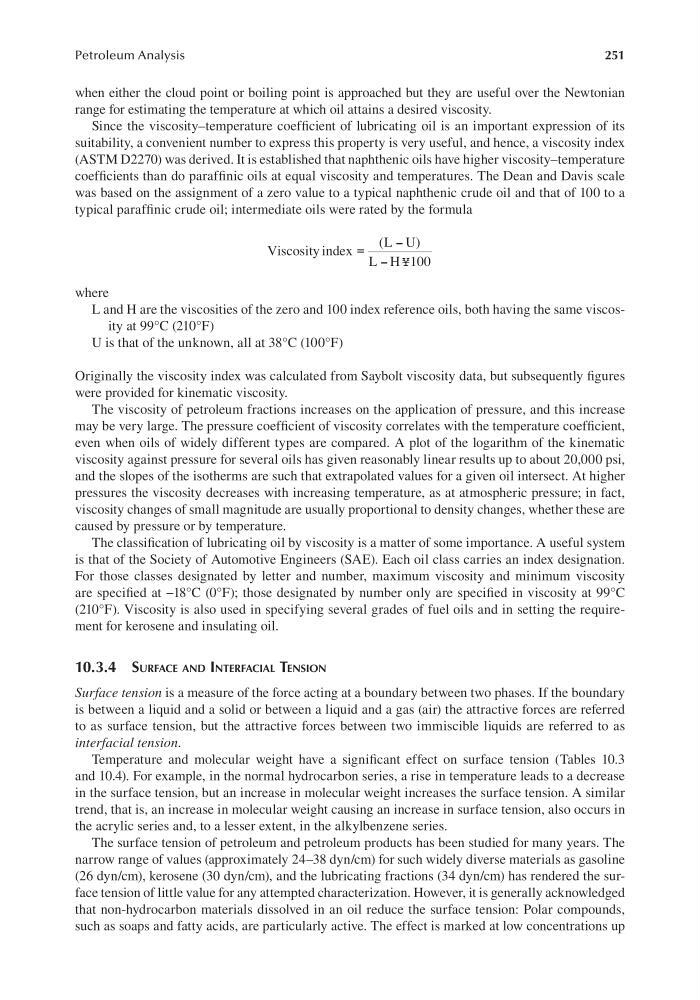
typical paraffinic crude oil; intermediate oils were rated by the formula
Viscosity index
L U
L H
=
-
- ¥
(
)
100
where
L and H are the viscosities of the zero and 100 index reference oils, both having the same viscosity at 99°C (210°F)
U is that of the unknown, all at 38°C (100°F)
Originally the viscosity index was calculated from Saybolt viscosity data, but subsequently figures
were provided for kinematic viscosity.
The viscosity of petroleum fractions increases on the application of pressure, and this increase
may be very large. The pressure coefficient of viscosity correlates with the temperature coefficient,
even when oils of widely different types are compared. A plot of the logarithm of the kinematic
viscosity against pressure for several oils has given reasonably linear results up to about 20,000 psi,
and the slopes of the isotherms are such that extrapolated values for a given oil intersect. At higher
pressures the viscosity decreases with increasing temperature, as at atmospheric pressure; in fact,
viscosity changes of small magnitude are usually proportional to density changes, whether these are
caused by pressure or by temperature.
The classification of lubricating oil by viscosity is a matter of some importance. A useful system
is that of the Society of Automotive Engineers (SAE). Each oil class carries an index designation.
For those classes designated by letter and number, maximum viscosity and minimum viscosity
are specified at −18°C (0°F); those designated by number only are specified in viscosity at 99°C
(210°F). Viscosity is also used in specifying several grades of fuel oils and in setting the requirement for kerosene and insulating oil.
10.3.4 surFACe And InterFACIAl tensIon
Surface tension is a measure of the force acting at a boundary between two phases. If the boundary
is between a liquid and a solid or between a liquid and a gas (air) the attractive forces are referred
to as surface tension, but the attractive forces between two immiscible liquids are referred to as
interfacial tension.
Temperature and molecular weight have a significant effect on surface tension (Tables 10.3
and 10.4). For example, in the normal hydrocarbon series, a rise in temperature leads to a decrease
in the surface tension, but an increase in molecular weight increases the surface tension. A similar
trend, that is, an increase in molecular weight causing an increase in surface tension, also occurs in
the acrylic series and, to a lesser extent, in the alkylbenzene series.
The surface tension of petroleum and petroleum products has been studied for many years. The
narrow range of values (approximately 24–38 dyn/cm) for such widely diverse materials as gasoline
(26 dyn/cm), kerosene (30 dyn/cm), and the lubricating fractions (34 dyn/cm) has rendered the surface tension of little value for any attempted characterization. However, it is generally acknowledged
that non-hydrocarbon materials dissolved in an oil reduce the surface tension: Polar compounds,
such as soaps and fatty acids, are particularly active. The effect is marked at low concentrations up
Petroleum Analysis
when either the cloud point or boiling point is approached but they are useful over the Newtonian
range for estimating the temperature at which oil attains a desired viscosity.
Since the viscosity–temperature coefficient of lubricating oil is an important expression of its
suitability, a convenient number to express this property is very useful, and hence, a viscosity index
(ASTM D2270) was derived. It is established that naphthenic oils have higher viscosity–temperature
coefficients than do paraffinic oils at equal viscosity and temperatures. The Dean and Davis scale
was based on the assignment of a zero value to a typical naphthenic crude oil and that of 100 to a
typical paraffinic crude oil; intermediate oils were rated by the formula
Viscosity index
L U
L H
=
-
- ¥
(
)
100
where
L and H are the viscosities of the zero and 100 index reference oils, both having the same viscosity at 99°C (210°F)
U is that of the unknown, all at 38°C (100°F)
Originally the viscosity index was calculated from Saybolt viscosity data, but subsequently figures
were provided for kinematic viscosity.
The viscosity of petroleum fractions increases on the application of pressure, and this increase
may be very large. The pressure coefficient of viscosity correlates with the temperature coefficient,
even when oils of widely different types are compared. A plot of the logarithm of the kinematic
viscosity against pressure for several oils has given reasonably linear results up to about 20,000 psi,
and the slopes of the isotherms are such that extrapolated values for a given oil intersect. At higher
pressures the viscosity decreases with increasing temperature, as at atmospheric pressure; in fact,
viscosity changes of small magnitude are usually proportional to density changes, whether these are
caused by pressure or by temperature.
The classification of lubricating oil by viscosity is a matter of some importance. A useful system
is that of the Society of Automotive Engineers (SAE). Each oil class carries an index designation.
For those classes designated by letter and number, maximum viscosity and minimum viscosity
are specified at −18°C (0°F); those designated by number only are specified in viscosity at 99°C
(210°F). Viscosity is also used in specifying several grades of fuel oils and in setting the requirement for kerosene and insulating oil.
10.3.4 surFACe And InterFACIAl tensIon
Surface tension is a measure of the force acting at a boundary between two phases. If the boundary
is between a liquid and a solid or between a liquid and a gas (air) the attractive forces are referred
to as surface tension, but the attractive forces between two immiscible liquids are referred to as
interfacial tension.
Temperature and molecular weight have a significant effect on surface tension (Tables 10.3
and 10.4). For example, in the normal hydrocarbon series, a rise in temperature leads to a decrease
in the surface tension, but an increase in molecular weight increases the surface tension. A similar
trend, that is, an increase in molecular weight causing an increase in surface tension, also occurs in
the acrylic series and, to a lesser extent, in the alkylbenzene series.
The surface tension of petroleum and petroleum products has been studied for many years. The
narrow range of values (approximately 24–38 dyn/cm) for such widely diverse materials as gasoline
(26 dyn/cm), kerosene (30 dyn/cm), and the lubricating fractions (34 dyn/cm) has rendered the surface tension of little value for any attempted characterization. However, it is generally acknowledged
that non-hydrocarbon materials dissolved in an oil reduce the surface tension: Polar compounds,
such as soaps and fatty acids, are particularly active. The effect is marked at low concentrations up