

215
Fractional Composition
The study of most distillation problems involves an estimate of the distribution of the components between the liquid and vapor phases. The distribution of any component of the mixture of
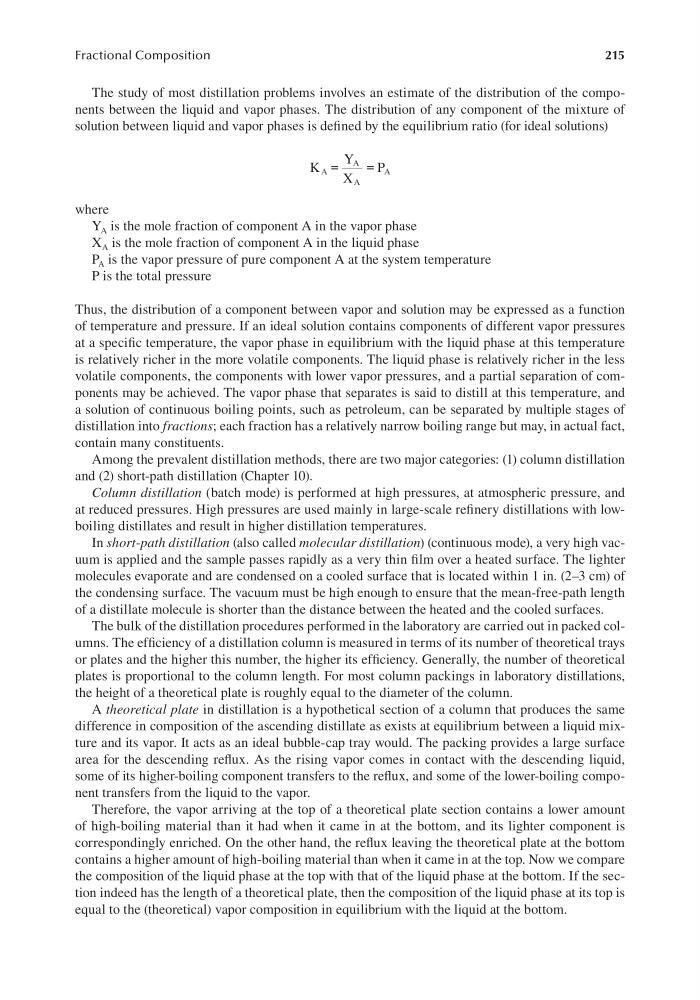
solution between liquid and vapor phases is defined by the equilibrium ratio (for ideal solutions)
K
Y
X
P
A
A
A
A
=
=
where
Y A is the mole fraction of component A in the vapor phase
X A is the mole fraction of component A in the liquid phase
P A is the vapor pressure of pure component A at the system temperature
P is the total pressure
Thus, the distribution of a component between vapor and solution may be expressed as a function
of temperature and pressure. If an ideal solution contains components of different vapor pressures
at a specific temperature, the vapor phase in equilibrium with the liquid phase at this temperature
is relatively richer in the more volatile components. The liquid phase is relatively richer in the less
volatile components, the components with lower vapor pressures, and a partial separation of components may be achieved. The vapor phase that separates is said to distill at this temperature, and
a solution of continuous boiling points, such as petroleum, can be separated by multiple stages of
distillation into fractions; each fraction has a relatively narrow boiling range but may, in actual fact,
contain many constituents.
Among the prevalent distillation methods, there are two major categories: (1) column distillation
and (2) short-path distillation (Chapter 10).
Column distillation (batch mode) is performed at high pressures, at atmospheric pressure, and
at reduced pressures. High pressures are used mainly in large-scale refinery distillations with lowboiling distillates and result in higher distillation temperatures.
In short-path distillation (also called molecular distillation) (continuous mode), a very high vacuum is applied and the sample passes rapidly as a very thin film over a heated surface. The lighter
molecules evaporate and are condensed on a cooled surface that is located within 1 in. (2–3 cm) of
the condensing surface. The vacuum must be high enough to ensure that the mean-free-path length
of a distillate molecule is shorter than the distance between the heated and the cooled surfaces.
The bulk of the distillation procedures performed in the laboratory are carried out in packed columns. The efficiency of a distillation column is measured in terms of its number of theoretical trays
or plates and the higher this number, the higher its efficiency. Generally, the number of theoretical
plates is proportional to the column length. For most column packings in laboratory distillations,
the height of a theoretical plate is roughly equal to the diameter of the column.
A theoretical plate in distillation is a hypothetical section of a column that produces the same
difference in composition of the ascending distillate as exists at equilibrium between a liquid mixture and its vapor. It acts as an ideal bubble-cap tray would. The packing provides a large surface
area for the descending reflux. As the rising vapor comes in contact with the descending liquid,
some of its higher-boiling component transfers to the reflux, and some of the lower-boiling component transfers from the liquid to the vapor.
Therefore, the vapor arriving at the top of a theoretical plate section contains a lower amount
of high-boiling material than it had when it came in at the bottom, and its lighter component is
correspondingly enriched. On the other hand, the reflux leaving the theoretical plate at the bottom
contains a higher amount of high-boiling material than when it came in at the top. Now we compare
the composition of the liquid phase at the top with that of the liquid phase at the bottom. If the section indeed has the length of a theoretical plate, then the composition of the liquid phase at its top is
equal to the (theoretical) vapor composition in equilibrium with the liquid at the bottom.
Fractional Composition
The study of most distillation problems involves an estimate of the distribution of the components between the liquid and vapor phases. The distribution of any component of the mixture of
solution between liquid and vapor phases is defined by the equilibrium ratio (for ideal solutions)
K
Y
X
P
A
A
A
A
=
=
where
Y A is the mole fraction of component A in the vapor phase
X A is the mole fraction of component A in the liquid phase
P A is the vapor pressure of pure component A at the system temperature
P is the total pressure
Thus, the distribution of a component between vapor and solution may be expressed as a function
of temperature and pressure. If an ideal solution contains components of different vapor pressures
at a specific temperature, the vapor phase in equilibrium with the liquid phase at this temperature
is relatively richer in the more volatile components. The liquid phase is relatively richer in the less
volatile components, the components with lower vapor pressures, and a partial separation of components may be achieved. The vapor phase that separates is said to distill at this temperature, and
a solution of continuous boiling points, such as petroleum, can be separated by multiple stages of
distillation into fractions; each fraction has a relatively narrow boiling range but may, in actual fact,
contain many constituents.
Among the prevalent distillation methods, there are two major categories: (1) column distillation
and (2) short-path distillation (Chapter 10).
Column distillation (batch mode) is performed at high pressures, at atmospheric pressure, and
at reduced pressures. High pressures are used mainly in large-scale refinery distillations with lowboiling distillates and result in higher distillation temperatures.
In short-path distillation (also called molecular distillation) (continuous mode), a very high vacuum is applied and the sample passes rapidly as a very thin film over a heated surface. The lighter
molecules evaporate and are condensed on a cooled surface that is located within 1 in. (2–3 cm) of
the condensing surface. The vacuum must be high enough to ensure that the mean-free-path length
of a distillate molecule is shorter than the distance between the heated and the cooled surfaces.
The bulk of the distillation procedures performed in the laboratory are carried out in packed columns. The efficiency of a distillation column is measured in terms of its number of theoretical trays
or plates and the higher this number, the higher its efficiency. Generally, the number of theoretical
plates is proportional to the column length. For most column packings in laboratory distillations,
the height of a theoretical plate is roughly equal to the diameter of the column.
A theoretical plate in distillation is a hypothetical section of a column that produces the same
difference in composition of the ascending distillate as exists at equilibrium between a liquid mixture and its vapor. It acts as an ideal bubble-cap tray would. The packing provides a large surface
area for the descending reflux. As the rising vapor comes in contact with the descending liquid,
some of its higher-boiling component transfers to the reflux, and some of the lower-boiling component transfers from the liquid to the vapor.
Therefore, the vapor arriving at the top of a theoretical plate section contains a lower amount
of high-boiling material than it had when it came in at the bottom, and its lighter component is
correspondingly enriched. On the other hand, the reflux leaving the theoretical plate at the bottom
contains a higher amount of high-boiling material than when it came in at the top. Now we compare
the composition of the liquid phase at the top with that of the liquid phase at the bottom. If the section indeed has the length of a theoretical plate, then the composition of the liquid phase at its top is
equal to the (theoretical) vapor composition in equilibrium with the liquid at the bottom.