

204
The Chemistry and Technology of Petroleum
However, petroleum can be separated into a variety of fractions on the basis of the boiling
points of the petroleum constituents. Such fractions are primarily identified by their respective
boiling ranges and, to a lesser extent, by chemical composition. However, it is often obvious that as
the boiling ranges increase, the nature of the constituents remains closely similar and it is the number of the substituents that caused the increase in boiling point. It is through the recognition of such
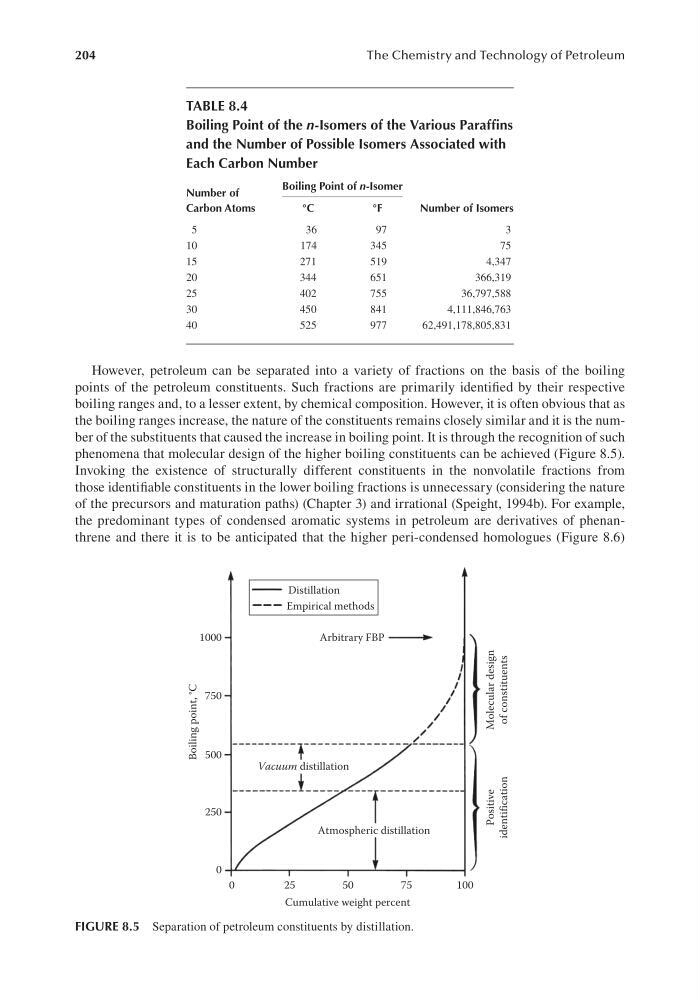
phenomena that molecular design of the higher boiling constituents can be achieved (Figure 8.5).
Invoking the existence of structurally different constituents in the nonvolatile fractions from
those identifiable constituents in the lower boiling fractions is unnecessary (considering the nature
of the precursors and maturation paths) (Chapter 3) and irrational (Speight, 1994b). For example,
the predominant types of condensed aromatic systems in petroleum are derivatives of phenanthrene and there it is to be anticipated that the higher peri-condensed homologues (Figure 8.6)
1000
750
500
250
0
0
2 5
5 0
Atmospheric distillation
Vacuum distillation
Boiling point, °C
Arbitrary FBP
Distillation
Empirical methods
Positive
identification
Molecular design
of constituents
75
100
Cumulative weight percent
FIGURE 8.5 Separation of petroleum constituents by distillation.
TABLE 8.4
Boiling Point of the n-Isomers of the Various Paraffins
and the Number of Possible Isomers Associated with
Each Carbon Number
Number of
Carbon Atoms
Boiling Point of n-Isomer
Number of Isomers
°C
°F
5
36
97
3
10
174
345
75
15
271
519
4,347
20
344
651
366,319
25
402
755
36,797,588
30
450
841
4,111,846,763
40
525
977
62,491,178,805,831
The Chemistry and Technology of Petroleum
However, petroleum can be separated into a variety of fractions on the basis of the boiling
points of the petroleum constituents. Such fractions are primarily identified by their respective
boiling ranges and, to a lesser extent, by chemical composition. However, it is often obvious that as
the boiling ranges increase, the nature of the constituents remains closely similar and it is the number of the substituents that caused the increase in boiling point. It is through the recognition of such
phenomena that molecular design of the higher boiling constituents can be achieved (Figure 8.5).
Invoking the existence of structurally different constituents in the nonvolatile fractions from
those identifiable constituents in the lower boiling fractions is unnecessary (considering the nature
of the precursors and maturation paths) (Chapter 3) and irrational (Speight, 1994b). For example,
the predominant types of condensed aromatic systems in petroleum are derivatives of phenanthrene and there it is to be anticipated that the higher peri-condensed homologues (Figure 8.6)
1000
750
500
250
0
0
2 5
5 0
Atmospheric distillation
Vacuum distillation
Boiling point, °C
Arbitrary FBP
Distillation
Empirical methods
Positive
identification
Molecular design
of constituents
75
100
Cumulative weight percent
FIGURE 8.5 Separation of petroleum constituents by distillation.
TABLE 8.4
Boiling Point of the n-Isomers of the Various Paraffins
and the Number of Possible Isomers Associated with
Each Carbon Number
Number of
Carbon Atoms
Boiling Point of n-Isomer
Number of Isomers
°C
°F
5
36
97
3
10
174
345
75
15
271
519
4,347
20
344
651
366,319
25
402
755
36,797,588
30
450
841
4,111,846,763
40
525
977
62,491,178,805,831