

202
The Chemistry and Technology of Petroleum
8.3.2.5 Porphyrins
Porphyrins are naturally occurring chemical species that exist in petroleum and usually occur
in the nonbasic portion of the nitrogen-containing concentrate (Reynolds, 1998). They are not
usually considered among the usual nitrogen-containing constituents of petroleum, nor are they
considered a metallo-containing organic material that also occurs in some crude oils. As a result
of these early investigations, there arose the concept of porphyrins as biomarkers that could
establish a link between compounds found in the geosphere and their corresponding biological
precursors.
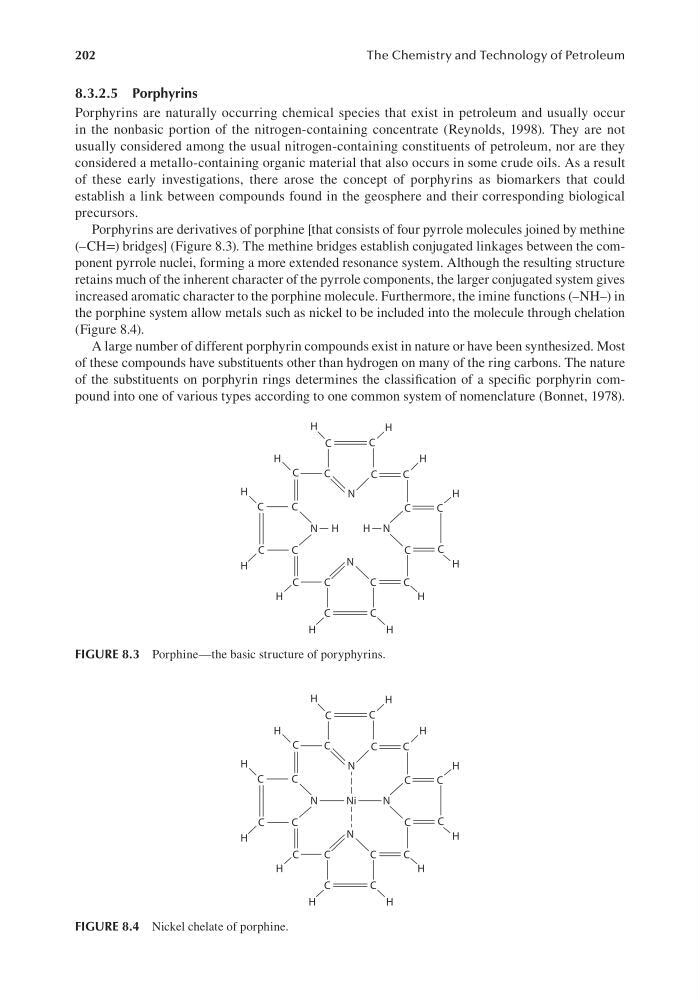
Porphyrins are derivatives of porphine [that consists of four pyrrole molecules joined by methine
(–CH=) bridges] (Figure 8.3). The methine bridges establish conjugated linkages between the component pyrrole nuclei, forming a more extended resonance system. Although the resulting structure
retains much of the inherent character of the pyrrole components, the larger conjugated system gives
increased aromatic character to the porphine molecule. Furthermore, the imine functions (–NH–) in
the porphine system allow metals such as nickel to be included into the molecule through chelation
(Figure 8.4).
A large number of different porphyrin compounds exist in nature or have been synthesized. Most
of these compounds have substituents other than hydrogen on many of the ring carbons. The nature
of the substituents on porphyrin rings determines the classification of a specific porphyrin compound into one of various types according to one common system of nomenclature (Bonnet, 1978).
N
N
N
N
C
C
C
C
C
H
H
H
H
H
H
H
H
H
H
H
H
H
H
C
C
C
C
C
C
C
C
C
C
C
C
C
C
C
FIGURE 8.3 Porphine—the basic structure of poryphyrins.
N
N i
N
N
N
C
C
C
C
C
H
H
H
H
H
H
H
H
H
H
H
H
C
C
C
C
C
C
C
C
C
C
C
C
C
C
C
FIGURE 8.4 Nickel chelate of porphine.
The Chemistry and Technology of Petroleum
8.3.2.5 Porphyrins
Porphyrins are naturally occurring chemical species that exist in petroleum and usually occur
in the nonbasic portion of the nitrogen-containing concentrate (Reynolds, 1998). They are not
usually considered among the usual nitrogen-containing constituents of petroleum, nor are they
considered a metallo-containing organic material that also occurs in some crude oils. As a result
of these early investigations, there arose the concept of porphyrins as biomarkers that could
establish a link between compounds found in the geosphere and their corresponding biological
precursors.
Porphyrins are derivatives of porphine [that consists of four pyrrole molecules joined by methine
(–CH=) bridges] (Figure 8.3). The methine bridges establish conjugated linkages between the component pyrrole nuclei, forming a more extended resonance system. Although the resulting structure
retains much of the inherent character of the pyrrole components, the larger conjugated system gives
increased aromatic character to the porphine molecule. Furthermore, the imine functions (–NH–) in
the porphine system allow metals such as nickel to be included into the molecule through chelation
(Figure 8.4).
A large number of different porphyrin compounds exist in nature or have been synthesized. Most
of these compounds have substituents other than hydrogen on many of the ring carbons. The nature
of the substituents on porphyrin rings determines the classification of a specific porphyrin compound into one of various types according to one common system of nomenclature (Bonnet, 1978).
N
N
N
N
C
C
C
C
C
H
H
H
H
H
H
H
H
H
H
H
H
H
H
C
C
C
C
C
C
C
C
C
C
C
C
C
C
C
FIGURE 8.3 Porphine—the basic structure of poryphyrins.
N
N i
N
N
N
C
C
C
C
C
H
H
H
H
H
H
H
H
H
H
H
H
C
C
C
C
C
C
C
C
C
C
C
C
C
C
C
FIGURE 8.4 Nickel chelate of porphine.