

200
The Chemistry and Technology of Petroleum
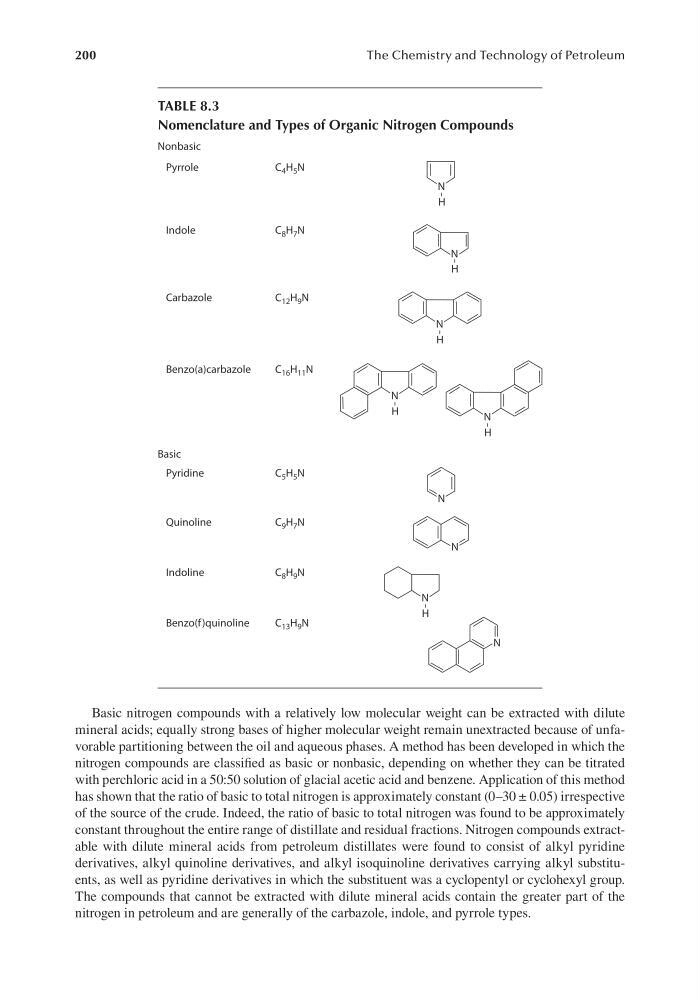
Basic nitrogen compounds with a relatively low molecular weight can be extracted with dilute
mineral acids; equally strong bases of higher molecular weight remain unextracted because of unfavorable partitioning between the oil and aqueous phases. A method has been developed in which the
nitrogen compounds are classified as basic or nonbasic, depending on whether they can be titrated
with perchloric acid in a 50:50 solution of glacial acetic acid and benzene. Application of this method
has shown that the ratio of basic to total nitrogen is approximately constant (0–30 ± 0.05) irrespective
of the source of the crude. Indeed, the ratio of basic to total nitrogen was found to be approximately
constant throughout the entire range of distillate and residual fractions. Nitrogen compounds extractable with dilute mineral acids from petroleum distillates were found to consist of alkyl pyridine
derivatives, alkyl quinoline derivatives, and alkyl isoquinoline derivatives carrying alkyl substituents, as well as pyridine derivatives in which the substituent was a cyclopentyl or cyclohexyl group.
The compounds that cannot be extracted with dilute mineral acids contain the greater part of the
nitrogen in petroleum and are generally of the carbazole, indole, and pyrrole types.
TABLE 8.3
Nomenclature and Types of Organic Nitrogen Compounds
Nonbasic
Pyrrole
C 4 H 5 N
C 8 H 7 N
C 16 H 11 N
C 12 H 9 N
C 5 H 5 N
C 9 H 7 N
C 8 H 9 N
C 13 H 9 N
Indole
Carbazole
H
Benzo(a)carbazole
Benzo(f)quinoline
Basic
Pyridine
Quinoline
Indoline
N
H
N
H
N
H
N
H
N
N
N
N
H
N
The Chemistry and Technology of Petroleum
Basic nitrogen compounds with a relatively low molecular weight can be extracted with dilute
mineral acids; equally strong bases of higher molecular weight remain unextracted because of unfavorable partitioning between the oil and aqueous phases. A method has been developed in which the
nitrogen compounds are classified as basic or nonbasic, depending on whether they can be titrated
with perchloric acid in a 50:50 solution of glacial acetic acid and benzene. Application of this method
has shown that the ratio of basic to total nitrogen is approximately constant (0–30 ± 0.05) irrespective
of the source of the crude. Indeed, the ratio of basic to total nitrogen was found to be approximately
constant throughout the entire range of distillate and residual fractions. Nitrogen compounds extractable with dilute mineral acids from petroleum distillates were found to consist of alkyl pyridine
derivatives, alkyl quinoline derivatives, and alkyl isoquinoline derivatives carrying alkyl substituents, as well as pyridine derivatives in which the substituent was a cyclopentyl or cyclohexyl group.
The compounds that cannot be extracted with dilute mineral acids contain the greater part of the
nitrogen in petroleum and are generally of the carbazole, indole, and pyrrole types.
TABLE 8.3
Nomenclature and Types of Organic Nitrogen Compounds
Nonbasic
Pyrrole
C 4 H 5 N
C 8 H 7 N
C 16 H 11 N
C 12 H 9 N
C 5 H 5 N
C 9 H 7 N
C 8 H 9 N
C 13 H 9 N
Indole
Carbazole
H
Benzo(a)carbazole
Benzo(f)quinoline
Basic
Pyridine
Quinoline
Indoline
N
H
N
H
N
H
N
H
N
N
N
N
H
N