

171
Recovery of Heavy Oil and Tar Sand Bitumen
3. Simultaneous CHOPS and SAGD, with CHOPS used in offset wells until steam breakthrough occurs. Then the CHOPS wells are converted to slow gas and hot-water (or steam)
injection wells to control the process. The high permeability zones generated by CHOPS
should accelerate the SAGD recovery process.
4. Incorporating pressure pulse technology along with CHOPS has already been field tested
with economic success, and pressure pulse technology has potential applications in other
hybrid approaches.
5. Pressure pulse technology may aid in partially stabilizing waterflood through reducing the
viscous fingering and coning intensity.
In addition to hybrid approaches, the new production technologies, along with older, pressuredriven technologies, will be used in successive phases to extract more oil from reservoirs, even from
reservoirs that have been abandoned after primary exploitation. Old reservoirs can be redeveloped
with horizontal wells, even linking up the wells to bypassed oil because of the physics of oil film
spreading between water and gas phases. These staged approaches hold the promise of significantly
increasing recoverable reserves worldwide, not just in heavy oil cases.
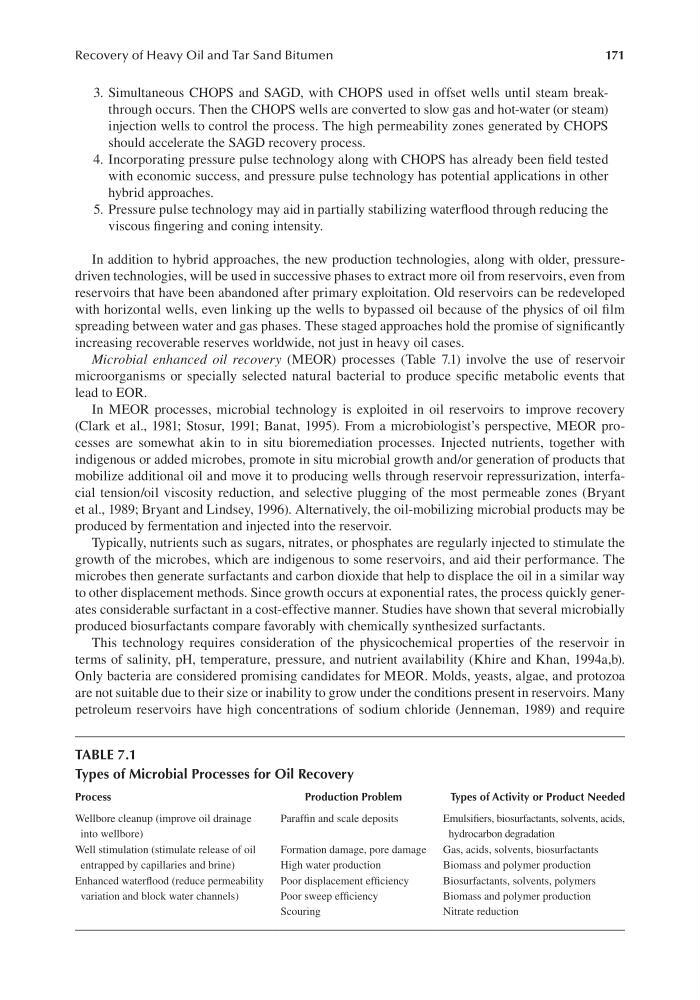
Microbial enhanced oil recovery (MEOR) processes (Table 7.1) involve the use of reservoir
microorganisms or specially selected natural bacterial to produce specific metabolic events that
lead to EOR.
In MEOR processes, microbial technology is exploited in oil reservoirs to improve recovery
(Clark et al., 1981; Stosur, 1991; Banat, 1995). From a microbiologist’s perspective, MEOR processes are somewhat akin to in situ bioremediation processes. Injected nutrients, together with
indigenous or added microbes, promote in situ microbial growth and/or generation of products that
mobilize additional oil and move it to producing wells through reservoir repressurization, interfacial tension/oil viscosity reduction, and selective plugging of the most permeable zones (Bryant
et al., 1989; Bryant and Lindsey, 1996). Alternatively, the oil-mobilizing microbial products may be
produced by fermentation and injected into the reservoir.
Typically, nutrients such as sugars, nitrates, or phosphates are regularly injected to stimulate the
growth of the microbes, which are indigenous to some reservoirs, and aid their performance. The
microbes then generate surfactants and carbon dioxide that help to displace the oil in a similar way
to other displacement methods. Since growth occurs at exponential rates, the process quickly generates considerable surfactant in a cost-effective manner. Studies have shown that several microbially
produced biosurfactants compare favorably with chemically synthesized surfactants.
This technology requires consideration of the physicochemical properties of the reservoir in
terms of salinity, pH, temperature, pressure, and nutrient availability (Khire and Khan, 1994a,b).
Only bacteria are considered promising candidates for MEOR. Molds, yeasts, algae, and protozoa
are not suitable due to their size or inability to grow under the conditions present in reservoirs. Many
petroleum reservoirs have high concentrations of sodium chloride (Jenneman, 1989) and require
TABLE 7.1
Types of Microbial Processes for Oil Recovery
Process
Production Problem
Types of Activity or Product Needed
Wellbore cleanup (improve oil drainage
into wellbore)
Paraffin and scale deposits
Emulsifiers, biosurfactants, solvents, acids,
hydrocarbon degradation
Well stimulation (stimulate release of oil
entrapped by capillaries and brine)
Formation damage, pore damage
High water production
Gas, acids, solvents, biosurfactants
Biomass and polymer production
Enhanced waterflood (reduce permeability
variation and block water channels)
Poor displacement efficiency
Poor sweep efficiency
Scouring
Biosurfactants, solvents, polymers
Biomass and polymer production
Nitrate reduction
Recovery of Heavy Oil and Tar Sand Bitumen
3. Simultaneous CHOPS and SAGD, with CHOPS used in offset wells until steam breakthrough occurs. Then the CHOPS wells are converted to slow gas and hot-water (or steam)
injection wells to control the process. The high permeability zones generated by CHOPS
should accelerate the SAGD recovery process.
4. Incorporating pressure pulse technology along with CHOPS has already been field tested
with economic success, and pressure pulse technology has potential applications in other
hybrid approaches.
5. Pressure pulse technology may aid in partially stabilizing waterflood through reducing the
viscous fingering and coning intensity.
In addition to hybrid approaches, the new production technologies, along with older, pressuredriven technologies, will be used in successive phases to extract more oil from reservoirs, even from
reservoirs that have been abandoned after primary exploitation. Old reservoirs can be redeveloped
with horizontal wells, even linking up the wells to bypassed oil because of the physics of oil film
spreading between water and gas phases. These staged approaches hold the promise of significantly
increasing recoverable reserves worldwide, not just in heavy oil cases.
Microbial enhanced oil recovery (MEOR) processes (Table 7.1) involve the use of reservoir
microorganisms or specially selected natural bacterial to produce specific metabolic events that
lead to EOR.
In MEOR processes, microbial technology is exploited in oil reservoirs to improve recovery
(Clark et al., 1981; Stosur, 1991; Banat, 1995). From a microbiologist’s perspective, MEOR processes are somewhat akin to in situ bioremediation processes. Injected nutrients, together with
indigenous or added microbes, promote in situ microbial growth and/or generation of products that
mobilize additional oil and move it to producing wells through reservoir repressurization, interfacial tension/oil viscosity reduction, and selective plugging of the most permeable zones (Bryant
et al., 1989; Bryant and Lindsey, 1996). Alternatively, the oil-mobilizing microbial products may be
produced by fermentation and injected into the reservoir.
Typically, nutrients such as sugars, nitrates, or phosphates are regularly injected to stimulate the
growth of the microbes, which are indigenous to some reservoirs, and aid their performance. The
microbes then generate surfactants and carbon dioxide that help to displace the oil in a similar way
to other displacement methods. Since growth occurs at exponential rates, the process quickly generates considerable surfactant in a cost-effective manner. Studies have shown that several microbially
produced biosurfactants compare favorably with chemically synthesized surfactants.
This technology requires consideration of the physicochemical properties of the reservoir in
terms of salinity, pH, temperature, pressure, and nutrient availability (Khire and Khan, 1994a,b).
Only bacteria are considered promising candidates for MEOR. Molds, yeasts, algae, and protozoa
are not suitable due to their size or inability to grow under the conditions present in reservoirs. Many
petroleum reservoirs have high concentrations of sodium chloride (Jenneman, 1989) and require
TABLE 7.1
Types of Microbial Processes for Oil Recovery
Process
Production Problem
Types of Activity or Product Needed
Wellbore cleanup (improve oil drainage
into wellbore)
Paraffin and scale deposits
Emulsifiers, biosurfactants, solvents, acids,
hydrocarbon degradation
Well stimulation (stimulate release of oil
entrapped by capillaries and brine)
Formation damage, pore damage
High water production
Gas, acids, solvents, biosurfactants
Biomass and polymer production
Enhanced waterflood (reduce permeability
variation and block water channels)
Poor displacement efficiency
Poor sweep efficiency
Scouring
Biosurfactants, solvents, polymers
Biomass and polymer production
Nitrate reduction