

166
The Chemistry and Technology of Petroleum
precisely so that the system does not become pressure driven, but remains in the gravity- dominated
flow regime (Meszaros et al., 1990).
High recovery ratios are achieved because, in the absence of elevated pressure gradients, a thin
oil film is maintained between the gas and water phases. The film is maintained because the sum of
the oil–water and gas–oil surface tensions is always less than the water–gas surface tension. Thus,
the thin film configuration is thermodynamically stable, and allows the oil to drain to values far
lower than the residual oil saturation value.
The interfaces in IGIs are gravity stabilized because of the difference in phase densities so that
at slow drainage rates the interfaces remain approximately horizontal without viscous fingering. In
one configuration, the horizontal wells are produced under a back pressure equal to the pressure
in the underlying water phase, so no water coning can occur. During production, if the water cut
increases, the production rate is reduced so that the interface becomes stable. Alternatively, if gas
is injected too quickly, gas coning can develop, and if this is observed, the gas injection rate must
be reduced to sustain stability. The process is continued until the oil zone is pinched down to the
horizontal well, achieving the high recovery ratios possible with gravity drainage methods. These
principles are fundamental to all gravity dominated processes and failure to adhere to them will
drive the system into conditions of instability (such as coning and fingering).
In reservoirs with excellent vertical permeability, the bottom-water zone can also be injected
with water to cause the oil–water interface to rise slowly toward the production well. First implemented in Canada, IGI is used extensively in carbonate pinnacle reefs with excellent vertical
permeability, and recovery ratios exceeding 80% are systematically achieved. As with all gravity
drainage processes, it is generally necessary to place the horizontal wells as low in the structure
as possible.
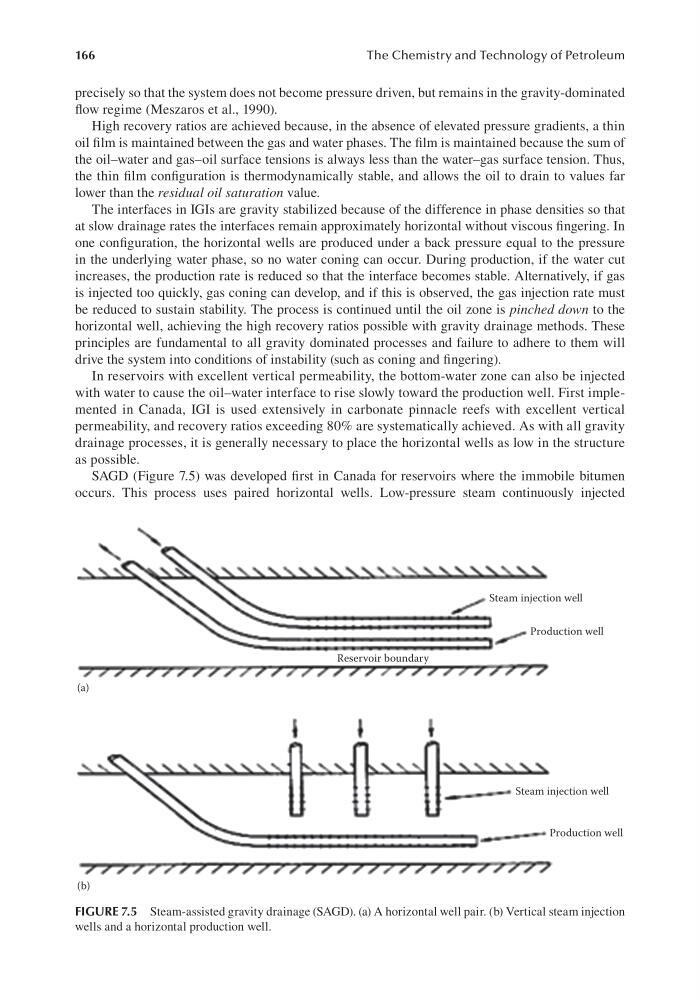
SAGD (Figure 7.5) was developed first in Canada for reservoirs where the immobile bitumen
occurs. This process uses paired horizontal wells. Low-pressure steam continuously injected
Steam injection well
Steam injection well
Production well
Production well
Reservoir boundary
(a)
(b)
FIGURE 7.5 Steam-assisted gravity drainage (SAGD). (a) A horizontal well pair. (b) Vertical steam injection
wells and a horizontal production well.
The Chemistry and Technology of Petroleum
precisely so that the system does not become pressure driven, but remains in the gravity- dominated
flow regime (Meszaros et al., 1990).
High recovery ratios are achieved because, in the absence of elevated pressure gradients, a thin
oil film is maintained between the gas and water phases. The film is maintained because the sum of
the oil–water and gas–oil surface tensions is always less than the water–gas surface tension. Thus,
the thin film configuration is thermodynamically stable, and allows the oil to drain to values far
lower than the residual oil saturation value.
The interfaces in IGIs are gravity stabilized because of the difference in phase densities so that
at slow drainage rates the interfaces remain approximately horizontal without viscous fingering. In
one configuration, the horizontal wells are produced under a back pressure equal to the pressure
in the underlying water phase, so no water coning can occur. During production, if the water cut
increases, the production rate is reduced so that the interface becomes stable. Alternatively, if gas
is injected too quickly, gas coning can develop, and if this is observed, the gas injection rate must
be reduced to sustain stability. The process is continued until the oil zone is pinched down to the
horizontal well, achieving the high recovery ratios possible with gravity drainage methods. These
principles are fundamental to all gravity dominated processes and failure to adhere to them will
drive the system into conditions of instability (such as coning and fingering).
In reservoirs with excellent vertical permeability, the bottom-water zone can also be injected
with water to cause the oil–water interface to rise slowly toward the production well. First implemented in Canada, IGI is used extensively in carbonate pinnacle reefs with excellent vertical
permeability, and recovery ratios exceeding 80% are systematically achieved. As with all gravity
drainage processes, it is generally necessary to place the horizontal wells as low in the structure
as possible.
SAGD (Figure 7.5) was developed first in Canada for reservoirs where the immobile bitumen
occurs. This process uses paired horizontal wells. Low-pressure steam continuously injected
Steam injection well
Steam injection well
Production well
Production well
Reservoir boundary
(a)
(b)
FIGURE 7.5 Steam-assisted gravity drainage (SAGD). (a) A horizontal well pair. (b) Vertical steam injection
wells and a horizontal production well.