

145
Exploration, Recovery, and Transportation
The cargo space in the tankers is usually divided into two, three, or four rows of cargo tanks by
longitudinal bulkheads. These are further divided into individual tanks (from 25 to 40 ft long in
large vessels) by transverse bulkheads. Access to the tanks is through oil-tight hatches on the deck,
cargo being loaded or discharged by means of the ship’s own pumps, which may have a capacity
in excess of 4000 ton/h. There has lately been some discussion about the wisdom of building such
tankers with double hulls. In theory, the single-hull tanker has a better chance of staying afloat but
will spill some of the cargo into the sea.
Over the past two decades it has also become evident that crude oil tankers are usually shorter
lived than most other cargo ships. Crude oil cargoes can deposit corrosive sludge on the bottom
of the hold, and gasoline cargoes can also have a corrosive effect on the steel of the tanks. As a
result, a tanker may last only 12 years instead of the 20 year life of a cargo ship, although protective coatings have been developed that help to withstand the corrosive effects of petroleum
products.
Transportation is a major aspect of oil sands exploitation (Demaison, 1977). There are four
major aspects of liquid fuels production from an oil sand resource: (1) ore recovery; (2) bitumen
separation; (3) bitumen conversion to synthetic crude oil; and (4) refining the synthetic crude oil
to usable liquid fuels. Currently, the two commercial plants carry out the first three stages onsite, and in this respect the plants are completely self-contained. The synthetic crude oil is then
shipped by pipeline to a more conventional refinery site (e.g., Edmonton) for fuel upgrading to
liquid fuels. There are, however, constraints on the character of liquids that may be shipped by
pipeline. The synthetic crude oil conveniently meets the specifications for pipeline shipment, but
should an alternative means of bitumen upgrading be established, that is, visbreaking (viscosity
breaking) (Chapter 18), pipeline specifications must be met.
However, it may be deemed desirable to ship the whole bitumen feed by pipeline, in which case
dilution with naphtha is necessary. The naphtha may actually be produced at the recovery site by
construction of a nominal conversion operation. However, it is to be anticipated that a feed having a
viscosity in excess of 15,000 cSt at 35°C (100°F) will require in excess of 0.5 bbl naphtha per barrel
of bitumen. At higher temperatures, the amount of naphtha required is reduced, but light ends and
even water may have to be removed to prevent undue pressure buildup in the pipeline if shipping
temperatures of about 95°C (200°F) are considered.
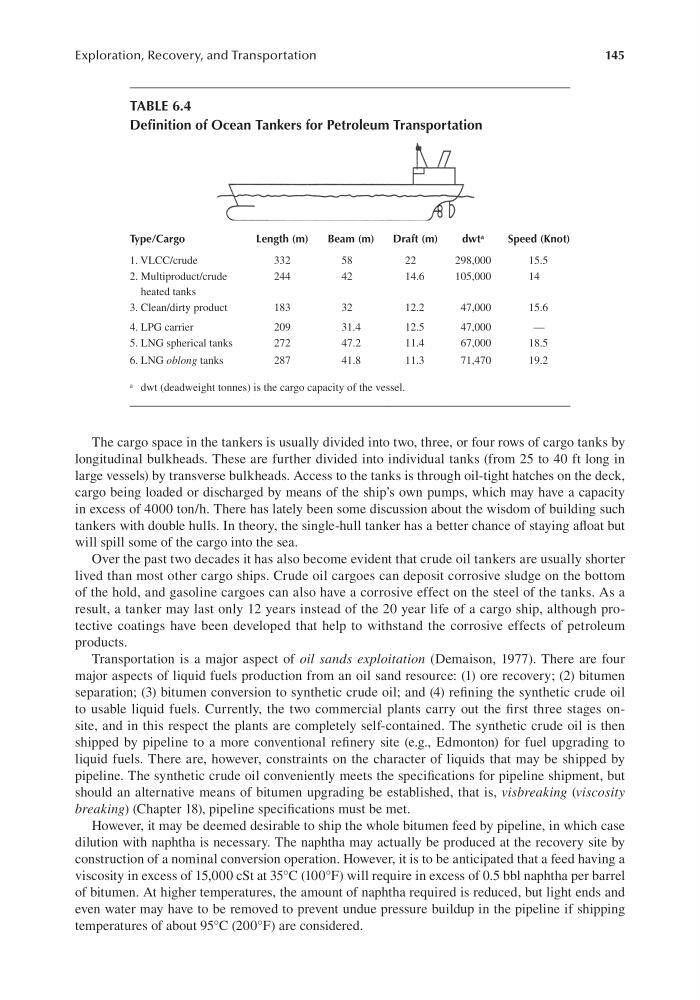
TABLE 6.4
Definition of Ocean Tankers for Petroleum Transportation
Type/Cargo
Length (m)
Beam (m)
Draft (m)
dwt a
Speed (Knot)
1. VLCC/crude
332
58
22
298,000
15.5
2. Multiproduct/crude
heated tanks
244
42
14.6
105,000
14
3. Clean/dirty product
183
32
12.2
47,000
15.6
4. LPG carrier
209
31.4
12.5
47,000
—
5. LNG spherical tanks
272
47.2
11.4
67,000
18.5
6. LNG oblong tanks
287
41.8
11.3
71,470
19.2
a dwt (deadweight tonnes) is the cargo capacity of the vessel.
Exploration, Recovery, and Transportation
The cargo space in the tankers is usually divided into two, three, or four rows of cargo tanks by
longitudinal bulkheads. These are further divided into individual tanks (from 25 to 40 ft long in
large vessels) by transverse bulkheads. Access to the tanks is through oil-tight hatches on the deck,
cargo being loaded or discharged by means of the ship’s own pumps, which may have a capacity
in excess of 4000 ton/h. There has lately been some discussion about the wisdom of building such
tankers with double hulls. In theory, the single-hull tanker has a better chance of staying afloat but
will spill some of the cargo into the sea.
Over the past two decades it has also become evident that crude oil tankers are usually shorter
lived than most other cargo ships. Crude oil cargoes can deposit corrosive sludge on the bottom
of the hold, and gasoline cargoes can also have a corrosive effect on the steel of the tanks. As a
result, a tanker may last only 12 years instead of the 20 year life of a cargo ship, although protective coatings have been developed that help to withstand the corrosive effects of petroleum
products.
Transportation is a major aspect of oil sands exploitation (Demaison, 1977). There are four
major aspects of liquid fuels production from an oil sand resource: (1) ore recovery; (2) bitumen
separation; (3) bitumen conversion to synthetic crude oil; and (4) refining the synthetic crude oil
to usable liquid fuels. Currently, the two commercial plants carry out the first three stages onsite, and in this respect the plants are completely self-contained. The synthetic crude oil is then
shipped by pipeline to a more conventional refinery site (e.g., Edmonton) for fuel upgrading to
liquid fuels. There are, however, constraints on the character of liquids that may be shipped by
pipeline. The synthetic crude oil conveniently meets the specifications for pipeline shipment, but
should an alternative means of bitumen upgrading be established, that is, visbreaking (viscosity
breaking) (Chapter 18), pipeline specifications must be met.
However, it may be deemed desirable to ship the whole bitumen feed by pipeline, in which case
dilution with naphtha is necessary. The naphtha may actually be produced at the recovery site by
construction of a nominal conversion operation. However, it is to be anticipated that a feed having a
viscosity in excess of 15,000 cSt at 35°C (100°F) will require in excess of 0.5 bbl naphtha per barrel
of bitumen. At higher temperatures, the amount of naphtha required is reduced, but light ends and
even water may have to be removed to prevent undue pressure buildup in the pipeline if shipping
temperatures of about 95°C (200°F) are considered.
TABLE 6.4
Definition of Ocean Tankers for Petroleum Transportation
Type/Cargo
Length (m)
Beam (m)
Draft (m)
dwt a
Speed (Knot)
1. VLCC/crude
332
58
22
298,000
15.5
2. Multiproduct/crude
heated tanks
244
42
14.6
105,000
14
3. Clean/dirty product
183
32
12.2
47,000
15.6
4. LPG carrier
209
31.4
12.5
47,000
—
5. LNG spherical tanks
272
47.2
11.4
67,000
18.5
6. LNG oblong tanks
287
41.8
11.3
71,470
19.2
a dwt (deadweight tonnes) is the cargo capacity of the vessel.