

143
Exploration, Recovery, and Transportation
cleaning usually take place at a central facility that collects the oil produced from several wells.
Gas can be separated conveniently at the wellhead. When the pressure of the gas in the crude oil
as it comes out at the surface is not too great, a simple flow tank fitted with baffles can be used to
separate the gas from the oil at atmospheric pressure. If a considerable amount of gas is present,
particularly if the crude oil is under considerable pressure, a series of flow tanks is necessary. The
natural gas itself may contain as impurities one or more non-hydrocarbon substances. The most
abundant of these impurities is hydrogen sulfide, which imparts a noticeable odor to the gas. A small
amount of this compound is considered advantageous as it gives an indication of leaks and where
they occur, as mentioned.
Another step that needs to be taken in the preparation of crude oil for transportation is the
removal of excessive quantities of water. Crude oil at the wellhead usually contains emulsified
water in proportions that may reach amounts approaching 80%–90%. It is generally required that
crude oil to be transported by pipeline contain substantially less water than may appear in the
crude at the wellhead. In fact, water contents from 0.5% to 2.0% have been specified as the maximum tolerable amount in a crude oil to be moved by pipeline. It is therefore necessary to remove
the excess water from the crude oil before transportation.
In an emulsion, the globules of one phase are usually surrounded by a thin film of an emulsifying
agent that prevents them from congregating into large droplets. In the case of an oil-water emulsion,
the emulsifying agent may be part of the heavier (asphaltic) more polar constituents. The film may be
broken mechanically, electrically, or by the use of demulsifying agents and the proportion of water in
the oil reduced to the specified amounts, thereby tendering the crude oil suitable for transportation.
The transportation of crude oil may be further simplified by blending crude oils from several
wells, thereby homogenizing the feedstock to the refinery. It is usual practice, however, to blend
crude oils of similar characteristics although fluctuations in the properties of the individual crude
oils may cause significant variations in the properties of the blend over a period of time. However,
the technique of blending several crude oils before transportation, or even after transportation but
before refining, may eliminate the frequent need to change the processing conditions that would
perhaps be required to process each of the crude oils individually.
The arrival of large quantities of petroleum oil at import and refining centers has brought about
the need for storage facilities. The usual form of crude oil storage is the collection of large cylindrical steel storage tanks (tank farm) that are a familiar sight at most refineries and shipping terminals.
The tanks vary in size, but some are capable of holding up to 950,000 barrels of oil. Crude oil may
Field
1–20,000 km
Oil transport
Refinery
Buried land and/or underwater pipelines
3.
2.
Options: 1.
Crude oil tanker, VLCC (very large crude carrier)
Liquefied petroleum gas (LPG) tanker
Road, rail, or barge transport
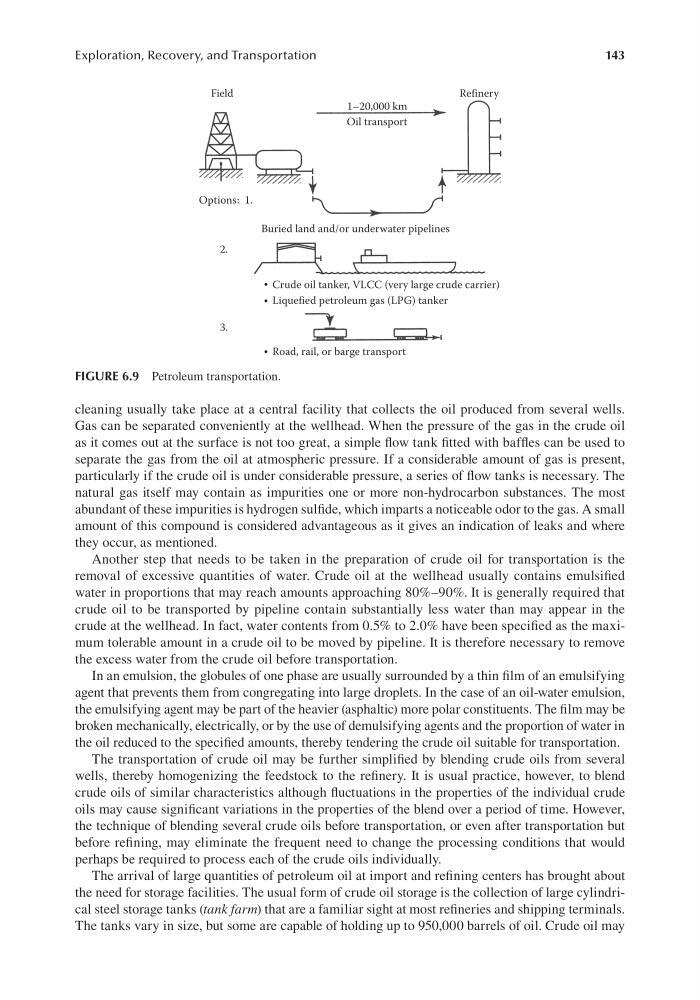
FIGURE 6.9 Petroleum transportation.
Exploration, Recovery, and Transportation
cleaning usually take place at a central facility that collects the oil produced from several wells.
Gas can be separated conveniently at the wellhead. When the pressure of the gas in the crude oil
as it comes out at the surface is not too great, a simple flow tank fitted with baffles can be used to
separate the gas from the oil at atmospheric pressure. If a considerable amount of gas is present,
particularly if the crude oil is under considerable pressure, a series of flow tanks is necessary. The
natural gas itself may contain as impurities one or more non-hydrocarbon substances. The most
abundant of these impurities is hydrogen sulfide, which imparts a noticeable odor to the gas. A small
amount of this compound is considered advantageous as it gives an indication of leaks and where
they occur, as mentioned.
Another step that needs to be taken in the preparation of crude oil for transportation is the
removal of excessive quantities of water. Crude oil at the wellhead usually contains emulsified
water in proportions that may reach amounts approaching 80%–90%. It is generally required that
crude oil to be transported by pipeline contain substantially less water than may appear in the
crude at the wellhead. In fact, water contents from 0.5% to 2.0% have been specified as the maximum tolerable amount in a crude oil to be moved by pipeline. It is therefore necessary to remove
the excess water from the crude oil before transportation.
In an emulsion, the globules of one phase are usually surrounded by a thin film of an emulsifying
agent that prevents them from congregating into large droplets. In the case of an oil-water emulsion,
the emulsifying agent may be part of the heavier (asphaltic) more polar constituents. The film may be
broken mechanically, electrically, or by the use of demulsifying agents and the proportion of water in
the oil reduced to the specified amounts, thereby tendering the crude oil suitable for transportation.
The transportation of crude oil may be further simplified by blending crude oils from several
wells, thereby homogenizing the feedstock to the refinery. It is usual practice, however, to blend
crude oils of similar characteristics although fluctuations in the properties of the individual crude
oils may cause significant variations in the properties of the blend over a period of time. However,
the technique of blending several crude oils before transportation, or even after transportation but
before refining, may eliminate the frequent need to change the processing conditions that would
perhaps be required to process each of the crude oils individually.
The arrival of large quantities of petroleum oil at import and refining centers has brought about
the need for storage facilities. The usual form of crude oil storage is the collection of large cylindrical steel storage tanks (tank farm) that are a familiar sight at most refineries and shipping terminals.
The tanks vary in size, but some are capable of holding up to 950,000 barrels of oil. Crude oil may
Field
1–20,000 km
Oil transport
Refinery
Buried land and/or underwater pipelines
3.
2.
Options: 1.
Crude oil tanker, VLCC (very large crude carrier)
Liquefied petroleum gas (LPG) tanker
Road, rail, or barge transport
FIGURE 6.9 Petroleum transportation.