

130
The Chemistry and Technology of Petroleum
The rate of production from a flowing well tends to decline as the natural reservoir energy is expended.
When a flowing well is no longer producing at an efficient rate, a pump is installed.
The recovery efficiency for primary production is generally low when liquid expansion and solution gas evolution are the driving mechanisms. Much higher recoveries are associated with reservoirs with water and gas cap drives and with reservoirs in which gravity effectively promotes
drainage of the oil from the rock pores. The overall recovery efficiency is related to how the reservoir is delineated by production wells. Thus for maximum recovery by primary recovery it is often
preferable to sink several wells into a reservoir, thereby bringing about recovery by a combination
of the methods outlined here.
6.5.2 seCondAry reCovery
Over the lifetime of the well the pressure will fall, and at some point there will be insufficient underground pressure to force the oil to the surface. If economical, and it often is, the remaining oil in the
well is extracted using secondary oil recovery methods. It is at this point that secondary recovery
methods must be applied.
Secondary oil recovery methods use various techniques to aid in recovering oil from depleted
or low-pressure reservoirs. Sometimes pumps on the surface or submerged ESPs are used to bring
the oil to the surface. Other secondary recovery techniques that increase the reservoir’s pressure by
water injection and gas injection, which injects air or some other gas into the reservoir, are used.
Together, primary recovery and secondary recovery allow 25%–35% of the reservoir’s oil to be
recovered.
Primary (or conventional) recovery can leave as much as 70% of the petroleum in the reservoir.
Such effects as microscopic trapping and by-passing are the more obvious reasons for the low recovery. There are two main objectives in secondary crude oil production. One objective is to supplement the depleted reservoir energy pressure, and the second objective is to sweep the crude oil from
the injection well toward and into the production well. In fact, secondary oil recovery involves the
introduction of energy into a reservoir to produce more oil. For example, the addition of materials
to reduce the interfacial tension of the oil results in a higher recovery of oil.
The most common follow-up, or secondary recovery, operations usually involve the application
of pumping operations or of injection of materials into a well to encourage movement and recovery
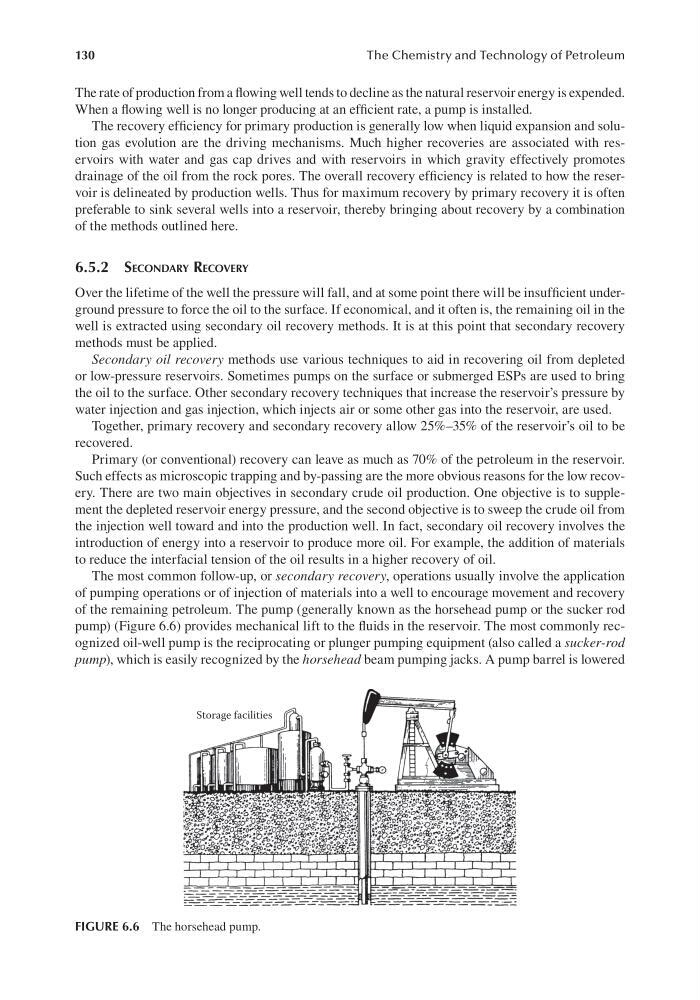
of the remaining petroleum. The pump (generally known as the horsehead pump or the sucker rod
pump) (Figure 6.6) provides mechanical lift to the fluids in the reservoir. The most commonly recognized oil-well pump is the reciprocating or plunger pumping equipment (also called a sucker-rod
pump), which is easily recognized by the horsehead beam pumping jacks. A pump barrel is lowered
Storage facilities
FIGURE 6.6 The horsehead pump.
The Chemistry and Technology of Petroleum
The rate of production from a flowing well tends to decline as the natural reservoir energy is expended.
When a flowing well is no longer producing at an efficient rate, a pump is installed.
The recovery efficiency for primary production is generally low when liquid expansion and solution gas evolution are the driving mechanisms. Much higher recoveries are associated with reservoirs with water and gas cap drives and with reservoirs in which gravity effectively promotes
drainage of the oil from the rock pores. The overall recovery efficiency is related to how the reservoir is delineated by production wells. Thus for maximum recovery by primary recovery it is often
preferable to sink several wells into a reservoir, thereby bringing about recovery by a combination
of the methods outlined here.
6.5.2 seCondAry reCovery
Over the lifetime of the well the pressure will fall, and at some point there will be insufficient underground pressure to force the oil to the surface. If economical, and it often is, the remaining oil in the
well is extracted using secondary oil recovery methods. It is at this point that secondary recovery
methods must be applied.
Secondary oil recovery methods use various techniques to aid in recovering oil from depleted
or low-pressure reservoirs. Sometimes pumps on the surface or submerged ESPs are used to bring
the oil to the surface. Other secondary recovery techniques that increase the reservoir’s pressure by
water injection and gas injection, which injects air or some other gas into the reservoir, are used.
Together, primary recovery and secondary recovery allow 25%–35% of the reservoir’s oil to be
recovered.
Primary (or conventional) recovery can leave as much as 70% of the petroleum in the reservoir.
Such effects as microscopic trapping and by-passing are the more obvious reasons for the low recovery. There are two main objectives in secondary crude oil production. One objective is to supplement the depleted reservoir energy pressure, and the second objective is to sweep the crude oil from
the injection well toward and into the production well. In fact, secondary oil recovery involves the
introduction of energy into a reservoir to produce more oil. For example, the addition of materials
to reduce the interfacial tension of the oil results in a higher recovery of oil.
The most common follow-up, or secondary recovery, operations usually involve the application
of pumping operations or of injection of materials into a well to encourage movement and recovery
of the remaining petroleum. The pump (generally known as the horsehead pump or the sucker rod
pump) (Figure 6.6) provides mechanical lift to the fluids in the reservoir. The most commonly recognized oil-well pump is the reciprocating or plunger pumping equipment (also called a sucker-rod
pump), which is easily recognized by the horsehead beam pumping jacks. A pump barrel is lowered
Storage facilities
FIGURE 6.6 The horsehead pump.