

128
The Chemistry and Technology of Petroleum
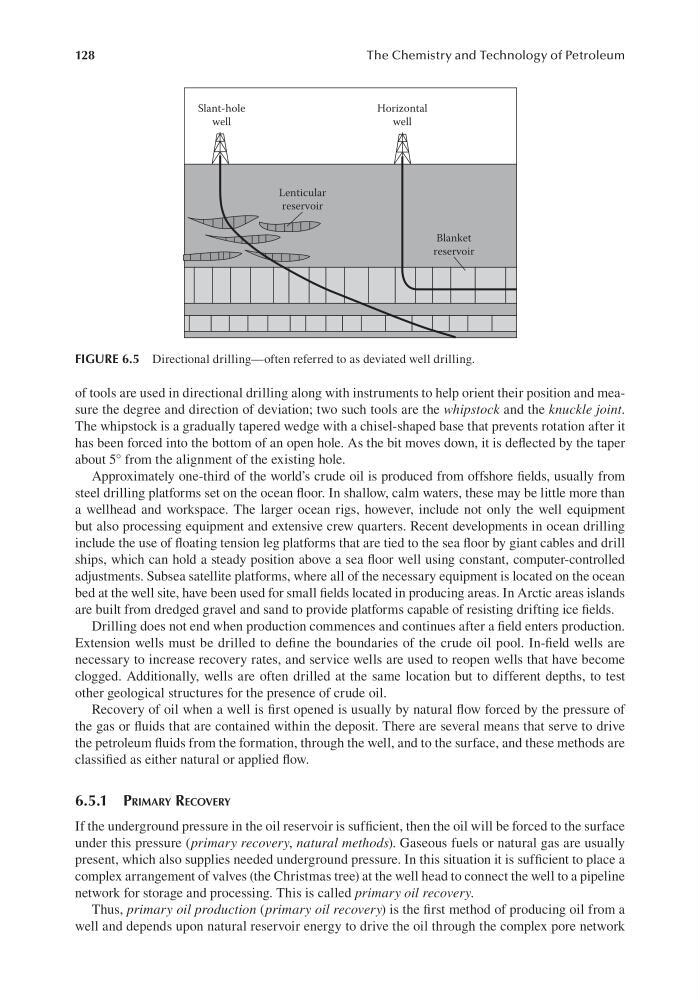
of tools are used in directional drilling along with instruments to help orient their position and measure the degree and direction of deviation; two such tools are the whipstock and the knuckle joint.
The whipstock is a gradually tapered wedge with a chisel-shaped base that prevents rotation after it
has been forced into the bottom of an open hole. As the bit moves down, it is deflected by the taper
about 5° from the alignment of the existing hole.
Approximately one-third of the world’s crude oil is produced from offshore fields, usually from
steel drilling platforms set on the ocean floor. In shallow, calm waters, these may be little more than
a wellhead and workspace. The larger ocean rigs, however, include not only the well equipment
but also processing equipment and extensive crew quarters. Recent developments in ocean drilling
include the use of floating tension leg platforms that are tied to the sea floor by giant cables and drill
ships, which can hold a steady position above a sea floor well using constant, computer-controlled
adjustments. Subsea satellite platforms, where all of the necessary equipment is located on the ocean
bed at the well site, have been used for small fields located in producing areas. In Arctic areas islands
are built from dredged gravel and sand to provide platforms capable of resisting drifting ice fields.
Drilling does not end when production commences and continues after a field enters production.
Extension wells must be drilled to define the boundaries of the crude oil pool. In-field wells are
necessary to increase recovery rates, and service wells are used to reopen wells that have become
clogged. Additionally, wells are often drilled at the same location but to different depths, to test
other geological structures for the presence of crude oil.
Recovery of oil when a well is first opened is usually by natural flow forced by the pressure of
the gas or fluids that are contained within the deposit. There are several means that serve to drive
the petroleum fluids from the formation, through the well, and to the surface, and these methods are
classified as either natural or applied flow.
6.5.1 PrImAry reCovery
If the underground pressure in the oil reservoir is sufficient, then the oil will be forced to the surface
under this pressure (primary recovery, natural methods). Gaseous fuels or natural gas are usually
present, which also supplies needed underground pressure. In this situation it is sufficient to place a
complex arrangement of valves (the Christmas tree) at the well head to connect the well to a pipeline
network for storage and processing. This is called primary oil recovery.
Thus, primary oil production (primary oil recovery) is the first method of producing oil from a
well and depends upon natural reservoir energy to drive the oil through the complex pore network
Blanket
reservoir
Lenticular
reservoir
Slant-hole
well
Horizontal
well
FIGURE 6.5 Directional drilling—often referred to as deviated well drilling.
The Chemistry and Technology of Petroleum
of tools are used in directional drilling along with instruments to help orient their position and measure the degree and direction of deviation; two such tools are the whipstock and the knuckle joint.
The whipstock is a gradually tapered wedge with a chisel-shaped base that prevents rotation after it
has been forced into the bottom of an open hole. As the bit moves down, it is deflected by the taper
about 5° from the alignment of the existing hole.
Approximately one-third of the world’s crude oil is produced from offshore fields, usually from
steel drilling platforms set on the ocean floor. In shallow, calm waters, these may be little more than
a wellhead and workspace. The larger ocean rigs, however, include not only the well equipment
but also processing equipment and extensive crew quarters. Recent developments in ocean drilling
include the use of floating tension leg platforms that are tied to the sea floor by giant cables and drill
ships, which can hold a steady position above a sea floor well using constant, computer-controlled
adjustments. Subsea satellite platforms, where all of the necessary equipment is located on the ocean
bed at the well site, have been used for small fields located in producing areas. In Arctic areas islands
are built from dredged gravel and sand to provide platforms capable of resisting drifting ice fields.
Drilling does not end when production commences and continues after a field enters production.
Extension wells must be drilled to define the boundaries of the crude oil pool. In-field wells are
necessary to increase recovery rates, and service wells are used to reopen wells that have become
clogged. Additionally, wells are often drilled at the same location but to different depths, to test
other geological structures for the presence of crude oil.
Recovery of oil when a well is first opened is usually by natural flow forced by the pressure of
the gas or fluids that are contained within the deposit. There are several means that serve to drive
the petroleum fluids from the formation, through the well, and to the surface, and these methods are
classified as either natural or applied flow.
6.5.1 PrImAry reCovery
If the underground pressure in the oil reservoir is sufficient, then the oil will be forced to the surface
under this pressure (primary recovery, natural methods). Gaseous fuels or natural gas are usually
present, which also supplies needed underground pressure. In this situation it is sufficient to place a
complex arrangement of valves (the Christmas tree) at the well head to connect the well to a pipeline
network for storage and processing. This is called primary oil recovery.
Thus, primary oil production (primary oil recovery) is the first method of producing oil from a
well and depends upon natural reservoir energy to drive the oil through the complex pore network
Blanket
reservoir
Lenticular
reservoir
Slant-hole
well
Horizontal
well
FIGURE 6.5 Directional drilling—often referred to as deviated well drilling.