

124
The Chemistry and Technology of Petroleum
where drilling mud is mixed and recycled, and (8) mud-mixing hopper, where new mud is
mixed and then sent to the mud pits.
6. Derrick: the support structure that holds the drilling apparatus; tall enough to allow new
sections of drill pipe to be added to the drilling apparatus as drilling progresses
7. Blowout preventer: high-pressure valves (located under the land rig or on the sea floor) that
seal the high-pressure drill lines and relieve pressure when necessary to prevent a blowout
(uncontrolled gush of gas or oil to the surface, often associated with fire).
6.3.3 drIllIng rIg
Although there are many variations in design, all modern rotary drilling rigs have essentially the
same components (Figure 6.1). The hoisting, or draw works, raises and lowers the drill pipe and
casing, which can weigh as much as 200 tons (200,000 kg). The height of the derrick depends on
the number of joints of drill pipe to be withdrawn as a unit before being unscrewed. The rotary
table located in the middle of the rig floor rotates the drill column. The table also gaps the drill
stem when the hoist is disconnected and pipe sections are inserted or removed. It imparts rotary
motion to the drill stem through the kelly attached to the upper end of the column. The kelly fits
into a shaped hole in the center of the rotary table. The couplings between pipe sections are called
tool joints.
The drilling bit is connected to drill collars at the bottom of the stem. These are thick steel
cylinders, 20–29 ft (6–9 m) long; as many as 10 may be screwed together. They concentrate
weight at the bottom of the column and exert tension on the more flexible pipe above, reducing
the tendency of the hole to go off-line and the drill pipe to fracture. Drill bits have many designs
and the variations include the number of blades, type of metal, and shape of cutting or brading
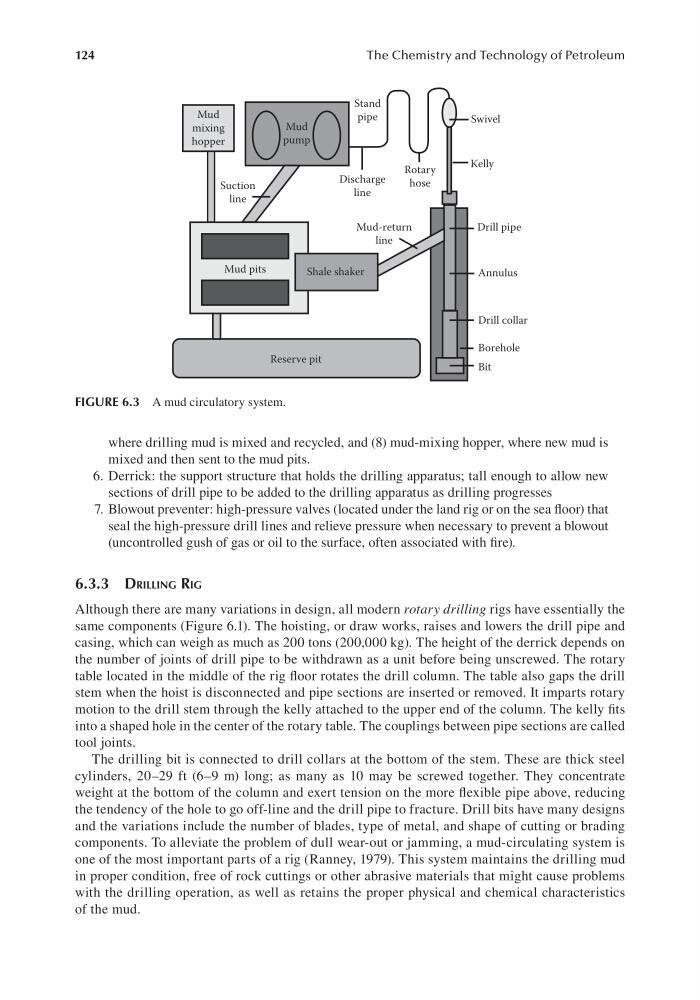
components. To alleviate the problem of dull wear-out or jamming, a mud-circulating system is
one of the most important parts of a rig (Ranney, 1979). This system maintains the drilling mud
in proper condition, free of rock cuttings or other abrasive materials that might cause problems
with the drilling operation, as well as retains the proper physical and chemical characteristics
of the mud.
Reserve pit
Bit
Borehole
Drill collar
Annulus
Drill pipe
Kelly
Rotary
hose
Discharge
line
Mud
pump
Stand
pipe
Mud
mixing
hopper
Suction
line
Swivel
Shale shaker
Mud-return
line
Mud pits
FIGURE 6.3 A mud circulatory system.
The Chemistry and Technology of Petroleum
where drilling mud is mixed and recycled, and (8) mud-mixing hopper, where new mud is
mixed and then sent to the mud pits.
6. Derrick: the support structure that holds the drilling apparatus; tall enough to allow new
sections of drill pipe to be added to the drilling apparatus as drilling progresses
7. Blowout preventer: high-pressure valves (located under the land rig or on the sea floor) that
seal the high-pressure drill lines and relieve pressure when necessary to prevent a blowout
(uncontrolled gush of gas or oil to the surface, often associated with fire).
6.3.3 drIllIng rIg
Although there are many variations in design, all modern rotary drilling rigs have essentially the
same components (Figure 6.1). The hoisting, or draw works, raises and lowers the drill pipe and
casing, which can weigh as much as 200 tons (200,000 kg). The height of the derrick depends on
the number of joints of drill pipe to be withdrawn as a unit before being unscrewed. The rotary
table located in the middle of the rig floor rotates the drill column. The table also gaps the drill
stem when the hoist is disconnected and pipe sections are inserted or removed. It imparts rotary
motion to the drill stem through the kelly attached to the upper end of the column. The kelly fits
into a shaped hole in the center of the rotary table. The couplings between pipe sections are called
tool joints.
The drilling bit is connected to drill collars at the bottom of the stem. These are thick steel
cylinders, 20–29 ft (6–9 m) long; as many as 10 may be screwed together. They concentrate
weight at the bottom of the column and exert tension on the more flexible pipe above, reducing
the tendency of the hole to go off-line and the drill pipe to fracture. Drill bits have many designs
and the variations include the number of blades, type of metal, and shape of cutting or brading
components. To alleviate the problem of dull wear-out or jamming, a mud-circulating system is
one of the most important parts of a rig (Ranney, 1979). This system maintains the drilling mud
in proper condition, free of rock cuttings or other abrasive materials that might cause problems
with the drilling operation, as well as retains the proper physical and chemical characteristics
of the mud.
Reserve pit
Bit
Borehole
Drill collar
Annulus
Drill pipe
Kelly
Rotary
hose
Discharge
line
Mud
pump
Stand
pipe
Mud
mixing
hopper
Suction
line
Swivel
Shale shaker
Mud-return
line
Mud pits
FIGURE 6.3 A mud circulatory system.