

106
The Chemistry and Technology of Petroleum
aromatic rings), nonvolatile benzene polycarboxylic acids, and unoxidized organic carbon. However,
because aliphatic material is oxidized mainly to carbon dioxide, this method is not well suited to
probe the structure of kerogen that is highly aliphatic. This led to the development of stepwise procedures to give products that retain more structural information about the starting kerogen.
The careful development of the stepwise alkaline permanganate method represented attempts to
minimize unwanted secondary oxidation of the first-formed product by adding the oxidant (KMnO 4
in 1% aqueous KOH) in small portions. In some cases, the acids obtained from stepwise oxidation
proved to be of such high molecular weight that they precipitated upon acidification, were insoluble
in ether, and were difficult to characterize. In these cases, the precipitated acids were subjected to
further stepwise oxidation to produce the desired ether-soluble acids of lower molecular weight.
In general terms, alkaline permanganate oxidizes alkylbenzenes, alkylthiophenes, and alkylpyridines (but not alkylfurans) to the corresponding carboxylic, acids. This is not true when the
aromatic ring bears an electron-donating group (e.g., –OH, –OR, or –NH 2 ). In such cases degradation of the aromatic portion is usually rapid. Condensed aromatics are also attacked and benzene
polycarboxylic acids are produced. In addition, caution is advised since benzene itself also reacts
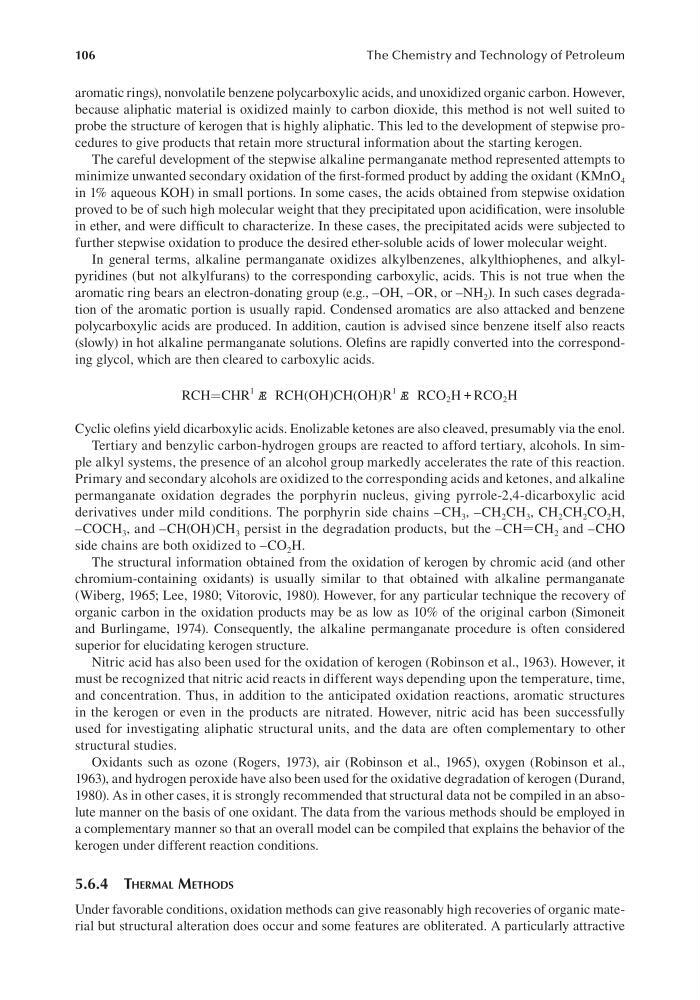
(slowly) in hot alkaline permanganate solutions. Olefins are rapidly converted into the corresponding glycol, which are then cleared to carboxylic acids.
RCH CHR
RCH OH CH OH R
RCO H RCO H
1
1
2
2
=
Æ
Æ
+
( ) ( )
Cyclic olefins yield dicarboxylic acids. Enolizable ketones are also cleaved, presumably via the enol.
Tertiary and benzylic carbon-hydrogen groups are reacted to afford tertiary, alcohols. In simple alkyl systems, the presence of an alcohol group markedly accelerates the rate of this reaction.
Primary and secondary alcohols are oxidized to the corresponding acids and ketones, and alkaline
permanganate oxidation degrades the porphyrin nucleus, giving pyrrole-2,4-dicarboxylic acid
derivatives under mild conditions. The porphyrin side chains –CH 3 , –CH 2 CH 3 , CH 2 CH 2 CO 2 H,
–COCH 3 , and –CH(OH)CH 3 persist in the degradation products, but the –CH=CH 2 and –CHO
side chains are both oxidized to –CO 2 H.
The structural information obtained from the oxidation of kerogen by chromic acid (and other
chromium-containing oxidants) is usually similar to that obtained with alkaline permanganate
(Wiberg, 1965; Lee, 1980; Vitorovic, 1980). However, for any particular technique the recovery of
organic carbon in the oxidation products may be as low as 10% of the original carbon (Simoneit
and Burlingame, 1974). Consequently, the alkaline permanganate procedure is often considered
superior for elucidating kerogen structure.
Nitric acid has also been used for the oxidation of kerogen (Robinson et al., 1963). However, it
must be recognized that nitric acid reacts in different ways depending upon the temperature, time,
and concentration. Thus, in addition to the anticipated oxidation reactions, aromatic structures
in the kerogen or even in the products are nitrated. However, nitric acid has been successfully
used for investigating aliphatic structural units, and the data are often complementary to other
structural studies.
Oxidants such as ozone (Rogers, 1973), air (Robinson et al., 1965), oxygen (Robinson et al.,
1963), and hydrogen peroxide have also been used for the oxidative degradation of kerogen (Durand,
1980). As in other cases, it is strongly recommended that structural data not be compiled in an absolute manner on the basis of one oxidant. The data from the various methods should be employed in
a complementary manner so that an overall model can be compiled that explains the behavior of the
kerogen under different reaction conditions.
5.6.4 tHermAl metHods
Under favorable conditions, oxidation methods can give reasonably high recoveries of organic material but structural alteration does occur and some features are obliterated. A particularly attractive
The Chemistry and Technology of Petroleum
aromatic rings), nonvolatile benzene polycarboxylic acids, and unoxidized organic carbon. However,
because aliphatic material is oxidized mainly to carbon dioxide, this method is not well suited to
probe the structure of kerogen that is highly aliphatic. This led to the development of stepwise procedures to give products that retain more structural information about the starting kerogen.
The careful development of the stepwise alkaline permanganate method represented attempts to
minimize unwanted secondary oxidation of the first-formed product by adding the oxidant (KMnO 4
in 1% aqueous KOH) in small portions. In some cases, the acids obtained from stepwise oxidation
proved to be of such high molecular weight that they precipitated upon acidification, were insoluble
in ether, and were difficult to characterize. In these cases, the precipitated acids were subjected to
further stepwise oxidation to produce the desired ether-soluble acids of lower molecular weight.
In general terms, alkaline permanganate oxidizes alkylbenzenes, alkylthiophenes, and alkylpyridines (but not alkylfurans) to the corresponding carboxylic, acids. This is not true when the
aromatic ring bears an electron-donating group (e.g., –OH, –OR, or –NH 2 ). In such cases degradation of the aromatic portion is usually rapid. Condensed aromatics are also attacked and benzene
polycarboxylic acids are produced. In addition, caution is advised since benzene itself also reacts
(slowly) in hot alkaline permanganate solutions. Olefins are rapidly converted into the corresponding glycol, which are then cleared to carboxylic acids.
RCH CHR
RCH OH CH OH R
RCO H RCO H
1
1
2
2
=
Æ
Æ
+
( ) ( )
Cyclic olefins yield dicarboxylic acids. Enolizable ketones are also cleaved, presumably via the enol.
Tertiary and benzylic carbon-hydrogen groups are reacted to afford tertiary, alcohols. In simple alkyl systems, the presence of an alcohol group markedly accelerates the rate of this reaction.
Primary and secondary alcohols are oxidized to the corresponding acids and ketones, and alkaline
permanganate oxidation degrades the porphyrin nucleus, giving pyrrole-2,4-dicarboxylic acid
derivatives under mild conditions. The porphyrin side chains –CH 3 , –CH 2 CH 3 , CH 2 CH 2 CO 2 H,
–COCH 3 , and –CH(OH)CH 3 persist in the degradation products, but the –CH=CH 2 and –CHO
side chains are both oxidized to –CO 2 H.
The structural information obtained from the oxidation of kerogen by chromic acid (and other
chromium-containing oxidants) is usually similar to that obtained with alkaline permanganate
(Wiberg, 1965; Lee, 1980; Vitorovic, 1980). However, for any particular technique the recovery of
organic carbon in the oxidation products may be as low as 10% of the original carbon (Simoneit
and Burlingame, 1974). Consequently, the alkaline permanganate procedure is often considered
superior for elucidating kerogen structure.
Nitric acid has also been used for the oxidation of kerogen (Robinson et al., 1963). However, it
must be recognized that nitric acid reacts in different ways depending upon the temperature, time,
and concentration. Thus, in addition to the anticipated oxidation reactions, aromatic structures
in the kerogen or even in the products are nitrated. However, nitric acid has been successfully
used for investigating aliphatic structural units, and the data are often complementary to other
structural studies.
Oxidants such as ozone (Rogers, 1973), air (Robinson et al., 1965), oxygen (Robinson et al.,
1963), and hydrogen peroxide have also been used for the oxidative degradation of kerogen (Durand,
1980). As in other cases, it is strongly recommended that structural data not be compiled in an absolute manner on the basis of one oxidant. The data from the various methods should be employed in
a complementary manner so that an overall model can be compiled that explains the behavior of the
kerogen under different reaction conditions.
5.6.4 tHermAl metHods
Under favorable conditions, oxidation methods can give reasonably high recoveries of organic material but structural alteration does occur and some features are obliterated. A particularly attractive