

100
The Chemistry and Technology of Petroleum
of kerogen. Of the main chemical families constituting organic matter from living organisms
(Chapter 3), it has been postulated that lipids and lignin are generally more resistant to decomposition and may be considered the chemical species more likely to produce kerogen (Erdman, 1981).
Indeed, lipids (with the exception of the ester links) contain a high proportion of carbon–carbon
bonds that require considerable energy for cleavage. Lignin, consisting of polymers and copolymers
of phenyl propenyl alcohols (Chapter 3), decomposes only very slowly under attack by specific
organisms (lignolytic fungi in particular). It is assumed that the other chemical species that make
up the original organic detritus decompose at a much quicker rate to produce the constituents that
eventually become part of the petroleum.
Once incorporated into sediments, the organic matter is buried under increasing depths as deposition of the mineral matter continues (sedimentation). Within the sediment, the physicochemical
and biological environment is then gradually modified by the following events: (1) compaction;
(2) decrease in water content; (3) cessation of bacterial activity; (4) transformation of the mineral
phase; and (5) to some extent, but largely unknown, an increase in temperature. Under these conditions, the skeletal structures of the lignin and lipids could be preserved to a significant degree.
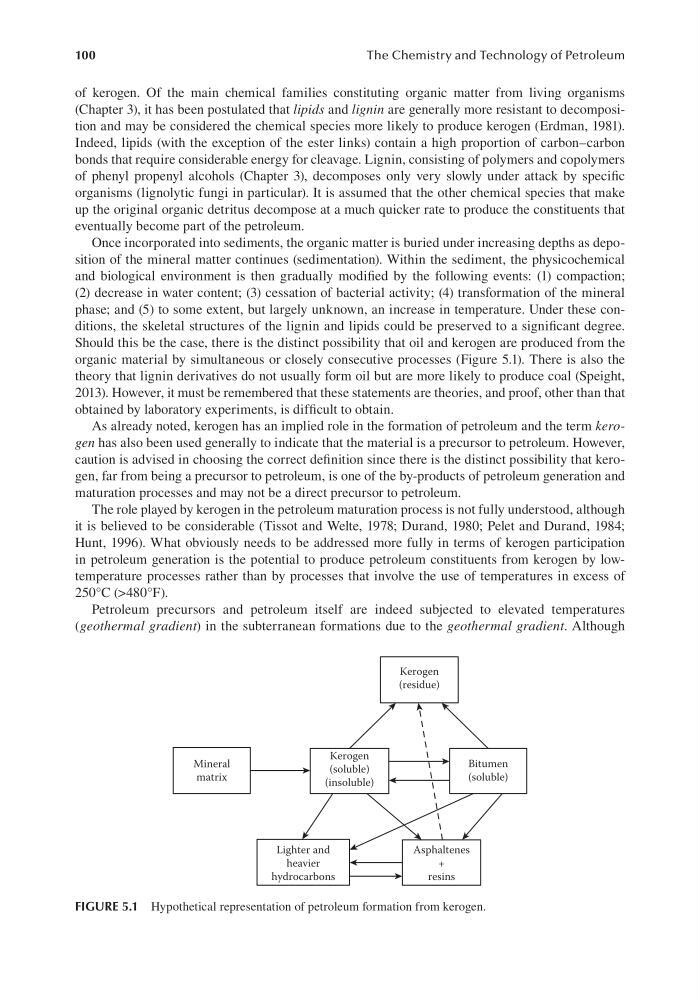
Should this be the case, there is the distinct possibility that oil and kerogen are produced from the
organic material by simultaneous or closely consecutive processes (Figure 5.1). There is also the
theory that lignin derivatives do not usually form oil but are more likely to produce coal (Speight,
2013). However, it must be remembered that these statements are theories, and proof, other than that
obtained by laboratory experiments, is difficult to obtain.
As already noted, kerogen has an implied role in the formation of petroleum and the term kerogen has also been used generally to indicate that the material is a precursor to petroleum. However,
caution is advised in choosing the correct definition since there is the distinct possibility that kerogen, far from being a precursor to petroleum, is one of the by-products of petroleum generation and
maturation processes and may not be a direct precursor to petroleum.
The role played by kerogen in the petroleum maturation process is not fully understood, although
it is believed to be considerable (Tissot and Welte, 1978; Durand, 1980; Pelet and Durand, 1984;
Hunt, 1996). What obviously needs to be addressed more fully in terms of kerogen participation
in petroleum generation is the potential to produce petroleum constituents from kerogen by lowtemperature processes rather than by processes that involve the use of temperatures in excess of
250°C (>480°F).
Petroleum precursors and petroleum itself are indeed subjected to elevated temperatures
(geothermal gradient) in the subterranean formations due to the geothermal gradient. Although
Kerogen
(residue)
Bitumen
(soluble)
Asphaltenes
+
resins
Kerogen
(soluble)
(insoluble)
Lighter and
heavier
hydrocarbons
Mineral
matrix
FIGURE 5.1 Hypothetical representation of petroleum formation from kerogen.
The Chemistry and Technology of Petroleum
of kerogen. Of the main chemical families constituting organic matter from living organisms
(Chapter 3), it has been postulated that lipids and lignin are generally more resistant to decomposition and may be considered the chemical species more likely to produce kerogen (Erdman, 1981).
Indeed, lipids (with the exception of the ester links) contain a high proportion of carbon–carbon
bonds that require considerable energy for cleavage. Lignin, consisting of polymers and copolymers
of phenyl propenyl alcohols (Chapter 3), decomposes only very slowly under attack by specific
organisms (lignolytic fungi in particular). It is assumed that the other chemical species that make
up the original organic detritus decompose at a much quicker rate to produce the constituents that
eventually become part of the petroleum.
Once incorporated into sediments, the organic matter is buried under increasing depths as deposition of the mineral matter continues (sedimentation). Within the sediment, the physicochemical
and biological environment is then gradually modified by the following events: (1) compaction;
(2) decrease in water content; (3) cessation of bacterial activity; (4) transformation of the mineral
phase; and (5) to some extent, but largely unknown, an increase in temperature. Under these conditions, the skeletal structures of the lignin and lipids could be preserved to a significant degree.
Should this be the case, there is the distinct possibility that oil and kerogen are produced from the
organic material by simultaneous or closely consecutive processes (Figure 5.1). There is also the
theory that lignin derivatives do not usually form oil but are more likely to produce coal (Speight,
2013). However, it must be remembered that these statements are theories, and proof, other than that
obtained by laboratory experiments, is difficult to obtain.
As already noted, kerogen has an implied role in the formation of petroleum and the term kerogen has also been used generally to indicate that the material is a precursor to petroleum. However,
caution is advised in choosing the correct definition since there is the distinct possibility that kerogen, far from being a precursor to petroleum, is one of the by-products of petroleum generation and
maturation processes and may not be a direct precursor to petroleum.
The role played by kerogen in the petroleum maturation process is not fully understood, although
it is believed to be considerable (Tissot and Welte, 1978; Durand, 1980; Pelet and Durand, 1984;
Hunt, 1996). What obviously needs to be addressed more fully in terms of kerogen participation
in petroleum generation is the potential to produce petroleum constituents from kerogen by lowtemperature processes rather than by processes that involve the use of temperatures in excess of
250°C (>480°F).
Petroleum precursors and petroleum itself are indeed subjected to elevated temperatures
(geothermal gradient) in the subterranean formations due to the geothermal gradient. Although
Kerogen
(residue)
Bitumen
(soluble)
Asphaltenes
+
resins
Kerogen
(soluble)
(insoluble)
Lighter and
heavier
hydrocarbons
Mineral
matrix
FIGURE 5.1 Hypothetical representation of petroleum formation from kerogen.