

94
The Chemistry and Technology of Petroleum
For any one sample the boiling point elevation is determined at a series of concentrations of
solute. Such determinations were carried out in practice by comparing the boiling point of pure
solvent, measured in an ebulliometer, with the boiling points, determined in a second ebulliometer,
of a series of solutions prepared by adding successive portions of the sample to the solvent. The first
ebulliometer serves as the control experiment.
In order to determine the ebullioscopic constant K, which depends not only on the solvent used
but also to a certain extent on the construction of the apparatus and the procedure followed, a series
of determinations is carried out on a pure hydrocarbon of known molecular weight, preferably of the
same order of magnitude as the molecular weight under investigation. The ebullioscopic constant
calculated for each concentration is plotted on a graph, just as in the case of a molecular weight
determination, and is extrapolated to zero concentration.
Before attempting to measure molecular weights, care should be taken to ensure that the oil
sample does not contain water or volatile components (boiling below 200°C, 392°F) because this
would invalidate the basic calculation.
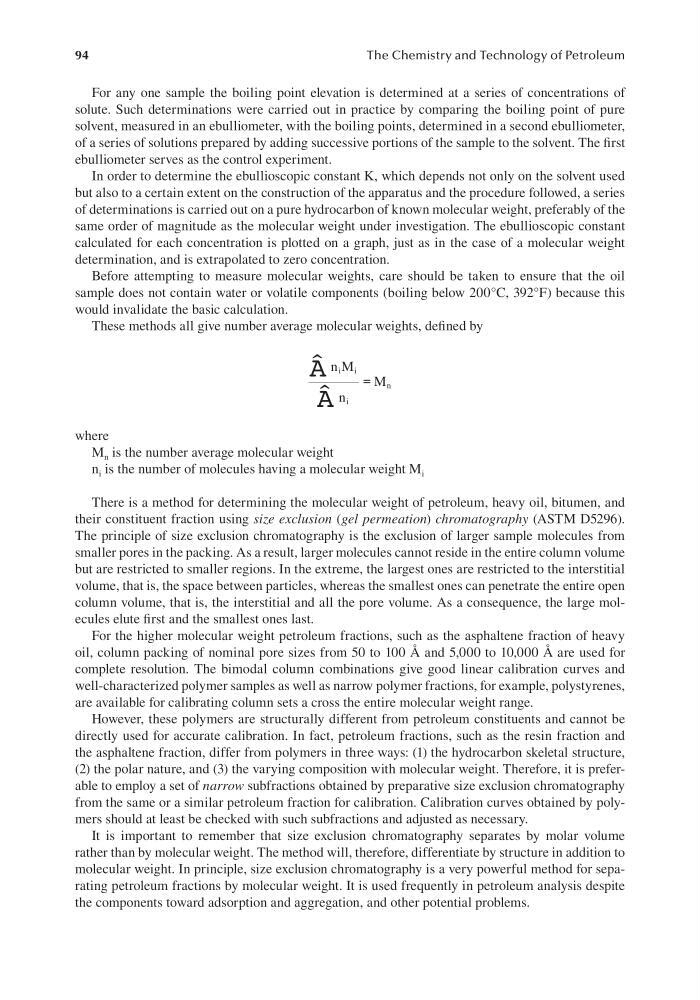
These methods all give number average molecular weights, defined by
n M
n
M
i
i
i
n
Â
Â
=
where
M n is the number average molecular weight
n i is the number of molecules having a molecular weight M i
There is a method for determining the molecular weight of petroleum, heavy oil, bitumen, and
their constituent fraction using size exclusion (gel permeation) chromatography (ASTM D5296).
The principle of size exclusion chromatography is the exclusion of larger sample molecules from
smaller pores in the packing. As a result, larger molecules cannot reside in the entire column volume
but are restricted to smaller regions. In the extreme, the largest ones are restricted to the interstitial
volume, that is, the space between particles, whereas the smallest ones can penetrate the entire open
column volume, that is, the interstitial and all the pore volume. As a consequence, the large molecules elute first and the smallest ones last.
For the higher molecular weight petroleum fractions, such as the asphaltene fraction of heavy
oil, column packing of nominal pore sizes from 50 to 100 Å and 5,000 to 10,000 Å are used for
complete resolution. The bimodal column combinations give good linear calibration curves and
well-characterized polymer samples as well as narrow polymer fractions, for example, polystyrenes,
are available for calibrating column sets a cross the entire molecular weight range.
However, these polymers are structurally different from petroleum constituents and cannot be
directly used for accurate calibration. In fact, petroleum fractions, such as the resin fraction and
the asphaltene fraction, differ from polymers in three ways: (1) the hydrocarbon skeletal structure,
(2) the polar nature, and (3) the varying composition with molecular weight. Therefore, it is preferable to employ a set of narrow subfractions obtained by preparative size exclusion chromatography
from the same or a similar petroleum fraction for calibration. Calibration curves obtained by polymers should at least be checked with such subfractions and adjusted as necessary.
It is important to remember that size exclusion chromatography separates by molar volume
rather than by molecular weight. The method will, therefore, differentiate by structure in addition to
molecular weight. In principle, size exclusion chromatography is a very powerful method for separating petroleum fractions by molecular weight. It is used frequently in petroleum analysis despite
the components toward adsorption and aggregation, and other potential problems.
The Chemistry and Technology of Petroleum
For any one sample the boiling point elevation is determined at a series of concentrations of
solute. Such determinations were carried out in practice by comparing the boiling point of pure
solvent, measured in an ebulliometer, with the boiling points, determined in a second ebulliometer,
of a series of solutions prepared by adding successive portions of the sample to the solvent. The first
ebulliometer serves as the control experiment.
In order to determine the ebullioscopic constant K, which depends not only on the solvent used
but also to a certain extent on the construction of the apparatus and the procedure followed, a series
of determinations is carried out on a pure hydrocarbon of known molecular weight, preferably of the
same order of magnitude as the molecular weight under investigation. The ebullioscopic constant
calculated for each concentration is plotted on a graph, just as in the case of a molecular weight
determination, and is extrapolated to zero concentration.
Before attempting to measure molecular weights, care should be taken to ensure that the oil
sample does not contain water or volatile components (boiling below 200°C, 392°F) because this
would invalidate the basic calculation.
These methods all give number average molecular weights, defined by
n M
n
M
i
i
i
n
Â
Â
=
where
M n is the number average molecular weight
n i is the number of molecules having a molecular weight M i
There is a method for determining the molecular weight of petroleum, heavy oil, bitumen, and
their constituent fraction using size exclusion (gel permeation) chromatography (ASTM D5296).
The principle of size exclusion chromatography is the exclusion of larger sample molecules from
smaller pores in the packing. As a result, larger molecules cannot reside in the entire column volume
but are restricted to smaller regions. In the extreme, the largest ones are restricted to the interstitial
volume, that is, the space between particles, whereas the smallest ones can penetrate the entire open
column volume, that is, the interstitial and all the pore volume. As a consequence, the large molecules elute first and the smallest ones last.
For the higher molecular weight petroleum fractions, such as the asphaltene fraction of heavy
oil, column packing of nominal pore sizes from 50 to 100 Å and 5,000 to 10,000 Å are used for
complete resolution. The bimodal column combinations give good linear calibration curves and
well-characterized polymer samples as well as narrow polymer fractions, for example, polystyrenes,
are available for calibrating column sets a cross the entire molecular weight range.
However, these polymers are structurally different from petroleum constituents and cannot be
directly used for accurate calibration. In fact, petroleum fractions, such as the resin fraction and
the asphaltene fraction, differ from polymers in three ways: (1) the hydrocarbon skeletal structure,
(2) the polar nature, and (3) the varying composition with molecular weight. Therefore, it is preferable to employ a set of narrow subfractions obtained by preparative size exclusion chromatography
from the same or a similar petroleum fraction for calibration. Calibration curves obtained by polymers should at least be checked with such subfractions and adjusted as necessary.
It is important to remember that size exclusion chromatography separates by molar volume
rather than by molecular weight. The method will, therefore, differentiate by structure in addition to
molecular weight. In principle, size exclusion chromatography is a very powerful method for separating petroleum fractions by molecular weight. It is used frequently in petroleum analysis despite
the components toward adsorption and aggregation, and other potential problems.