

92
The Chemistry and Technology of Petroleum
solvent, solvent from the chamber atmosphere will condense on it. The difference in vapor pressure
is proportional to its sample concentration. The heat of condensation warms the solution drop until
its vapor pressure is the same as that of the surroundings. From then on, a steady state of condensation and warming is established. The temperature increase is measured and recorded. The solvent
drop on the other thermistor is in equilibrium with the solvent in the chamber and, theoretically,
gives no temperature effect. In reality, convection and other effects cause minute disturbances in the
system, the effect of which can be minimized by subtracting the voltage of the solvent thermistor
from that of the solution thermistor.
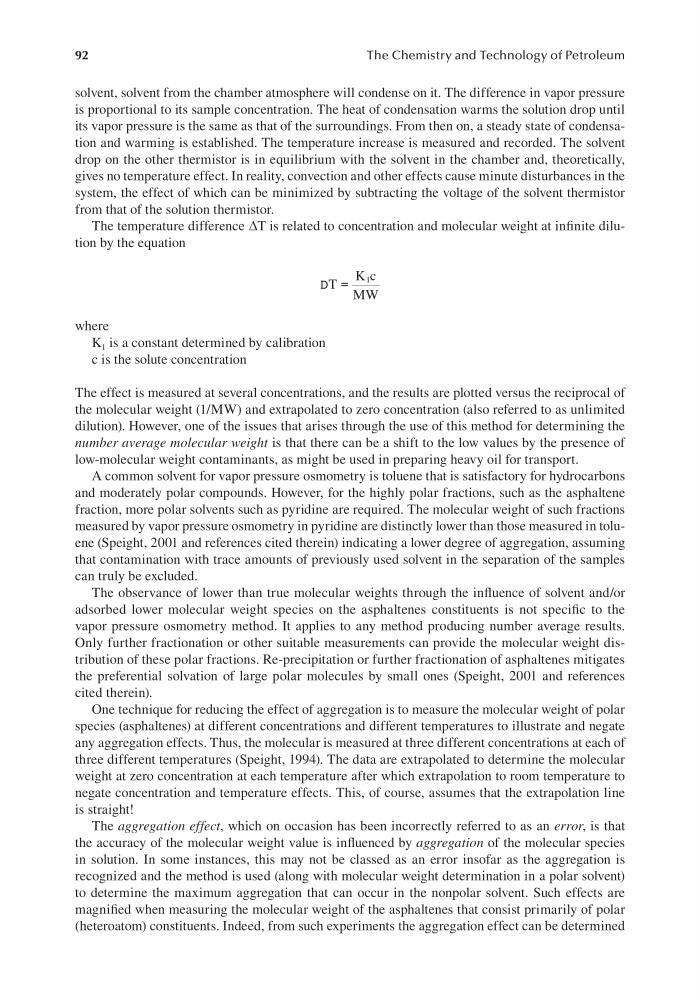
The temperature difference ∆T is related to concentration and molecular weight at infinite dilution by the equation
DT
K c
MW
1
=
where
K 1 is a constant determined by calibration
c is the solute concentration
The effect is measured at several concentrations, and the results are plotted versus the reciprocal of
the molecular weight (1/MW) and extrapolated to zero concentration (also referred to as unlimited
dilution). However, one of the issues that arises through the use of this method for determining the
number average molecular weight is that there can be a shift to the low values by the presence of
low-molecular weight contaminants, as might be used in preparing heavy oil for transport.
A common solvent for vapor pressure osmometry is toluene that is satisfactory for hydrocarbons
and moderately polar compounds. However, for the highly polar fractions, such as the asphaltene
fraction, more polar solvents such as pyridine are required. The molecular weight of such fractions
measured by vapor pressure osmometry in pyridine are distinctly lower than those measured in toluene (Speight, 2001 and references cited therein) indicating a lower degree of aggregation, assuming
that contamination with trace amounts of previously used solvent in the separation of the samples
can truly be excluded.
The observance of lower than true molecular weights through the influence of solvent and/or
adsorbed lower molecular weight species on the asphaltenes constituents is not specific to the
vapor pressure osmometry method. It applies to any method producing number average results.
Only further fractionation or other suitable measurements can provide the molecular weight distribution of these polar fractions. Re-precipitation or further fractionation of asphaltenes mitigates
the preferential solvation of large polar molecules by small ones (Speight, 2001 and references
cited therein).
One technique for reducing the effect of aggregation is to measure the molecular weight of polar
species (asphaltenes) at different concentrations and different temperatures to illustrate and negate
any aggregation effects. Thus, the molecular is measured at three different concentrations at each of
three different temperatures (Speight, 1994). The data are extrapolated to determine the molecular
weight at zero concentration at each temperature after which extrapolation to room temperature to
negate concentration and temperature effects. This, of course, assumes that the extrapolation line
is straight!
The aggregation effect, which on occasion has been incorrectly referred to as an error, is that
the accuracy of the molecular weight value is influenced by aggregation of the molecular species
in solution. In some instances, this may not be classed as an error insofar as the aggregation is
recognized and the method is used (along with molecular weight determination in a polar solvent)
to determine the maximum aggregation that can occur in the nonpolar solvent. Such effects are
magnified when measuring the molecular weight of the asphaltenes that consist primarily of polar
(heteroatom) constituents. Indeed, from such experiments the aggregation effect can be determined
The Chemistry and Technology of Petroleum
solvent, solvent from the chamber atmosphere will condense on it. The difference in vapor pressure
is proportional to its sample concentration. The heat of condensation warms the solution drop until
its vapor pressure is the same as that of the surroundings. From then on, a steady state of condensation and warming is established. The temperature increase is measured and recorded. The solvent
drop on the other thermistor is in equilibrium with the solvent in the chamber and, theoretically,
gives no temperature effect. In reality, convection and other effects cause minute disturbances in the
system, the effect of which can be minimized by subtracting the voltage of the solvent thermistor
from that of the solution thermistor.
The temperature difference ∆T is related to concentration and molecular weight at infinite dilution by the equation
DT
K c
MW
1
=
where
K 1 is a constant determined by calibration
c is the solute concentration
The effect is measured at several concentrations, and the results are plotted versus the reciprocal of
the molecular weight (1/MW) and extrapolated to zero concentration (also referred to as unlimited
dilution). However, one of the issues that arises through the use of this method for determining the
number average molecular weight is that there can be a shift to the low values by the presence of
low-molecular weight contaminants, as might be used in preparing heavy oil for transport.
A common solvent for vapor pressure osmometry is toluene that is satisfactory for hydrocarbons
and moderately polar compounds. However, for the highly polar fractions, such as the asphaltene
fraction, more polar solvents such as pyridine are required. The molecular weight of such fractions
measured by vapor pressure osmometry in pyridine are distinctly lower than those measured in toluene (Speight, 2001 and references cited therein) indicating a lower degree of aggregation, assuming
that contamination with trace amounts of previously used solvent in the separation of the samples
can truly be excluded.
The observance of lower than true molecular weights through the influence of solvent and/or
adsorbed lower molecular weight species on the asphaltenes constituents is not specific to the
vapor pressure osmometry method. It applies to any method producing number average results.
Only further fractionation or other suitable measurements can provide the molecular weight distribution of these polar fractions. Re-precipitation or further fractionation of asphaltenes mitigates
the preferential solvation of large polar molecules by small ones (Speight, 2001 and references
cited therein).
One technique for reducing the effect of aggregation is to measure the molecular weight of polar
species (asphaltenes) at different concentrations and different temperatures to illustrate and negate
any aggregation effects. Thus, the molecular is measured at three different concentrations at each of
three different temperatures (Speight, 1994). The data are extrapolated to determine the molecular
weight at zero concentration at each temperature after which extrapolation to room temperature to
negate concentration and temperature effects. This, of course, assumes that the extrapolation line
is straight!
The aggregation effect, which on occasion has been incorrectly referred to as an error, is that
the accuracy of the molecular weight value is influenced by aggregation of the molecular species
in solution. In some instances, this may not be classed as an error insofar as the aggregation is
recognized and the method is used (along with molecular weight determination in a polar solvent)
to determine the maximum aggregation that can occur in the nonpolar solvent. Such effects are
magnified when measuring the molecular weight of the asphaltenes that consist primarily of polar
(heteroatom) constituents. Indeed, from such experiments the aggregation effect can be determined