

for the riverbank ecosystem for both floral and fauna (Bennie et al. 2016). Riverbank ecosystems
are important to humans; the loss of ecosystems in riverbank areas will cause the loss of aesthetic,
economic, recreational, and other characteristics that have human value (National Research Council
2002). Another disadvantage for the ecosystem is changes in the food chain that occur in riverbank
areas, so that the balance of the ecosystem is disturbed (Manfrin et al. 2017). With the destruction
of the food chain, it will directly affect humans. In fact, research from several places in the river area
shows that the breakdown of the food chain will cause the growth of algae, and in worst conditions
the river oxygen levels decrease and damage fish habitats, causing an unpleasant odor (Longcore &
Rich 2016). This, of course, will have an impact on humans by losing the economic and recreational
aspect. In terms of area coverage, this park is not too large, so that artificial lighting that occurs at
night will have a significant impact on the riverbank ecosystem (Longcore & Rich 2016).
The purpose of this study is to provide an evaluation and solution to the lighting design at Teras
Cikapundung in relation to its function as a conservation area. Evaluation and solution are to be
met in terms of armature selection, and color spectrum of the light used in relation to the balance
of the garden’s functions as nature conservation.
2 RESEARCH METHODOLGY
The research method used is comparative observation. Observations were made by paying attention
to the type of luminaire, light color temperature in each luminaire, lighting control device, and its
light distribution. The results from these observations are then compared with lighting standards
for environmental conservation. This research method is used to provide an evaluation of lighting
and the impact that occurs in this park in the field of conservation so that it is expected to provide
improvements in the future.
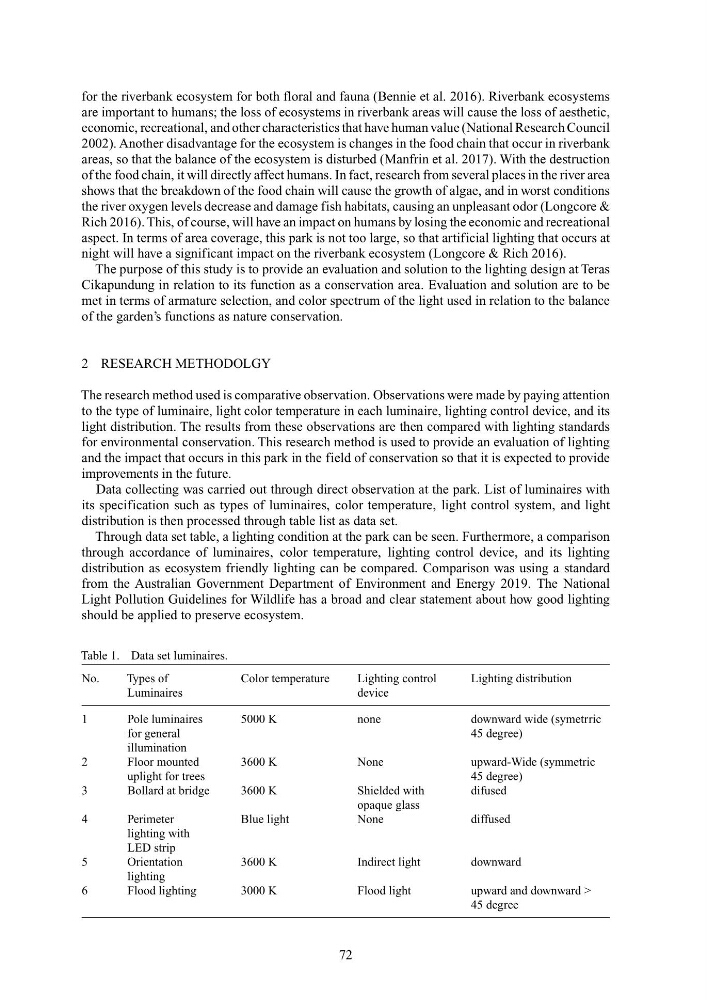
Data collecting was carried out through direct observation at the park. List of luminaires with
its specification such as types of luminaires, color temperature, light control system, and light
distribution is then processed through table list as data set.
Through data set table, a lighting condition at the park can be seen. Furthermore, a comparison
through accordance of luminaires, color temperature, lighting control device, and its lighting
distribution as ecosystem friendly lighting can be compared. Comparison was using a standard
from the Australian Government Department of Environment and Energy 2019. The National
Light Pollution Guidelines for Wildlife has a broad and clear statement about how good lighting
should be applied to preserve ecosystem.
Table 1. Data set luminaires.
No.
Types of
Luminaires
Color temperature
Lighting control
device
Lighting distribution
1
Pole luminaires
for general
illumination
5000 K
none
downward wide (symetrric
45 degree)
2
Floor mounted
uplight for trees
3600 K
None
upward-Wide (symmetric
45 degree)
3
Bollard at bridge
3600 K
Shielded with
opaque glass
difused
4
Perimeter
lighting with
LED strip
Blue light
None
diffused
5
Orientation
lighting
3600 K
Indirect light
downward
6
Flood lighting
3000 K
Flood light
upward and downward >
45 degree
72
are important to humans; the loss of ecosystems in riverbank areas will cause the loss of aesthetic,
economic, recreational, and other characteristics that have human value (National Research Council
2002). Another disadvantage for the ecosystem is changes in the food chain that occur in riverbank
areas, so that the balance of the ecosystem is disturbed (Manfrin et al. 2017). With the destruction
of the food chain, it will directly affect humans. In fact, research from several places in the river area
shows that the breakdown of the food chain will cause the growth of algae, and in worst conditions
the river oxygen levels decrease and damage fish habitats, causing an unpleasant odor (Longcore &
Rich 2016). This, of course, will have an impact on humans by losing the economic and recreational
aspect. In terms of area coverage, this park is not too large, so that artificial lighting that occurs at
night will have a significant impact on the riverbank ecosystem (Longcore & Rich 2016).
The purpose of this study is to provide an evaluation and solution to the lighting design at Teras
Cikapundung in relation to its function as a conservation area. Evaluation and solution are to be
met in terms of armature selection, and color spectrum of the light used in relation to the balance
of the garden’s functions as nature conservation.
2 RESEARCH METHODOLGY
The research method used is comparative observation. Observations were made by paying attention
to the type of luminaire, light color temperature in each luminaire, lighting control device, and its
light distribution. The results from these observations are then compared with lighting standards
for environmental conservation. This research method is used to provide an evaluation of lighting
and the impact that occurs in this park in the field of conservation so that it is expected to provide
improvements in the future.
Data collecting was carried out through direct observation at the park. List of luminaires with
its specification such as types of luminaires, color temperature, light control system, and light
distribution is then processed through table list as data set.
Through data set table, a lighting condition at the park can be seen. Furthermore, a comparison
through accordance of luminaires, color temperature, lighting control device, and its lighting
distribution as ecosystem friendly lighting can be compared. Comparison was using a standard
from the Australian Government Department of Environment and Energy 2019. The National
Light Pollution Guidelines for Wildlife has a broad and clear statement about how good lighting
should be applied to preserve ecosystem.
Table 1. Data set luminaires.
No.
Types of
Luminaires
Color temperature
Lighting control
device
Lighting distribution
1
Pole luminaires
for general
illumination
5000 K
none
downward wide (symetrric
45 degree)
2
Floor mounted
uplight for trees
3600 K
None
upward-Wide (symmetric
45 degree)
3
Bollard at bridge
3600 K
Shielded with
opaque glass
difused
4
Perimeter
lighting with
LED strip
Blue light
None
diffused
5
Orientation
lighting
3600 K
Indirect light
downward
6
Flood lighting
3000 K
Flood light
upward and downward >
45 degree
72