

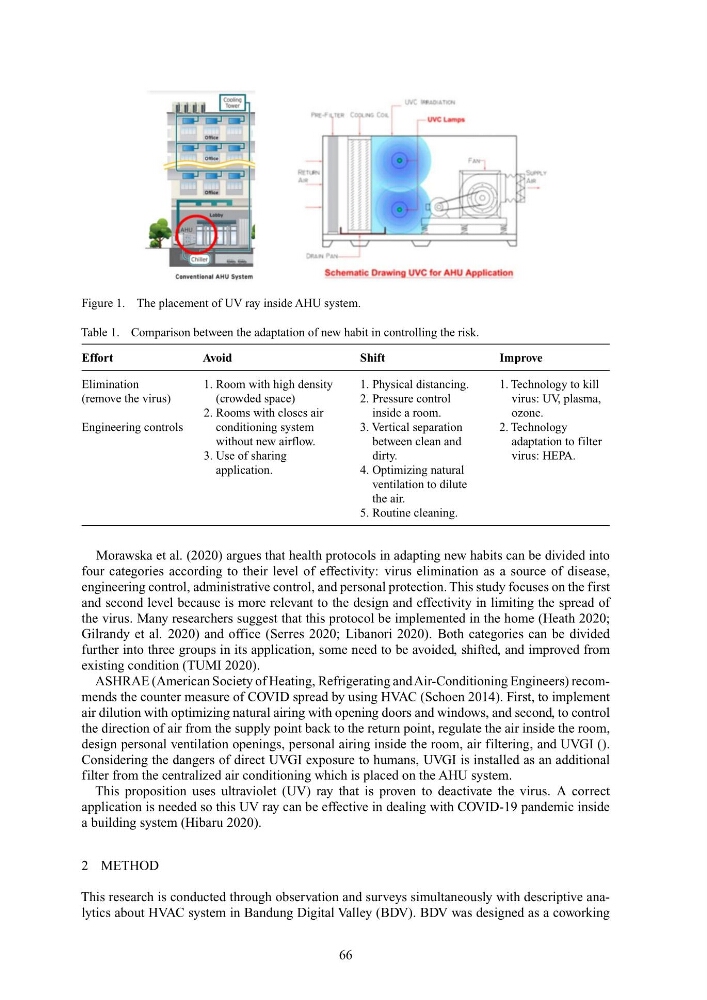
Figure 1. The placement of UV ray inside AHU system.
Table 1. Comparison between the adaptation of new habit in controlling the risk.
Effort
Avoid
Shift
Improve
Elimination
(remove the virus)
Engineering controls
1. Room with high density
(crowded space)
2. Rooms with closes air
conditioning system
without new airflow.
3. Use of sharing
application.
1. Physical distancing.
2. Pressure control
inside a room.
3. Vertical separation
between clean and
dirty.
4. Optimizing natural
ventilation to dilute
the air.
5. Routine cleaning.
1. Technology to kill
virus: UV, plasma,
ozone.
2. Technology
adaptation to filter
virus: HEPA.
Morawska et al. (2020) argues that health protocols in adapting new habits can be divided into
four categories according to their level of effectivity: virus elimination as a source of disease,
engineering control, administrative control, and personal protection. This study focuses on the first
and second level because is more relevant to the design and effectivity in limiting the spread of
the virus. Many researchers suggest that this protocol be implemented in the home (Heath 2020;
Gilrandy et al. 2020) and office (Serres 2020; Libanori 2020). Both categories can be divided
further into three groups in its application, some need to be avoided, shifted, and improved from
existing condition (TUMI 2020).
ASHRAE (American Society of Heating, Refrigerating and Air-Conditioning Engineers) recommends the counter measure of COVID spread by using HVAC (Schoen 2014). First, to implement
air dilution with optimizing natural airing with opening doors and windows, and second, to control
the direction of air from the supply point back to the return point, regulate the air inside the room,
design personal ventilation openings, personal airing inside the room, air filtering, and UVGI ().
Considering the dangers of direct UVGI exposure to humans, UVGI is installed as an additional
filter from the centralized air conditioning which is placed on the AHU system.
This proposition uses ultraviolet (UV) ray that is proven to deactivate the virus. A correct
application is needed so this UV ray can be effective in dealing with COVID-19 pandemic inside
a building system (Hibaru 2020).
2 METHOD
This research is conducted through observation and surveys simultaneously with descriptive analytics about HVAC system in Bandung Digital Valley (BDV). BDV was designed as a coworking
66
Table 1. Comparison between the adaptation of new habit in controlling the risk.
Effort
Avoid
Shift
Improve
Elimination
(remove the virus)
Engineering controls
1. Room with high density
(crowded space)
2. Rooms with closes air
conditioning system
without new airflow.
3. Use of sharing
application.
1. Physical distancing.
2. Pressure control
inside a room.
3. Vertical separation
between clean and
dirty.
4. Optimizing natural
ventilation to dilute
the air.
5. Routine cleaning.
1. Technology to kill
virus: UV, plasma,
ozone.
2. Technology
adaptation to filter
virus: HEPA.
Morawska et al. (2020) argues that health protocols in adapting new habits can be divided into
four categories according to their level of effectivity: virus elimination as a source of disease,
engineering control, administrative control, and personal protection. This study focuses on the first
and second level because is more relevant to the design and effectivity in limiting the spread of
the virus. Many researchers suggest that this protocol be implemented in the home (Heath 2020;
Gilrandy et al. 2020) and office (Serres 2020; Libanori 2020). Both categories can be divided
further into three groups in its application, some need to be avoided, shifted, and improved from
existing condition (TUMI 2020).
ASHRAE (American Society of Heating, Refrigerating and Air-Conditioning Engineers) recommends the counter measure of COVID spread by using HVAC (Schoen 2014). First, to implement
air dilution with optimizing natural airing with opening doors and windows, and second, to control
the direction of air from the supply point back to the return point, regulate the air inside the room,
design personal ventilation openings, personal airing inside the room, air filtering, and UVGI ().
Considering the dangers of direct UVGI exposure to humans, UVGI is installed as an additional
filter from the centralized air conditioning which is placed on the AHU system.
This proposition uses ultraviolet (UV) ray that is proven to deactivate the virus. A correct
application is needed so this UV ray can be effective in dealing with COVID-19 pandemic inside
a building system (Hibaru 2020).
2 METHOD
This research is conducted through observation and surveys simultaneously with descriptive analytics about HVAC system in Bandung Digital Valley (BDV). BDV was designed as a coworking
66