

2 METHOD
Based on the design process, there are three steps, as shown in the research method phase (Wang
et al. 2013)
1. Identification: in this stage, extracting features from an original object,
2. Translation: in this stage, transforming object elements into design elements, principles,
technique
3. Implementation: in the last stage, designing the product
2.1 Data collection
The data collection method in this study is observation and experiment. Through the direct field
observation method to the Muslim fashion events or Muslim market place in Indonesia both online
and on-site, the focus was on how decorative elements in Muslim fashion products were made.
Using visual references to generate ideas is a way to get source information, and it is not the same
as copying. It is important to take the information and develop and transform it (Purcell 2005).
Based on the Hijrah phenomenon, Muslim celebrities and Indonesian Muslim fashion designers
play a role in increasing public interest in using fashionable products. Therefore, the design process
begins with the determination of fashion icons and determining the inspiration derived from the
form of flower (Gaimster 2011). The determination of the inspiration at this stage is based on
observations made other than that flower has a symbolic and meaningful relation to the women
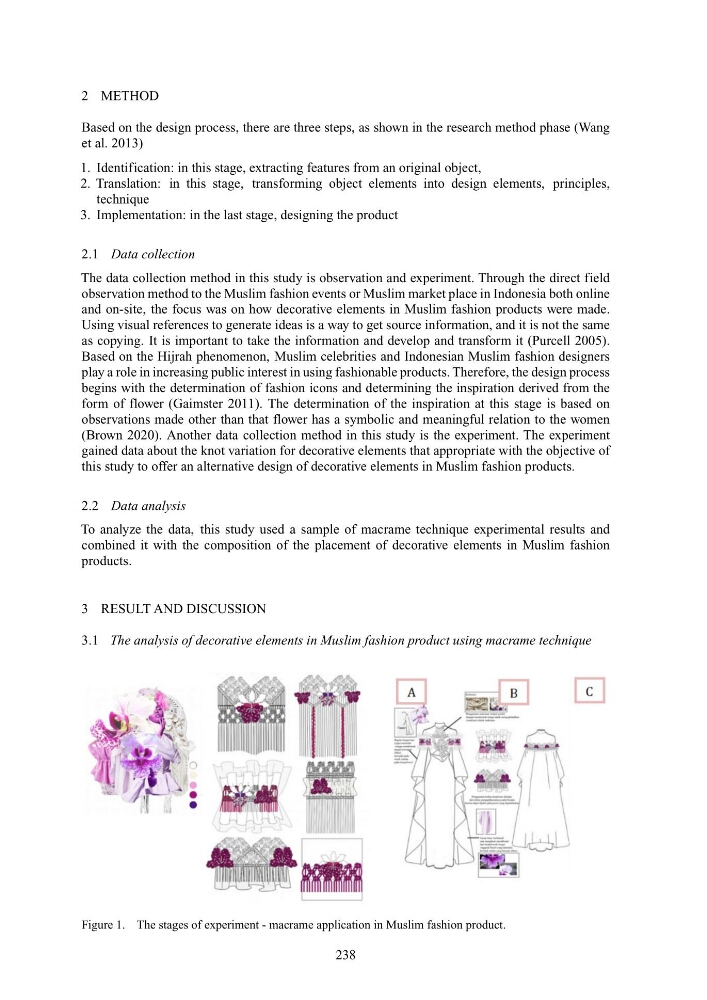
(Brown 2020). Another data collection method in this study is the experiment. The experiment
gained data about the knot variation for decorative elements that appropriate with the objective of
this study to offer an alternative design of decorative elements in Muslim fashion products.
2.2 Data analysis
To analyze the data, this study used a sample of macrame technique experimental results and
combined it with the composition of the placement of decorative elements in Muslim fashion
products.
3 RESULT AND DISCUSSION
3.1 The analysis of decorative elements in Muslim fashion product using macrame technique
Figure 1. The stages of experiment - macrame application in Muslim fashion product.
238
Based on the design process, there are three steps, as shown in the research method phase (Wang
et al. 2013)
1. Identification: in this stage, extracting features from an original object,
2. Translation: in this stage, transforming object elements into design elements, principles,
technique
3. Implementation: in the last stage, designing the product
2.1 Data collection
The data collection method in this study is observation and experiment. Through the direct field
observation method to the Muslim fashion events or Muslim market place in Indonesia both online
and on-site, the focus was on how decorative elements in Muslim fashion products were made.
Using visual references to generate ideas is a way to get source information, and it is not the same
as copying. It is important to take the information and develop and transform it (Purcell 2005).
Based on the Hijrah phenomenon, Muslim celebrities and Indonesian Muslim fashion designers
play a role in increasing public interest in using fashionable products. Therefore, the design process
begins with the determination of fashion icons and determining the inspiration derived from the
form of flower (Gaimster 2011). The determination of the inspiration at this stage is based on
observations made other than that flower has a symbolic and meaningful relation to the women
(Brown 2020). Another data collection method in this study is the experiment. The experiment
gained data about the knot variation for decorative elements that appropriate with the objective of
this study to offer an alternative design of decorative elements in Muslim fashion products.
2.2 Data analysis
To analyze the data, this study used a sample of macrame technique experimental results and
combined it with the composition of the placement of decorative elements in Muslim fashion
products.
3 RESULT AND DISCUSSION
3.1 The analysis of decorative elements in Muslim fashion product using macrame technique
Figure 1. The stages of experiment - macrame application in Muslim fashion product.
238