

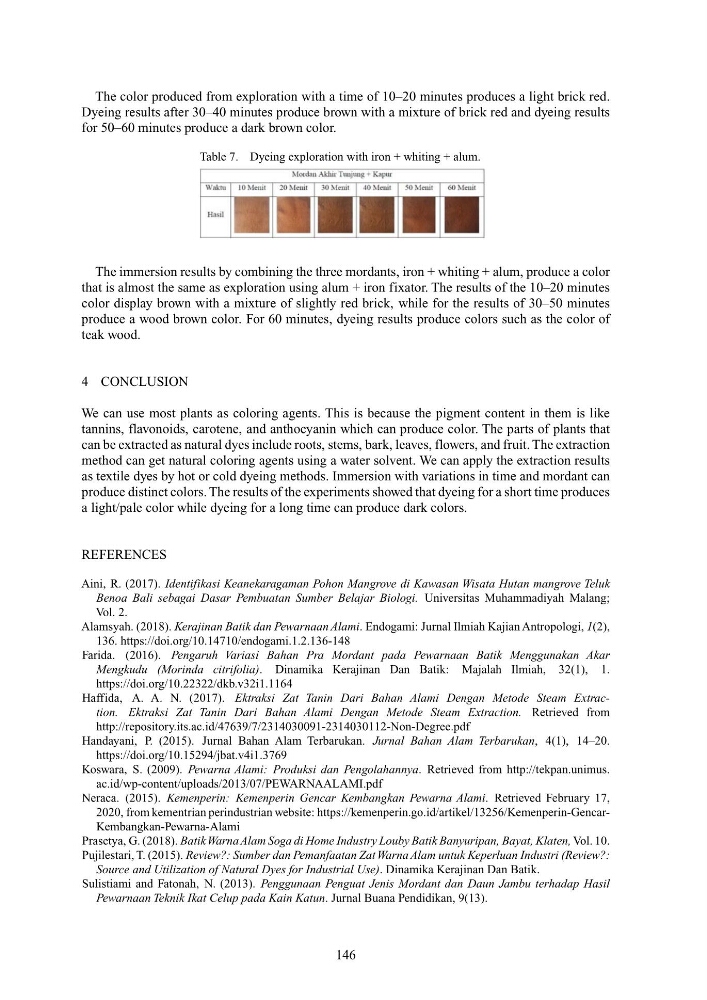
The color produced from exploration with a time of 10–20 minutes produces a light brick red.
Dyeing results after 30–40 minutes produce brown with a mixture of brick red and dyeing results
for 50–60 minutes produce a dark brown color.
Table 7. Dyeing exploration with iron + whiting + alum.
The immersion results by combining the three mordants, iron + whiting + alum, produce a color
that is almost the same as exploration using alum + iron fixator. The results of the 10–20 minutes
color display brown with a mixture of slightly red brick, while for the results of 30–50 minutes
produce a wood brown color. For 60 minutes, dyeing results produce colors such as the color of
teak wood.
4 CONCLUSION
We can use most plants as coloring agents. This is because the pigment content in them is like
tannins, flavonoids, carotene, and anthocyanin which can produce color. The parts of plants that
can be extracted as natural dyes include roots, stems, bark, leaves, flowers, and fruit. The extraction
method can get natural coloring agents using a water solvent. We can apply the extraction results
as textile dyes by hot or cold dyeing methods. Immersion with variations in time and mordant can
produce distinct colors. The results of the experiments showed that dyeing for a short time produces
a light/pale color while dyeing for a long time can produce dark colors.
REFERENCES
Aini, R. (2017). Identifikasi Keanekaragaman Pohon Mangrove di Kawasan Wisata Hutan mangrove Teluk
Benoa Bali sebagai Dasar Pembuatan Sumber Belajar Biologi. Universitas Muhammadiyah Malang;
Vol. 2.
Alamsyah. (2018). Kerajinan Batik dan Pewarnaan Alami. Endogami: Jurnal Ilmiah Kajian Antropologi, 1(2),
136. https://doi.org/10.14710/endogami.1.2.136-148
Farida. (2016). Pengaruh Variasi Bahan Pra Mordant pada Pewarnaan Batik Menggunakan Akar
Mengkudu (Morinda citrifolia). Dinamika Kerajinan Dan Batik: Majalah Ilmiah, 32(1), 1.
https://doi.org/10.22322/dkb.v32i1.1164
Haffida, A. A. N. (2017). Ektraksi Zat Tanin Dari Bahan Alami Dengan Metode Steam Extraction. Ektraksi Zat Tanin Dari Bahan Alami Dengan Metode Steam Extraction. Retrieved from
http://repository.its.ac.id/47639/7/2314030091-2314030112-Non-Degree.pdf
Handayani, P. (2015). Jurnal Bahan Alam Terbarukan. Jurnal Bahan Alam Terbarukan, 4(1), 14–20.
https://doi.org/10.15294/jbat.v4i1.3769
Koswara, S. (2009). Pewarna Alami: Produksi dan Pengolahannya. Retrieved from http://tekpan.unimus.
ac.id/wp-content/uploads/2013/07/PEWARNAALAMI.pdf
Neraca. (2015). Kemenperin: Kemenperin Gencar Kembangkan Pewarna Alami. Retrieved February 17,
2020, from kementrian perindustrian website: https://kemenperin.go.id/artikel/13256/Kemenperin-GencarKembangkan-Pewarna-Alami
Prasetya, G. (2018). Batik Warna Alam Soga di Home Industry Louby Batik Banyuripan, Bayat, Klaten, Vol. 10.
Pujilestari, T. (2015). Review?: Sumber dan Pemanfaatan Zat Warna Alam untuk Keperluan Industri (Review?:
Source and Utilization of Natural Dyes for Industrial Use). Dinamika Kerajinan Dan Batik.
Sulistiami and Fatonah, N. (2013). Penggunaan Penguat Jenis Mordant dan Daun Jambu terhadap Hasil
Pewarnaan Teknik Ikat Celup pada Kain Katun. Jurnal Buana Pendidikan, 9(13).
146
Dyeing results after 30–40 minutes produce brown with a mixture of brick red and dyeing results
for 50–60 minutes produce a dark brown color.
Table 7. Dyeing exploration with iron + whiting + alum.
The immersion results by combining the three mordants, iron + whiting + alum, produce a color
that is almost the same as exploration using alum + iron fixator. The results of the 10–20 minutes
color display brown with a mixture of slightly red brick, while for the results of 30–50 minutes
produce a wood brown color. For 60 minutes, dyeing results produce colors such as the color of
teak wood.
4 CONCLUSION
We can use most plants as coloring agents. This is because the pigment content in them is like
tannins, flavonoids, carotene, and anthocyanin which can produce color. The parts of plants that
can be extracted as natural dyes include roots, stems, bark, leaves, flowers, and fruit. The extraction
method can get natural coloring agents using a water solvent. We can apply the extraction results
as textile dyes by hot or cold dyeing methods. Immersion with variations in time and mordant can
produce distinct colors. The results of the experiments showed that dyeing for a short time produces
a light/pale color while dyeing for a long time can produce dark colors.
REFERENCES
Aini, R. (2017). Identifikasi Keanekaragaman Pohon Mangrove di Kawasan Wisata Hutan mangrove Teluk
Benoa Bali sebagai Dasar Pembuatan Sumber Belajar Biologi. Universitas Muhammadiyah Malang;
Vol. 2.
Alamsyah. (2018). Kerajinan Batik dan Pewarnaan Alami. Endogami: Jurnal Ilmiah Kajian Antropologi, 1(2),
136. https://doi.org/10.14710/endogami.1.2.136-148
Farida. (2016). Pengaruh Variasi Bahan Pra Mordant pada Pewarnaan Batik Menggunakan Akar
Mengkudu (Morinda citrifolia). Dinamika Kerajinan Dan Batik: Majalah Ilmiah, 32(1), 1.
https://doi.org/10.22322/dkb.v32i1.1164
Haffida, A. A. N. (2017). Ektraksi Zat Tanin Dari Bahan Alami Dengan Metode Steam Extraction. Ektraksi Zat Tanin Dari Bahan Alami Dengan Metode Steam Extraction. Retrieved from
http://repository.its.ac.id/47639/7/2314030091-2314030112-Non-Degree.pdf
Handayani, P. (2015). Jurnal Bahan Alam Terbarukan. Jurnal Bahan Alam Terbarukan, 4(1), 14–20.
https://doi.org/10.15294/jbat.v4i1.3769
Koswara, S. (2009). Pewarna Alami: Produksi dan Pengolahannya. Retrieved from http://tekpan.unimus.
ac.id/wp-content/uploads/2013/07/PEWARNAALAMI.pdf
Neraca. (2015). Kemenperin: Kemenperin Gencar Kembangkan Pewarna Alami. Retrieved February 17,
2020, from kementrian perindustrian website: https://kemenperin.go.id/artikel/13256/Kemenperin-GencarKembangkan-Pewarna-Alami
Prasetya, G. (2018). Batik Warna Alam Soga di Home Industry Louby Batik Banyuripan, Bayat, Klaten, Vol. 10.
Pujilestari, T. (2015). Review?: Sumber dan Pemanfaatan Zat Warna Alam untuk Keperluan Industri (Review?:
Source and Utilization of Natural Dyes for Industrial Use). Dinamika Kerajinan Dan Batik.
Sulistiami and Fatonah, N. (2013). Penggunaan Penguat Jenis Mordant dan Daun Jambu terhadap Hasil
Pewarnaan Teknik Ikat Celup pada Kain Katun. Jurnal Buana Pendidikan, 9(13).
146