

The reason why this research connects with the COVID-19 pandemic is because of the philosophy
within the Lontong Tjap Go Meh itself. The origin of the rice cakes originally came from rice balls,
meaning of the family reunion. COVID-19 greatly changed social interactions, therefore many
families could not gather because of need to social distance in order to reduce and stop the spread
of the virus. That is why this animation project discusses the value of celebrating family gatherings
for the younger generations.
The philosophy in Lontong Tjap Go Meh sounds simple, but it is also complicated to describe
as the narration needs some deep cultural understanding because of the acculturations and lengthy
and complicated historical trivia. ;t is said that, for the Chinese, dishes are not only something that
is served for eating, but also play a role in diplomacy, friendship, as a cure for diseases, respect
for one’s ancestors, and also to avoid negative energy. It is a pity due to Soeharto’s New Order
Regime, which lasted over 30 years, that the Chinese Peranakan lost their relationship with their
ancestors’ cultural artifacts and values. Back then, not many Chinese Peranakan celebrated Tjap
Go Meh until 1999, when former president, Abdulrahman Wahid, changed Soeharto’s regulations
in the Indonesian–Chinese society. Because of that, the celebration of the Tjap Go Meh was merely
new for all children and teenagers who live after 1998.
Lontong Tjap Go Meh is one of the most famous Chinese Peranakan culinary dishes in Indonesia.
Everybody in Indonesia, especially the Chinese Peranakan community, knows the taste of this
unique dish well. Contrary to the dish, not everyone in Indonesia knows about the history and
origins behind the dish. In fact, even in China, there are no dishes similar to Lontong Tjap Go Meh
itself. Lontong Tjap Go Meh has similar components as Ketupat Lebaran, the famous dish served in
Idul Fitri celebrations. The dish contains solid steamed rice cakes mixed with chicken curry, which
is served with marrow slice, bean sprouts, fried shallots, and crackers. In Malaysia and Singapore,
the dish is very similar with their Laksa. The similar components and the philosophy with the
Ketupat Lebaran (which also did not exist in the Arab and other Middle Eastern countries, except
the curry) made the two dishes become parts of Indonesian people’s traditional culinary assets that
came from two different custom and religion’s assimilation. Some of stories of its origin state that
the two dishes were introduced by either Sunan Kalijagaone of the Muslim’s Nine apostles, or Wali
Sanga, who spread Islam in the Java Island. Sunan Kalijaga used the cultural and acculturation
approach during his missionary to spread Islam, such as Wayang Kulit/Shadow Puppet. The term
Tjap Go Meh itself refers to the Hokkian people’s celebration on the 15th day of the Lunar New
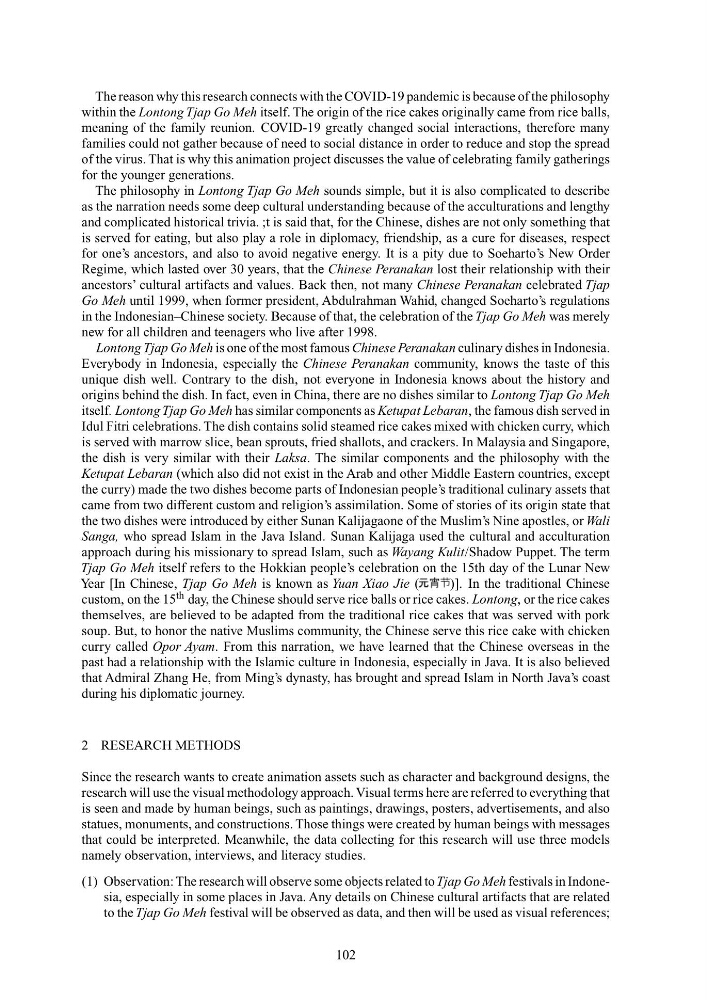
Year [In Chinese, Tjap Go Meh is known as Yuan Xiao Jie (
)]. In the traditional Chinese
custom, on the 15 th day, the Chinese should serve rice balls or rice cakes. Lontong, or the rice cakes
themselves, are believed to be adapted from the traditional rice cakes that was served with pork
soup. But, to honor the native Muslims community, the Chinese serve this rice cake with chicken
curry called Opor Ayam. From this narration, we have learned that the Chinese overseas in the
past had a relationship with the Islamic culture in Indonesia, especially in Java. It is also believed
that Admiral Zhang He, from Ming’s dynasty, has brought and spread Islam in North Java’s coast
during his diplomatic journey.
2 RESEARCH METHODS
Since the research wants to create animation assets such as character and background designs, the
research will use the visual methodology approach. Visual terms here are referred to everything that
is seen and made by human beings, such as paintings, drawings, posters, advertisements, and also
statues, monuments, and constructions. Those things were created by human beings with messages
that could be interpreted. Meanwhile, the data collecting for this research will use three models
namely observation, interviews, and literacy studies.
(1) Observation: The research will observe some objects related toTjap Go Meh festivals in Indonesia, especially in some places in Java. Any details on Chinese cultural artifacts that are related
to the Tjap Go Meh festival will be observed as data, and then will be used as visual references;
102
within the Lontong Tjap Go Meh itself. The origin of the rice cakes originally came from rice balls,
meaning of the family reunion. COVID-19 greatly changed social interactions, therefore many
families could not gather because of need to social distance in order to reduce and stop the spread
of the virus. That is why this animation project discusses the value of celebrating family gatherings
for the younger generations.
The philosophy in Lontong Tjap Go Meh sounds simple, but it is also complicated to describe
as the narration needs some deep cultural understanding because of the acculturations and lengthy
and complicated historical trivia. ;t is said that, for the Chinese, dishes are not only something that
is served for eating, but also play a role in diplomacy, friendship, as a cure for diseases, respect
for one’s ancestors, and also to avoid negative energy. It is a pity due to Soeharto’s New Order
Regime, which lasted over 30 years, that the Chinese Peranakan lost their relationship with their
ancestors’ cultural artifacts and values. Back then, not many Chinese Peranakan celebrated Tjap
Go Meh until 1999, when former president, Abdulrahman Wahid, changed Soeharto’s regulations
in the Indonesian–Chinese society. Because of that, the celebration of the Tjap Go Meh was merely
new for all children and teenagers who live after 1998.
Lontong Tjap Go Meh is one of the most famous Chinese Peranakan culinary dishes in Indonesia.
Everybody in Indonesia, especially the Chinese Peranakan community, knows the taste of this
unique dish well. Contrary to the dish, not everyone in Indonesia knows about the history and
origins behind the dish. In fact, even in China, there are no dishes similar to Lontong Tjap Go Meh
itself. Lontong Tjap Go Meh has similar components as Ketupat Lebaran, the famous dish served in
Idul Fitri celebrations. The dish contains solid steamed rice cakes mixed with chicken curry, which
is served with marrow slice, bean sprouts, fried shallots, and crackers. In Malaysia and Singapore,
the dish is very similar with their Laksa. The similar components and the philosophy with the
Ketupat Lebaran (which also did not exist in the Arab and other Middle Eastern countries, except
the curry) made the two dishes become parts of Indonesian people’s traditional culinary assets that
came from two different custom and religion’s assimilation. Some of stories of its origin state that
the two dishes were introduced by either Sunan Kalijagaone of the Muslim’s Nine apostles, or Wali
Sanga, who spread Islam in the Java Island. Sunan Kalijaga used the cultural and acculturation
approach during his missionary to spread Islam, such as Wayang Kulit/Shadow Puppet. The term
Tjap Go Meh itself refers to the Hokkian people’s celebration on the 15th day of the Lunar New
Year [In Chinese, Tjap Go Meh is known as Yuan Xiao Jie (
)]. In the traditional Chinese
custom, on the 15 th day, the Chinese should serve rice balls or rice cakes. Lontong, or the rice cakes
themselves, are believed to be adapted from the traditional rice cakes that was served with pork
soup. But, to honor the native Muslims community, the Chinese serve this rice cake with chicken
curry called Opor Ayam. From this narration, we have learned that the Chinese overseas in the
past had a relationship with the Islamic culture in Indonesia, especially in Java. It is also believed
that Admiral Zhang He, from Ming’s dynasty, has brought and spread Islam in North Java’s coast
during his diplomatic journey.
2 RESEARCH METHODS
Since the research wants to create animation assets such as character and background designs, the
research will use the visual methodology approach. Visual terms here are referred to everything that
is seen and made by human beings, such as paintings, drawings, posters, advertisements, and also
statues, monuments, and constructions. Those things were created by human beings with messages
that could be interpreted. Meanwhile, the data collecting for this research will use three models
namely observation, interviews, and literacy studies.
(1) Observation: The research will observe some objects related toTjap Go Meh festivals in Indonesia, especially in some places in Java. Any details on Chinese cultural artifacts that are related
to the Tjap Go Meh festival will be observed as data, and then will be used as visual references;
102