

Beam dynamics topics 65
-20
-15
-10
-5
0
5
10
15
20
x (mm)
0
0.5
1
1.5
2
2.5
3
3.5
y (mm)
0
50
100
150
200
s (m)
-0.03
-0.02
-0.01
0
0.01
0.02
0.03
max
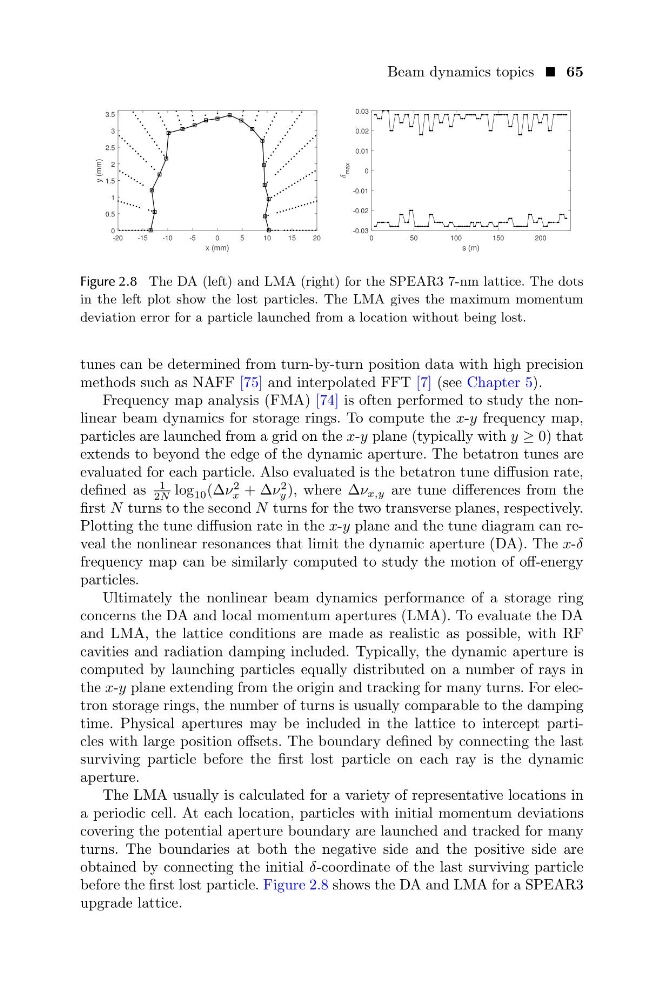
Figure 2.8 The DA (left) and LMA (right) for the SPEAR3 7-nm lattice. The dots
in the left plot show the lost particles. The LMA gives the maximum momentum
deviation error for a particle launched from a location without being lost.
tunes can be determined from turn-by-turn position data with high precision
methods such as NAFF [75] and interpolated FFT [7] (see Chapter 5).
Frequency map analysis (FMA) [74] is often performed to study the nonlinear beam dynamics for storage rings. To compute the x-y frequency map,
particles are launched from a grid on the x-y plane (typically with y ≥ 0) that
extends to beyond the edge of the dynamic aperture. The betatron tunes are
evaluated for each particle. Also evaluated is the betatron tune diffusion rate,
defined as
1
2N log 10 (∆ν
2
x + ∆ν
2
y ), where ∆ν x,y are tune differences from the
first N turns to the second N turns for the two transverse planes, respectively.
Plotting the tune diffusion rate in the x-y plane and the tune diagram can reveal the nonlinear resonances that limit the dynamic aperture (DA). The x-δ
frequency map can be similarly computed to study the motion of off-energy
particles.
Ultimately the nonlinear beam dynamics performance of a storage ring
concerns the DA and local momentum apertures (LMA). To evaluate the DA
and LMA, the lattice conditions are made as realistic as possible, with RF
cavities and radiation damping included. Typically, the dynamic aperture is
computed by launching particles equally distributed on a number of rays in
the x-y plane extending from the origin and tracking for many turns. For electron storage rings, the number of turns is usually comparable to the damping
time. Physical apertures may be included in the lattice to intercept particles with large position offsets. The boundary defined by connecting the last
surviving particle before the first lost particle on each ray is the dynamic
aperture.
The LMA usually is calculated for a variety of representative locations in
a periodic cell. At each location, particles with initial momentum deviations
covering the potential aperture boundary are launched and tracked for many
turns. The boundaries at both the negative side and the positive side are
obtained by connecting the initial δ-coordinate of the last surviving particle
before the first lost particle. Figure 2.8 shows the DA and LMA for a SPEAR3
upgrade lattice.
-20
-15
-10
-5
0
5
10
15
20
x (mm)
0
0.5
1
1.5
2
2.5
3
3.5
y (mm)
0
50
100
150
200
s (m)
-0.03
-0.02
-0.01
0
0.01
0.02
0.03
max
Figure 2.8 The DA (left) and LMA (right) for the SPEAR3 7-nm lattice. The dots
in the left plot show the lost particles. The LMA gives the maximum momentum
deviation error for a particle launched from a location without being lost.
tunes can be determined from turn-by-turn position data with high precision
methods such as NAFF [75] and interpolated FFT [7] (see Chapter 5).
Frequency map analysis (FMA) [74] is often performed to study the nonlinear beam dynamics for storage rings. To compute the x-y frequency map,
particles are launched from a grid on the x-y plane (typically with y ≥ 0) that
extends to beyond the edge of the dynamic aperture. The betatron tunes are
evaluated for each particle. Also evaluated is the betatron tune diffusion rate,
defined as
1
2N log 10 (∆ν
2
x + ∆ν
2
y ), where ∆ν x,y are tune differences from the
first N turns to the second N turns for the two transverse planes, respectively.
Plotting the tune diffusion rate in the x-y plane and the tune diagram can reveal the nonlinear resonances that limit the dynamic aperture (DA). The x-δ
frequency map can be similarly computed to study the motion of off-energy
particles.
Ultimately the nonlinear beam dynamics performance of a storage ring
concerns the DA and local momentum apertures (LMA). To evaluate the DA
and LMA, the lattice conditions are made as realistic as possible, with RF
cavities and radiation damping included. Typically, the dynamic aperture is
computed by launching particles equally distributed on a number of rays in
the x-y plane extending from the origin and tracking for many turns. For electron storage rings, the number of turns is usually comparable to the damping
time. Physical apertures may be included in the lattice to intercept particles with large position offsets. The boundary defined by connecting the last
surviving particle before the first lost particle on each ray is the dynamic
aperture.
The LMA usually is calculated for a variety of representative locations in
a periodic cell. At each location, particles with initial momentum deviations
covering the potential aperture boundary are launched and tracked for many
turns. The boundaries at both the negative side and the positive side are
obtained by connecting the initial δ-coordinate of the last surviving particle
before the first lost particle. Figure 2.8 shows the DA and LMA for a SPEAR3
upgrade lattice.