

Beam dynamics topics 57
where f and g are the generating functions for the first and second elements
(noting the order), respectively, and
h = f + g +
1
2
: f : g +
1
12
: f :
2 g +
1
12
: g :
2 f + · · · .
(2.106)
With concatenation, the Lie map for any section with multiple elements can
be obtained. The one-turn map at a location in a ring is a special example.
The terms in the generating function can be grouped by their orders in
the polynomial,
e
:h: = e
:f2: e
:f3: e
:f4: · · · ,
(2.107)
where f 2 contains all quadratic terms, f 3 all third order terms, etc. Note that
f 3 , f 4 , and higher order terms differ from terms in h because extra terms are
generated when the BCH formula is used to separate the map in Eq. (2.107).
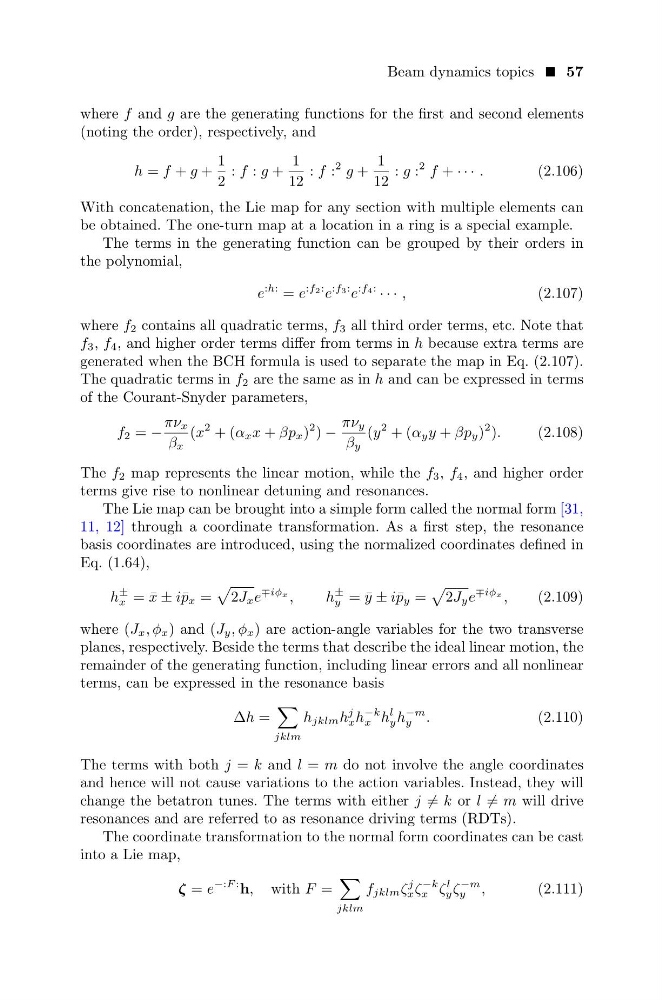
The quadratic terms in f 2 are the same as in h and can be expressed in terms
of the Courant-Snyder parameters,
f 2 = −
πν x
β x
(x
2 + (α x x + βp x )
2 ) −
πν y
β y
(y
2 + (α y y + βp y )
2 ).
(2.108)
The f 2 map represents the linear motion, while the f 3 , f 4 , and higher order
terms give rise to nonlinear detuning and resonances.
The Lie map can be brought into a simple form called the normal form [31,
11, 12] through a coordinate transformation. As a first step, the resonance
basis coordinates are introduced, using the normalized coordinates defined in
Eq. (1.64),
h
±
x = ¯
x ± i¯ p x =
2J x e
∓iφx ,
h
±
y = ¯
y ± i¯ p y =
2J y e
∓iφx ,
(2.109)
where (J x , φ x ) and (J y , φ x ) are action-angle variables for the two transverse
planes, respectively. Beside the terms that describe the ideal linear motion, the
remainder of the generating function, including linear errors and all nonlinear
terms, can be expressed in the resonance basis
∆h =
jklm
h jklm h
j
x h
−k
x h
l
y h
−m
y .
(2.110)
The terms with both j = k and l = m do not involve the angle coordinates
and hence will not cause variations to the action variables. Instead, they will
change the betatron tunes. The terms with either j = k or l = m will drive
resonances and are referred to as resonance driving terms (RDTs).
The coordinate transformation to the normal form coordinates can be cast
into a Lie map,
ζ = e
−:F : h, with F =
jklm
f jklm ζ
j
x ζ
−k
x ζ
l
y ζ
−m
y
,
(2.111)
where f and g are the generating functions for the first and second elements
(noting the order), respectively, and
h = f + g +
1
2
: f : g +
1
12
: f :
2 g +
1
12
: g :
2 f + · · · .
(2.106)
With concatenation, the Lie map for any section with multiple elements can
be obtained. The one-turn map at a location in a ring is a special example.
The terms in the generating function can be grouped by their orders in
the polynomial,
e
:h: = e
:f2: e
:f3: e
:f4: · · · ,
(2.107)
where f 2 contains all quadratic terms, f 3 all third order terms, etc. Note that
f 3 , f 4 , and higher order terms differ from terms in h because extra terms are
generated when the BCH formula is used to separate the map in Eq. (2.107).
The quadratic terms in f 2 are the same as in h and can be expressed in terms
of the Courant-Snyder parameters,
f 2 = −
πν x
β x
(x
2 + (α x x + βp x )
2 ) −
πν y
β y
(y
2 + (α y y + βp y )
2 ).
(2.108)
The f 2 map represents the linear motion, while the f 3 , f 4 , and higher order
terms give rise to nonlinear detuning and resonances.
The Lie map can be brought into a simple form called the normal form [31,
11, 12] through a coordinate transformation. As a first step, the resonance
basis coordinates are introduced, using the normalized coordinates defined in
Eq. (1.64),
h
±
x = ¯
x ± i¯ p x =
2J x e
∓iφx ,
h
±
y = ¯
y ± i¯ p y =
2J y e
∓iφx ,
(2.109)
where (J x , φ x ) and (J y , φ x ) are action-angle variables for the two transverse
planes, respectively. Beside the terms that describe the ideal linear motion, the
remainder of the generating function, including linear errors and all nonlinear
terms, can be expressed in the resonance basis
∆h =
jklm
h jklm h
j
x h
−k
x h
l
y h
−m
y .
(2.110)
The terms with both j = k and l = m do not involve the angle coordinates
and hence will not cause variations to the action variables. Instead, they will
change the betatron tunes. The terms with either j = k or l = m will drive
resonances and are referred to as resonance driving terms (RDTs).
The coordinate transformation to the normal form coordinates can be cast
into a Lie map,
ζ = e
−:F : h, with F =
jklm
f jklm ζ
j
x ζ
−k
x ζ
l
y ζ
−m
y
,
(2.111)