

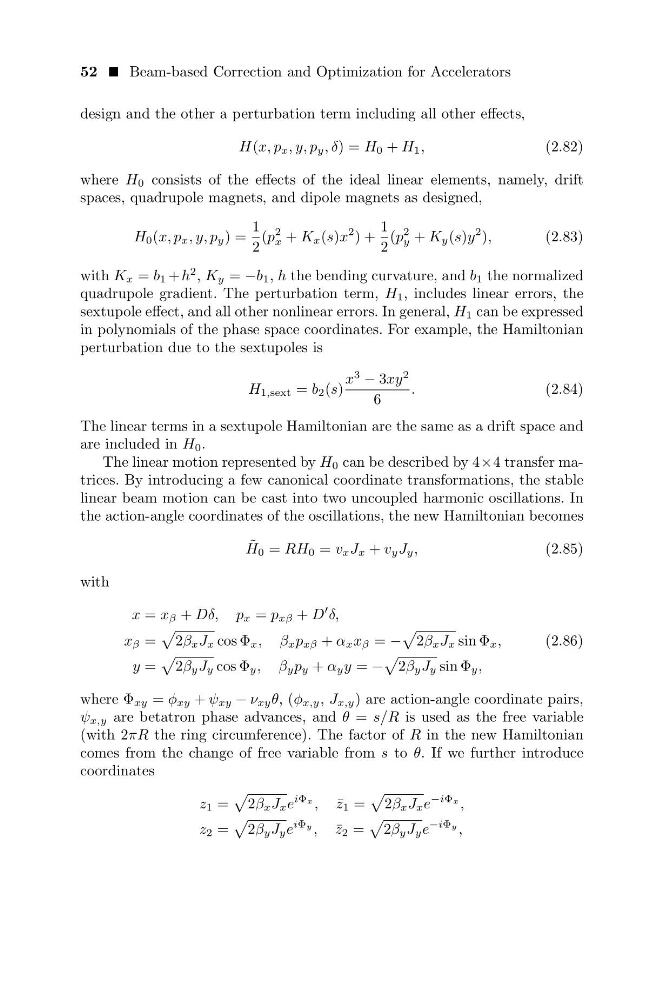
52 Beam-based Correction and Optimization for Accelerators
design and the other a perturbation term including all other effects,
H(x, p x , y, p y , δ) = H 0 + H 1 ,
(2.82)
where H 0 consists of the effects of the ideal linear elements, namely, drift
spaces, quadrupole magnets, and dipole magnets as designed,
H 0 (x, p x , y, p y ) =
1
2
(p
2
x + K x (s)x
2 ) +
1
2
(p
2
y + K y (s)y
2 ),
(2.83)
with K x = b 1 + h
2 , K y = −b 1 , h the bending curvature, and b 1 the normalized
quadrupole gradient. The perturbation term, H 1 , includes linear errors, the
sextupole effect, and all other nonlinear errors. In general, H 1 can be expressed
in polynomials of the phase space coordinates. For example, the Hamiltonian
perturbation due to the sextupoles is
H 1,sext = b 2 (s)
x
3 − 3xy
2
6
.
(2.84)
The linear terms in a sextupole Hamiltonian are the same as a drift space and
are included in H 0 .
The linear motion represented by H 0 can be described by 4×4 transfer matrices. By introducing a few canonical coordinate transformations, the stable
linear beam motion can be cast into two uncoupled harmonic oscillations. In
the action-angle coordinates of the oscillations, the new Hamiltonian becomes
˜
H 0 = RH 0 = v x J x + v y J y ,
(2.85)
with
x = x β + Dδ, p x = p xβ + D
δ,
x β =
2β x J x cos Φ x , β x p xβ + α x x β = −
2β x J x sin Φ x ,
(2.86)
y =
2β y J y cos Φ y , β y p y + α y y = −
2β y J y sin Φ y ,
where Φ xy = φ xy + ψ xy − ν xy θ, (φ x,y , J x,y ) are action-angle coordinate pairs,
ψ x,y are betatron phase advances, and θ = s/R is used as the free variable
(with 2πR the ring circumference). The factor of R in the new Hamiltonian
comes from the change of free variable from s to θ. If we further introduce
coordinates
z 1 =
2β x J x e
iΦx , ¯
z 1 =
2β x J x e
−iΦx ,
z 2 =
2β y J y e
iΦy , ¯
z 2 =
2β y J y e
−iΦy ,
design and the other a perturbation term including all other effects,
H(x, p x , y, p y , δ) = H 0 + H 1 ,
(2.82)
where H 0 consists of the effects of the ideal linear elements, namely, drift
spaces, quadrupole magnets, and dipole magnets as designed,
H 0 (x, p x , y, p y ) =
1
2
(p
2
x + K x (s)x
2 ) +
1
2
(p
2
y + K y (s)y
2 ),
(2.83)
with K x = b 1 + h
2 , K y = −b 1 , h the bending curvature, and b 1 the normalized
quadrupole gradient. The perturbation term, H 1 , includes linear errors, the
sextupole effect, and all other nonlinear errors. In general, H 1 can be expressed
in polynomials of the phase space coordinates. For example, the Hamiltonian
perturbation due to the sextupoles is
H 1,sext = b 2 (s)
x
3 − 3xy
2
6
.
(2.84)
The linear terms in a sextupole Hamiltonian are the same as a drift space and
are included in H 0 .
The linear motion represented by H 0 can be described by 4×4 transfer matrices. By introducing a few canonical coordinate transformations, the stable
linear beam motion can be cast into two uncoupled harmonic oscillations. In
the action-angle coordinates of the oscillations, the new Hamiltonian becomes
˜
H 0 = RH 0 = v x J x + v y J y ,
(2.85)
with
x = x β + Dδ, p x = p xβ + D
δ,
x β =
2β x J x cos Φ x , β x p xβ + α x x β = −
2β x J x sin Φ x ,
(2.86)
y =
2β y J y cos Φ y , β y p y + α y y = −
2β y J y sin Φ y ,
where Φ xy = φ xy + ψ xy − ν xy θ, (φ x,y , J x,y ) are action-angle coordinate pairs,
ψ x,y are betatron phase advances, and θ = s/R is used as the free variable
(with 2πR the ring circumference). The factor of R in the new Hamiltonian
comes from the change of free variable from s to θ. If we further introduce
coordinates
z 1 =
2β x J x e
iΦx , ¯
z 1 =
2β x J x e
−iΦx ,
z 2 =
2β y J y e
iΦy , ¯
z 2 =
2β y J y e
−iΦy ,