

50 Beam-based Correction and Optimization for Accelerators
For example, the horizontal transfer matrix for a FODO cell for an offmomentum particle would need to change from Eq. (1.50) by replacing the
focal length, f , with f (1 + δ). The betatron tune contribution of the cell will
change accordingly. From Eqs. (1.65) and (2.77), the natural chromaticity of
a FODO cell is found to be
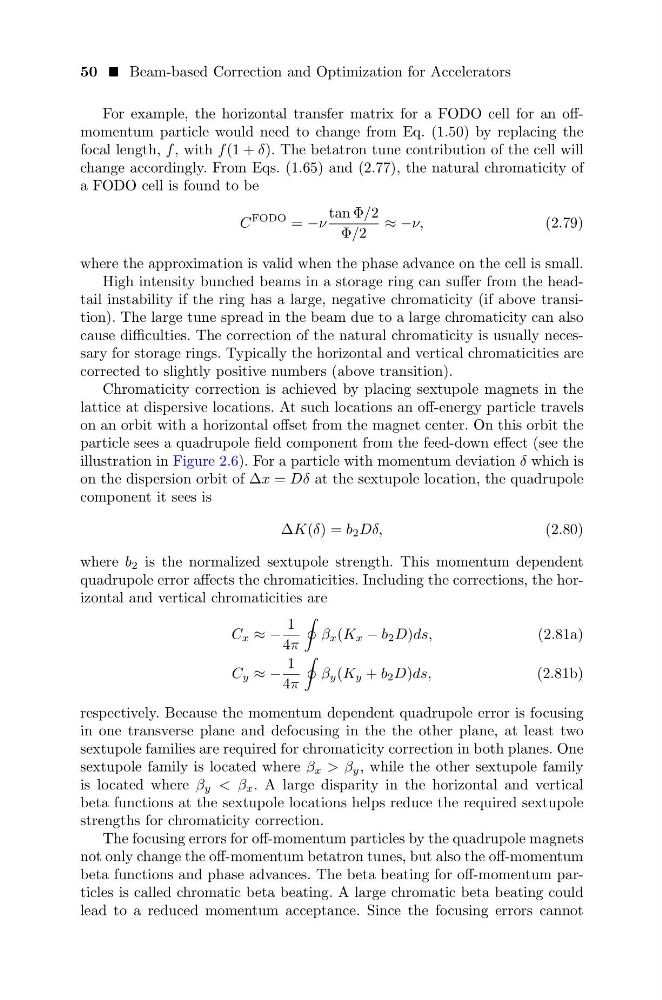
C
FODO = −ν
tan Φ/2
Φ/2
≈ −ν,
(2.79)
where the approximation is valid when the phase advance on the cell is small.
High intensity bunched beams in a storage ring can suffer from the headtail instability if the ring has a large, negative chromaticity (if above transition). The large tune spread in the beam due to a large chromaticity can also
cause difficulties. The correction of the natural chromaticity is usually necessary for storage rings. Typically the horizontal and vertical chromaticities are
corrected to slightly positive numbers (above transition).
Chromaticity correction is achieved by placing sextupole magnets in the
lattice at dispersive locations. At such locations an off-energy particle travels
on an orbit with a horizontal offset from the magnet center. On this orbit the
particle sees a quadrupole field component from the feed-down effect (see the
illustration in Figure 2.6). For a particle with momentum deviation δ which is
on the dispersion orbit of ∆x = Dδ at the sextupole location, the quadrupole
component it sees is
∆K(δ) = b 2 Dδ,
(2.80)
where b 2 is the normalized sextupole strength. This momentum dependent
quadrupole error affects the chromaticities. Including the corrections, the horizontal and vertical chromaticities are
C x ≈ −
1
4π
β x (K x − b 2 D)ds,
(2.81a)
C y ≈ −
1
4π
β y (K y + b 2 D)ds,
(2.81b)
respectively. Because the momentum dependent quadrupole error is focusing
in one transverse plane and defocusing in the the other plane, at least two
sextupole families are required for chromaticity correction in both planes. One
sextupole family is located where β x > β y , while the other sextupole family
is located where β y < β x . A large disparity in the horizontal and vertical
beta functions at the sextupole locations helps reduce the required sextupole
strengths for chromaticity correction.
The focusing errors for off-momentum particles by the quadrupole magnets
not only change the off-momentum betatron tunes, but also the off-momentum
beta functions and phase advances. The beta beating for off-momentum particles is called chromatic beta beating. A large chromatic beta beating could
lead to a reduced momentum acceptance. Since the focusing errors cannot
For example, the horizontal transfer matrix for a FODO cell for an offmomentum particle would need to change from Eq. (1.50) by replacing the
focal length, f , with f (1 + δ). The betatron tune contribution of the cell will
change accordingly. From Eqs. (1.65) and (2.77), the natural chromaticity of
a FODO cell is found to be
C
FODO = −ν
tan Φ/2
Φ/2
≈ −ν,
(2.79)
where the approximation is valid when the phase advance on the cell is small.
High intensity bunched beams in a storage ring can suffer from the headtail instability if the ring has a large, negative chromaticity (if above transition). The large tune spread in the beam due to a large chromaticity can also
cause difficulties. The correction of the natural chromaticity is usually necessary for storage rings. Typically the horizontal and vertical chromaticities are
corrected to slightly positive numbers (above transition).
Chromaticity correction is achieved by placing sextupole magnets in the
lattice at dispersive locations. At such locations an off-energy particle travels
on an orbit with a horizontal offset from the magnet center. On this orbit the
particle sees a quadrupole field component from the feed-down effect (see the
illustration in Figure 2.6). For a particle with momentum deviation δ which is
on the dispersion orbit of ∆x = Dδ at the sextupole location, the quadrupole
component it sees is
∆K(δ) = b 2 Dδ,
(2.80)
where b 2 is the normalized sextupole strength. This momentum dependent
quadrupole error affects the chromaticities. Including the corrections, the horizontal and vertical chromaticities are
C x ≈ −
1
4π
β x (K x − b 2 D)ds,
(2.81a)
C y ≈ −
1
4π
β y (K y + b 2 D)ds,
(2.81b)
respectively. Because the momentum dependent quadrupole error is focusing
in one transverse plane and defocusing in the the other plane, at least two
sextupole families are required for chromaticity correction in both planes. One
sextupole family is located where β x > β y , while the other sextupole family
is located where β y < β x . A large disparity in the horizontal and vertical
beta functions at the sextupole locations helps reduce the required sextupole
strengths for chromaticity correction.
The focusing errors for off-momentum particles by the quadrupole magnets
not only change the off-momentum betatron tunes, but also the off-momentum
beta functions and phase advances. The beta beating for off-momentum particles is called chromatic beta beating. A large chromatic beta beating could
lead to a reduced momentum acceptance. Since the focusing errors cannot