

Beam dynamics topics 47
where C
+ is the symplectic conjugate of C, defined as
C
+ ≡ S
T
2 C
T S 2 =
C 22 −C 12
−C 21 C 11
,
(2.61)
and the matrix C is defined as
C = −
Hsgn[Tr(M − N)]
r
[Tr(M − N)] 2 + 4||H||
,
(2.62)
with H ≡ m + n
+ , ||H|| is the determinant of H, sgn(·) gives the sign, and
r =
1
2
+
1
2
[Tr(M − N)] 2
[Tr(M − N)] 2 + 4||H||
,
(2.63)
respectively. Parameter r and the determinant of the matrix C satisfy
r
2 + ||C|| = 1.
(2.64)
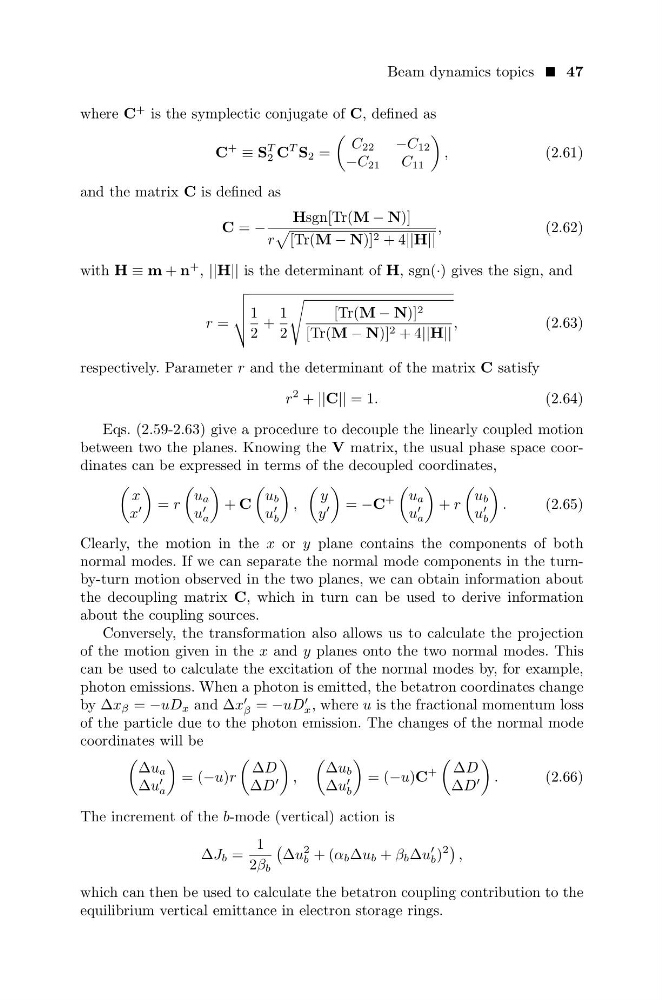
Eqs. (2.59-2.63) give a procedure to decouple the linearly coupled motion
between two the planes. Knowing the V matrix, the usual phase space coordinates can be expressed in terms of the decoupled coordinates,
x
x
= r
u a
u
a
+ C
u b
u
b
,
y
y
= −C
+
u a
u
a
+ r
u b
u
b
.
(2.65)
Clearly, the motion in the x or y plane contains the components of both
normal modes. If we can separate the normal mode components in the turnby-turn motion observed in the two planes, we can obtain information about
the decoupling matrix C, which in turn can be used to derive information
about the coupling sources.
Conversely, the transformation also allows us to calculate the projection
of the motion given in the x and y planes onto the two normal modes. This
can be used to calculate the excitation of the normal modes by, for example,
photon emissions. When a photon is emitted, the betatron coordinates change
by ∆x β = −uD x and ∆x
β = −uD
x , where u is the fractional momentum loss
of the particle due to the photon emission. The changes of the normal mode
coordinates will be
∆u a
∆u
a
= (−u)r
∆D
∆D
,
∆u b
∆u
b
= (−u)C
+
∆D
∆D
.
(2.66)
The increment of the b-mode (vertical) action is
∆J b =
1
2β b
∆u
2
b + (α b ∆u b + β b ∆u
b )
2
,
which can then be used to calculate the betatron coupling contribution to the
equilibrium vertical emittance in electron storage rings.
where C
+ is the symplectic conjugate of C, defined as
C
+ ≡ S
T
2 C
T S 2 =
C 22 −C 12
−C 21 C 11
,
(2.61)
and the matrix C is defined as
C = −
Hsgn[Tr(M − N)]
r
[Tr(M − N)] 2 + 4||H||
,
(2.62)
with H ≡ m + n
+ , ||H|| is the determinant of H, sgn(·) gives the sign, and
r =
1
2
+
1
2
[Tr(M − N)] 2
[Tr(M − N)] 2 + 4||H||
,
(2.63)
respectively. Parameter r and the determinant of the matrix C satisfy
r
2 + ||C|| = 1.
(2.64)
Eqs. (2.59-2.63) give a procedure to decouple the linearly coupled motion
between two the planes. Knowing the V matrix, the usual phase space coordinates can be expressed in terms of the decoupled coordinates,
x
x
= r
u a
u
a
+ C
u b
u
b
,
y
y
= −C
+
u a
u
a
+ r
u b
u
b
.
(2.65)
Clearly, the motion in the x or y plane contains the components of both
normal modes. If we can separate the normal mode components in the turnby-turn motion observed in the two planes, we can obtain information about
the decoupling matrix C, which in turn can be used to derive information
about the coupling sources.
Conversely, the transformation also allows us to calculate the projection
of the motion given in the x and y planes onto the two normal modes. This
can be used to calculate the excitation of the normal modes by, for example,
photon emissions. When a photon is emitted, the betatron coordinates change
by ∆x β = −uD x and ∆x
β = −uD
x , where u is the fractional momentum loss
of the particle due to the photon emission. The changes of the normal mode
coordinates will be
∆u a
∆u
a
= (−u)r
∆D
∆D
,
∆u b
∆u
b
= (−u)C
+
∆D
∆D
.
(2.66)
The increment of the b-mode (vertical) action is
∆J b =
1
2β b
∆u
2
b + (α b ∆u b + β b ∆u
b )
2
,
which can then be used to calculate the betatron coupling contribution to the
equilibrium vertical emittance in electron storage rings.