

Basics of beam dynamics 23
y
y
′
y
y
′
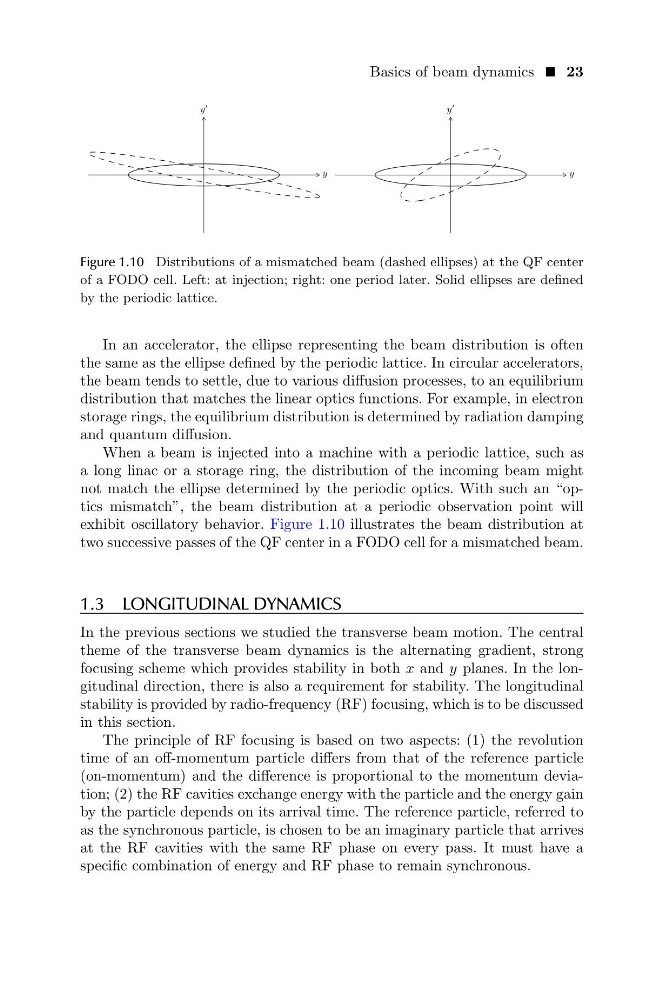
Figure 1.10 Distributions of a mismatched beam (dashed ellipses) at the QF center
of a FODO cell. Left: at injection; right: one period later. Solid ellipses are defined
by the periodic lattice.
In an accelerator, the ellipse representing the beam distribution is often
the same as the ellipse defined by the periodic lattice. In circular accelerators,
the beam tends to settle, due to various diffusion processes, to an equilibrium
distribution that matches the linear optics functions. For example, in electron
storage rings, the equilibrium distribution is determined by radiation damping
and quantum diffusion.
When a beam is injected into a machine with a periodic lattice, such as
a long linac or a storage ring, the distribution of the incoming beam might
not match the ellipse determined by the periodic optics. With such an “optics mismatch”, the beam distribution at a periodic observation point will
exhibit oscillatory behavior. Figure 1.10 illustrates the beam distribution at
two successive passes of the QF center in a FODO cell for a mismatched beam.
1.3 LONGITUDINAL DYNAMICS
In the previous sections we studied the transverse beam motion. The central
theme of the transverse beam dynamics is the alternating gradient, strong
focusing scheme which provides stability in both x and y planes. In the longitudinal direction, there is also a requirement for stability. The longitudinal
stability is provided by radio-frequency (RF) focusing, which is to be discussed
in this section.
The principle of RF focusing is based on two aspects: (1) the revolution
time of an off-momentum particle differs from that of the reference particle
(on-momentum) and the difference is proportional to the momentum deviation; (2) the RF cavities exchange energy with the particle and the energy gain
by the particle depends on its arrival time. The reference particle, referred to
as the synchronous particle, is chosen to be an imaginary particle that arrives
at the RF cavities with the same RF phase on every pass. It must have a
specific combination of energy and RF phase to remain synchronous.
y
y
′
y
y
′
Figure 1.10 Distributions of a mismatched beam (dashed ellipses) at the QF center
of a FODO cell. Left: at injection; right: one period later. Solid ellipses are defined
by the periodic lattice.
In an accelerator, the ellipse representing the beam distribution is often
the same as the ellipse defined by the periodic lattice. In circular accelerators,
the beam tends to settle, due to various diffusion processes, to an equilibrium
distribution that matches the linear optics functions. For example, in electron
storage rings, the equilibrium distribution is determined by radiation damping
and quantum diffusion.
When a beam is injected into a machine with a periodic lattice, such as
a long linac or a storage ring, the distribution of the incoming beam might
not match the ellipse determined by the periodic optics. With such an “optics mismatch”, the beam distribution at a periodic observation point will
exhibit oscillatory behavior. Figure 1.10 illustrates the beam distribution at
two successive passes of the QF center in a FODO cell for a mismatched beam.
1.3 LONGITUDINAL DYNAMICS
In the previous sections we studied the transverse beam motion. The central
theme of the transverse beam dynamics is the alternating gradient, strong
focusing scheme which provides stability in both x and y planes. In the longitudinal direction, there is also a requirement for stability. The longitudinal
stability is provided by radio-frequency (RF) focusing, which is to be discussed
in this section.
The principle of RF focusing is based on two aspects: (1) the revolution
time of an off-momentum particle differs from that of the reference particle
(on-momentum) and the difference is proportional to the momentum deviation; (2) the RF cavities exchange energy with the particle and the energy gain
by the particle depends on its arrival time. The reference particle, referred to
as the synchronous particle, is chosen to be an imaginary particle that arrives
at the RF cavities with the same RF phase on every pass. It must have a
specific combination of energy and RF phase to remain synchronous.