

216 Beam-based Correction and Optimization for Accelerators
0
2
4
6
8
10
12
14
knob index
0
0.02
0.04
0.06
0.08
0.1
0
2
4
6
8
10
12
14
skew quadrupoles
-0.5
0
0.5
V
1
, V
2
V 1
V 2
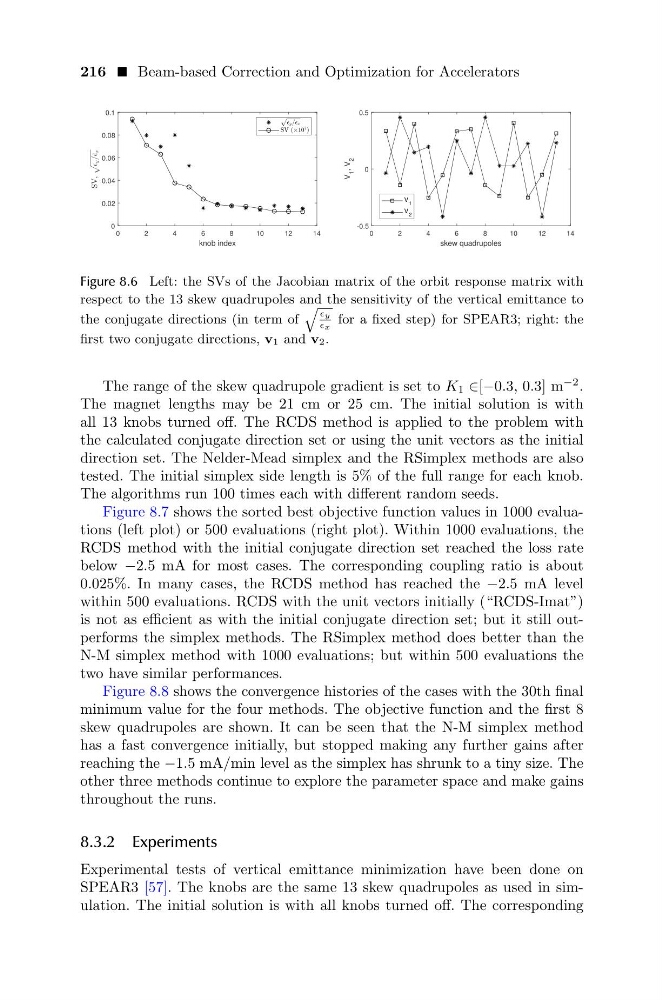
Figure 8.6 Left: the SVs of the Jacobian matrix of the orbit response matrix with
respect to the 13 skew quadrupoles and the sensitivity of the vertical emittance to
the conjugate directions (in term of
y
x
for a fixed step) for SPEAR3; right: the
first two conjugate directions, v1 and v2.
The range of the skew quadrupole gradient is set to K 1 ∈[−0.3, 0.3] m
−2 .
The magnet lengths may be 21 cm or 25 cm. The initial solution is with
all 13 knobs turned off. The RCDS method is applied to the problem with
the calculated conjugate direction set or using the unit vectors as the initial
direction set. The Nelder-Mead simplex and the RSimplex methods are also
tested. The initial simplex side length is 5% of the full range for each knob.
The algorithms run 100 times each with different random seeds.
Figure 8.7 shows the sorted best objective function values in 1000 evaluations (left plot) or 500 evaluations (right plot). Within 1000 evaluations, the
RCDS method with the initial conjugate direction set reached the loss rate
below −2.5 mA for most cases. The corresponding coupling ratio is about
0.025%. In many cases, the RCDS method has reached the −2.5 mA level
within 500 evaluations. RCDS with the unit vectors initially (“RCDS-Imat”)
is not as efficient as with the initial conjugate direction set; but it still outperforms the simplex methods. The RSimplex method does better than the
N-M simplex method with 1000 evaluations; but within 500 evaluations the
two have similar performances.
Figure 8.8 shows the convergence histories of the cases with the 30th final
minimum value for the four methods. The objective function and the first 8
skew quadrupoles are shown. It can be seen that the N-M simplex method
has a fast convergence initially, but stopped making any further gains after
reaching the −1.5 mA/min level as the simplex has shrunk to a tiny size. The
other three methods continue to explore the parameter space and make gains
throughout the runs.
8.3.2 Experiments
Experimental tests of vertical emittance minimization have been done on
SPEAR3 [57]. The knobs are the same 13 skew quadrupoles as used in simulation. The initial solution is with all knobs turned off. The corresponding
0
2
4
6
8
10
12
14
knob index
0
0.02
0.04
0.06
0.08
0.1
0
2
4
6
8
10
12
14
skew quadrupoles
-0.5
0
0.5
V
1
, V
2
V 1
V 2
Figure 8.6 Left: the SVs of the Jacobian matrix of the orbit response matrix with
respect to the 13 skew quadrupoles and the sensitivity of the vertical emittance to
the conjugate directions (in term of
y
x
for a fixed step) for SPEAR3; right: the
first two conjugate directions, v1 and v2.
The range of the skew quadrupole gradient is set to K 1 ∈[−0.3, 0.3] m
−2 .
The magnet lengths may be 21 cm or 25 cm. The initial solution is with
all 13 knobs turned off. The RCDS method is applied to the problem with
the calculated conjugate direction set or using the unit vectors as the initial
direction set. The Nelder-Mead simplex and the RSimplex methods are also
tested. The initial simplex side length is 5% of the full range for each knob.
The algorithms run 100 times each with different random seeds.
Figure 8.7 shows the sorted best objective function values in 1000 evaluations (left plot) or 500 evaluations (right plot). Within 1000 evaluations, the
RCDS method with the initial conjugate direction set reached the loss rate
below −2.5 mA for most cases. The corresponding coupling ratio is about
0.025%. In many cases, the RCDS method has reached the −2.5 mA level
within 500 evaluations. RCDS with the unit vectors initially (“RCDS-Imat”)
is not as efficient as with the initial conjugate direction set; but it still outperforms the simplex methods. The RSimplex method does better than the
N-M simplex method with 1000 evaluations; but within 500 evaluations the
two have similar performances.
Figure 8.8 shows the convergence histories of the cases with the 30th final
minimum value for the four methods. The objective function and the first 8
skew quadrupoles are shown. It can be seen that the N-M simplex method
has a fast convergence initially, but stopped making any further gains after
reaching the −1.5 mA/min level as the simplex has shrunk to a tiny size. The
other three methods continue to explore the parameter space and make gains
throughout the runs.
8.3.2 Experiments
Experimental tests of vertical emittance minimization have been done on
SPEAR3 [57]. The knobs are the same 13 skew quadrupoles as used in simulation. The initial solution is with all knobs turned off. The corresponding