

Linear optics measurement and correction - II 149
-200 -100 0
100 200
x ( m)
-15
-10
-5
0
5
10
15
xp ( rad)
-200 -100 0
100 200
y ( m)
-50
0
50
yp ( rad)
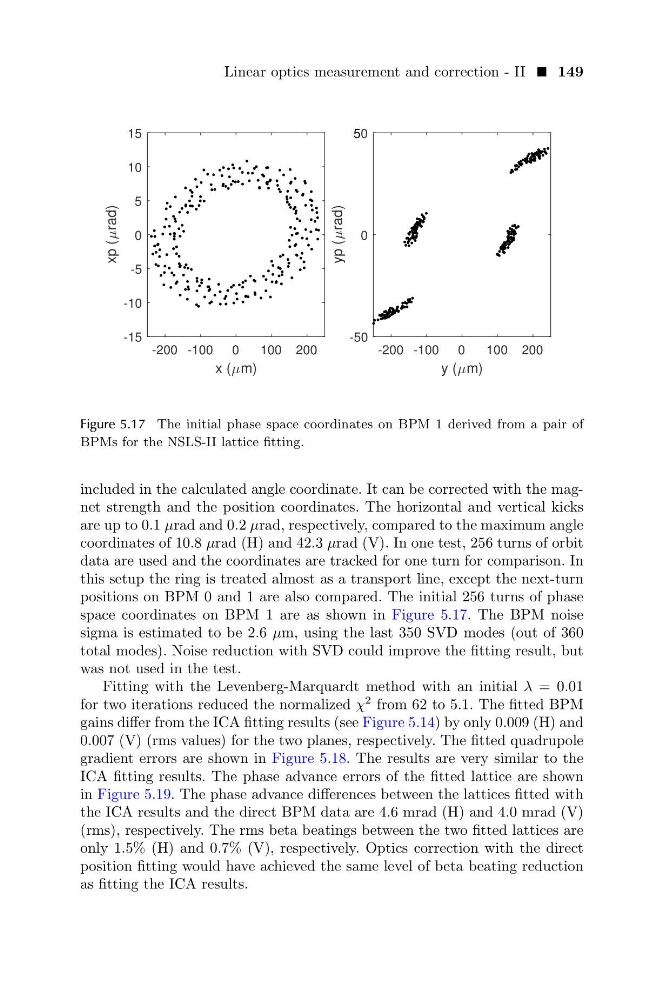
Figure 5.17 The initial phase space coordinates on BPM 1 derived from a pair of
BPMs for the NSLS-II lattice fitting.
included in the calculated angle coordinate. It can be corrected with the magnet strength and the position coordinates. The horizontal and vertical kicks
are up to 0.1 µrad and 0.2 µrad, respectively, compared to the maximum angle
coordinates of 10.8 µrad (H) and 42.3 µrad (V). In one test, 256 turns of orbit
data are used and the coordinates are tracked for one turn for comparison. In
this setup the ring is treated almost as a transport line, except the next-turn
positions on BPM 0 and 1 are also compared. The initial 256 turns of phase
space coordinates on BPM 1 are as shown in Figure 5.17. The BPM noise
sigma is estimated to be 2.6 µm, using the last 350 SVD modes (out of 360
total modes). Noise reduction with SVD could improve the fitting result, but
was not used in the test.
Fitting with the Levenberg-Marquardt method with an initial λ = 0.01
for two iterations reduced the normalized χ
2 from 62 to 5.1. The fitted BPM
gains differ from the ICA fitting results (see Figure 5.14) by only 0.009 (H) and
0.007 (V) (rms values) for the two planes, respectively. The fitted quadrupole
gradient errors are shown in Figure 5.18. The results are very similar to the
ICA fitting results. The phase advance errors of the fitted lattice are shown
in Figure 5.19. The phase advance differences between the lattices fitted with
the ICA results and the direct BPM data are 4.6 mrad (H) and 4.0 mrad (V)
(rms), respectively. The rms beta beatings between the two fitted lattices are
only 1.5% (H) and 0.7% (V), respectively. Optics correction with the direct
position fitting would have achieved the same level of beta beating reduction
as fitting the ICA results.
-200 -100 0
100 200
x ( m)
-15
-10
-5
0
5
10
15
xp ( rad)
-200 -100 0
100 200
y ( m)
-50
0
50
yp ( rad)
Figure 5.17 The initial phase space coordinates on BPM 1 derived from a pair of
BPMs for the NSLS-II lattice fitting.
included in the calculated angle coordinate. It can be corrected with the magnet strength and the position coordinates. The horizontal and vertical kicks
are up to 0.1 µrad and 0.2 µrad, respectively, compared to the maximum angle
coordinates of 10.8 µrad (H) and 42.3 µrad (V). In one test, 256 turns of orbit
data are used and the coordinates are tracked for one turn for comparison. In
this setup the ring is treated almost as a transport line, except the next-turn
positions on BPM 0 and 1 are also compared. The initial 256 turns of phase
space coordinates on BPM 1 are as shown in Figure 5.17. The BPM noise
sigma is estimated to be 2.6 µm, using the last 350 SVD modes (out of 360
total modes). Noise reduction with SVD could improve the fitting result, but
was not used in the test.
Fitting with the Levenberg-Marquardt method with an initial λ = 0.01
for two iterations reduced the normalized χ
2 from 62 to 5.1. The fitted BPM
gains differ from the ICA fitting results (see Figure 5.14) by only 0.009 (H) and
0.007 (V) (rms values) for the two planes, respectively. The fitted quadrupole
gradient errors are shown in Figure 5.18. The results are very similar to the
ICA fitting results. The phase advance errors of the fitted lattice are shown
in Figure 5.19. The phase advance differences between the lattices fitted with
the ICA results and the direct BPM data are 4.6 mrad (H) and 4.0 mrad (V)
(rms), respectively. The rms beta beatings between the two fitted lattices are
only 1.5% (H) and 0.7% (V), respectively. Optics correction with the direct
position fitting would have achieved the same level of beta beating reduction
as fitting the ICA results.