

Linear optics measurement and correction - I 113
under-constrained directions. To introduce constraints on the quadrupole parameters, the least-square objective function is modified to [49, 52, 50]
χ
2
c =
ij
1
σ 2
ij
(R
meas
ij
− R
model
ij
)
2 +
1
σ 2
K
Nq
i=1
w
2
i ∆K
2
i ,
(4.37)
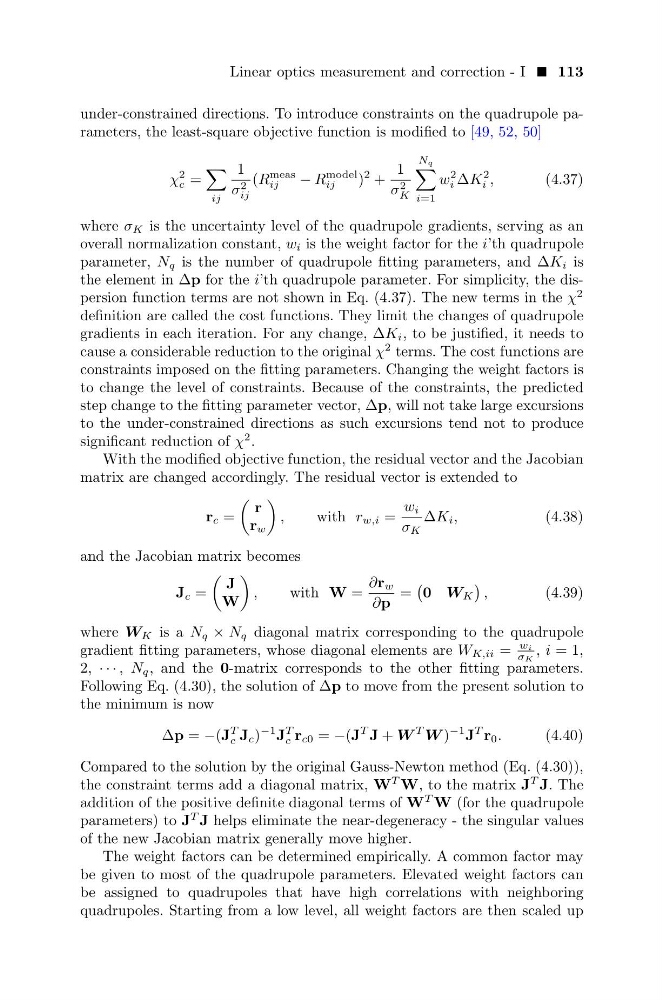
where σ K is the uncertainty level of the quadrupole gradients, serving as an
overall normalization constant, w i is the weight factor for the i’th quadrupole
parameter, N q is the number of quadrupole fitting parameters, and ∆K i is
the element in ∆p for the i’th quadrupole parameter. For simplicity, the dispersion function terms are not shown in Eq. (4.37). The new terms in the χ
2
definition are called the cost functions. They limit the changes of quadrupole
gradients in each iteration. For any change, ∆K i , to be justified, it needs to
cause a considerable reduction to the original χ
2 terms. The cost functions are
constraints imposed on the fitting parameters. Changing the weight factors is
to change the level of constraints. Because of the constraints, the predicted
step change to the fitting parameter vector, ∆p, will not take large excursions
to the under-constrained directions as such excursions tend not to produce
significant reduction of χ
2 .
With the modified objective function, the residual vector and the Jacobian
matrix are changed accordingly. The residual vector is extended to
r c =
r
r w
,
with r w,i =
w i
σ K
∆K i ,
(4.38)
and the Jacobian matrix becomes
J c =
J
W
,
with W =
∂r w
∂p
=
0 W K
,
(4.39)
where W K is a N q × N q diagonal matrix corresponding to the quadrupole
gradient fitting parameters, whose diagonal elements are W K,ii =
wi
σ K
, i = 1,
2, · · · , N q , and the 0-matrix corresponds to the other fitting parameters.
Following Eq. (4.30), the solution of ∆p to move from the present solution to
the minimum is now
∆p = −(J
T
c J c )
−1 J
T
c r c0 = −(J
T J + W
T W )
−1 J
T r 0 .
(4.40)
Compared to the solution by the original Gauss-Newton method (Eq. (4.30)),
the constraint terms add a diagonal matrix, W
T W, to the matrix J
T J. The
addition of the positive definite diagonal terms of W
T W (for the quadrupole
parameters) to J
T J helps eliminate the near-degeneracy - the singular values
of the new Jacobian matrix generally move higher.
The weight factors can be determined empirically. A common factor may
be given to most of the quadrupole parameters. Elevated weight factors can
be assigned to quadrupoles that have high correlations with neighboring
quadrupoles. Starting from a low level, all weight factors are then scaled up
under-constrained directions. To introduce constraints on the quadrupole parameters, the least-square objective function is modified to [49, 52, 50]
χ
2
c =
ij
1
σ 2
ij
(R
meas
ij
− R
model
ij
)
2 +
1
σ 2
K
Nq
i=1
w
2
i ∆K
2
i ,
(4.37)
where σ K is the uncertainty level of the quadrupole gradients, serving as an
overall normalization constant, w i is the weight factor for the i’th quadrupole
parameter, N q is the number of quadrupole fitting parameters, and ∆K i is
the element in ∆p for the i’th quadrupole parameter. For simplicity, the dispersion function terms are not shown in Eq. (4.37). The new terms in the χ
2
definition are called the cost functions. They limit the changes of quadrupole
gradients in each iteration. For any change, ∆K i , to be justified, it needs to
cause a considerable reduction to the original χ
2 terms. The cost functions are
constraints imposed on the fitting parameters. Changing the weight factors is
to change the level of constraints. Because of the constraints, the predicted
step change to the fitting parameter vector, ∆p, will not take large excursions
to the under-constrained directions as such excursions tend not to produce
significant reduction of χ
2 .
With the modified objective function, the residual vector and the Jacobian
matrix are changed accordingly. The residual vector is extended to
r c =
r
r w
,
with r w,i =
w i
σ K
∆K i ,
(4.38)
and the Jacobian matrix becomes
J c =
J
W
,
with W =
∂r w
∂p
=
0 W K
,
(4.39)
where W K is a N q × N q diagonal matrix corresponding to the quadrupole
gradient fitting parameters, whose diagonal elements are W K,ii =
wi
σ K
, i = 1,
2, · · · , N q , and the 0-matrix corresponds to the other fitting parameters.
Following Eq. (4.30), the solution of ∆p to move from the present solution to
the minimum is now
∆p = −(J
T
c J c )
−1 J
T
c r c0 = −(J
T J + W
T W )
−1 J
T r 0 .
(4.40)
Compared to the solution by the original Gauss-Newton method (Eq. (4.30)),
the constraint terms add a diagonal matrix, W
T W, to the matrix J
T J. The
addition of the positive definite diagonal terms of W
T W (for the quadrupole
parameters) to J
T J helps eliminate the near-degeneracy - the singular values
of the new Jacobian matrix generally move higher.
The weight factors can be determined empirically. A common factor may
be given to most of the quadrupole parameters. Elevated weight factors can
be assigned to quadrupoles that have high correlations with neighboring
quadrupoles. Starting from a low level, all weight factors are then scaled up