

1 3
Top Curr Chem (Z) (2018) 376:24
fused to an imidazole ring. Adenine has just one more π-orbital in the valence
active space than indole (MOs depicted in Fig. 5a), i.e. CAS(12,10), and similar MOs that give rise to analogous electronic transitions (Figs. 5, 7). As with
indole, adenine features two close-lying ππ* excited states, but in the purine base
the GS → L a transition has higher TDM than GS → L b . As shown in Fig. 7b, the
benchmark of 2DUV–UV maps demonstrates remarkable changes when the active
space is increased with respect to the full valence space, with positions of the Ω 1
traces more sensible to the level of theory than in indole, while convergence is still
reached when eight extravalence orbitals are added in a RAS(12,10|2,8) scheme.
A comparison of the computed S 0 → S N excitation energies with the available
experimental cross-sections indicated unexpected discrepancies in the case of
adenine [57] relative to other aromatic systems. Therefore, for this nucleobase,
the benchmark study was extended to investigate the role of the geometry optimization methodology used to define the GS equilibrium structure. In particular, the
lack of dynamic correlation at the CASSCF level introduces significant shortening of double bonds in the Ade heterocycle that are significantly elongated when
optimizing the geometry at density functional theory (DFT) or second-order
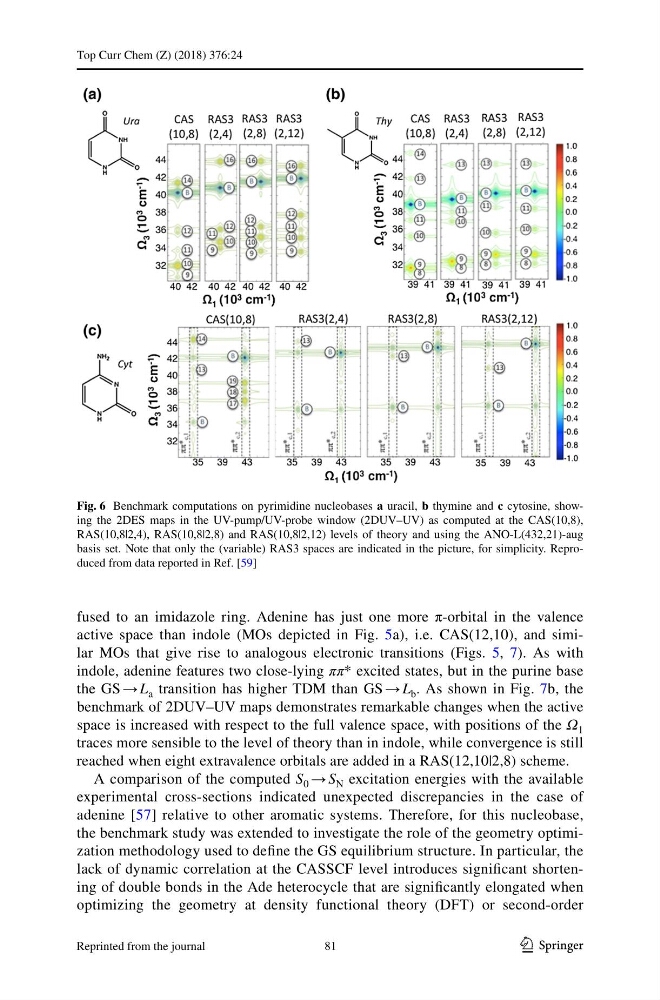
Fig. 6 Benchmark computations on pyrimidine nucleobases a uracil, b thymine and c cytosine, showing the 2DES maps in the UV-pump/UV-probe window (2DUV–UV) as computed at the CAS(10,8),
RAS(10,8|2,4), RAS(10,8|2,8) and RAS(10,8|2,12) levels of theory and using the ANO-L(432,21)-aug
basis set. Note that only the (variable) RAS3 spaces are indicated in the picture, for simplicity. Reproduced from data reported in Ref. [59]
81
Reprinted from the journal
Top Curr Chem (Z) (2018) 376:24
fused to an imidazole ring. Adenine has just one more π-orbital in the valence
active space than indole (MOs depicted in Fig. 5a), i.e. CAS(12,10), and similar MOs that give rise to analogous electronic transitions (Figs. 5, 7). As with
indole, adenine features two close-lying ππ* excited states, but in the purine base
the GS → L a transition has higher TDM than GS → L b . As shown in Fig. 7b, the
benchmark of 2DUV–UV maps demonstrates remarkable changes when the active
space is increased with respect to the full valence space, with positions of the Ω 1
traces more sensible to the level of theory than in indole, while convergence is still
reached when eight extravalence orbitals are added in a RAS(12,10|2,8) scheme.
A comparison of the computed S 0 → S N excitation energies with the available
experimental cross-sections indicated unexpected discrepancies in the case of
adenine [57] relative to other aromatic systems. Therefore, for this nucleobase,
the benchmark study was extended to investigate the role of the geometry optimization methodology used to define the GS equilibrium structure. In particular, the
lack of dynamic correlation at the CASSCF level introduces significant shortening of double bonds in the Ade heterocycle that are significantly elongated when
optimizing the geometry at density functional theory (DFT) or second-order
Fig. 6 Benchmark computations on pyrimidine nucleobases a uracil, b thymine and c cytosine, showing the 2DES maps in the UV-pump/UV-probe window (2DUV–UV) as computed at the CAS(10,8),
RAS(10,8|2,4), RAS(10,8|2,8) and RAS(10,8|2,12) levels of theory and using the ANO-L(432,21)-aug
basis set. Note that only the (variable) RAS3 spaces are indicated in the picture, for simplicity. Reproduced from data reported in Ref. [59]
81
Reprinted from the journal