

Top Curr Chem (Z) (2018) 376:10
1 3
(marks V and VI). Those oscillations take place in the excited state. Moreover, a
clear phase shift is observed at the minimum of the potential energy surface according to the coherent wavepacket evolution. Thus, the formation of the TTT involves
wavepacket motions on the excited potential energy surface S 1 . The photoproduct is
formed on the timescale of a few vibrational periods in the S 1 state.
This analysis clearly probes an ultrafast photoisomerization dynamics where the
main reaction coordinates are a torsional angle and a second not-further-specified
vibrational coordinate. Those two modes were clearly observed by wave-packet
dynamics on the excited state. After TTC excitation, most molecules relax back to
the ground state. However, a small portion undergoes a photoisomerization cis-trans
on the excited state. 2DES can isolate molecular reactive modes involved in an ultrafast photochemical process.
7 Conclusions and Perspectives
As we have shown in this chapter, 2DES allows to study i) heterogeneity in the
ground state, ii) electronic coupling between chromophores during excitation energy
transfer, iii) coherent oscillations in photoinduced dynamics, iv) intermediate or
dark states in a photoreactivity cycle.
Furthermore, lots of experimental efforts have been recently done in pushing the
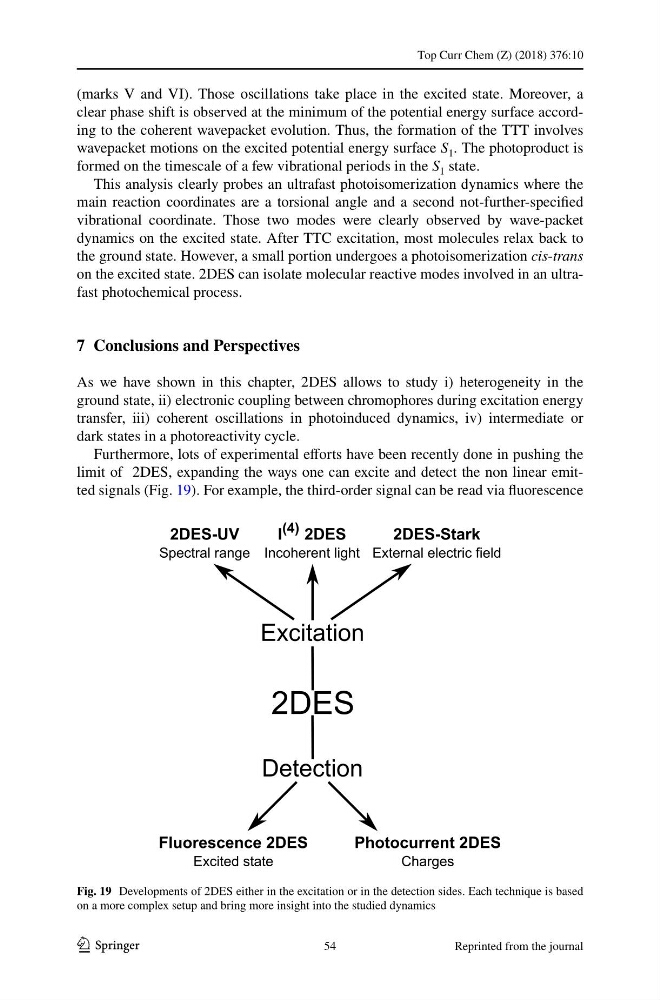
limit of 2DES, expanding the ways one can excite and detect the non linear emitted signals (Fig. 19). For example, the third-order signal can be read via fluorescence
Fig. 19 Developments of 2DES either in the excitation or in the detection sides. Each technique is based
on a more complex setup and bring more insight into the studied dynamics
54
Reprinted from the journal
1 3
(marks V and VI). Those oscillations take place in the excited state. Moreover, a
clear phase shift is observed at the minimum of the potential energy surface according to the coherent wavepacket evolution. Thus, the formation of the TTT involves
wavepacket motions on the excited potential energy surface S 1 . The photoproduct is
formed on the timescale of a few vibrational periods in the S 1 state.
This analysis clearly probes an ultrafast photoisomerization dynamics where the
main reaction coordinates are a torsional angle and a second not-further-specified
vibrational coordinate. Those two modes were clearly observed by wave-packet
dynamics on the excited state. After TTC excitation, most molecules relax back to
the ground state. However, a small portion undergoes a photoisomerization cis-trans
on the excited state. 2DES can isolate molecular reactive modes involved in an ultrafast photochemical process.
7 Conclusions and Perspectives
As we have shown in this chapter, 2DES allows to study i) heterogeneity in the
ground state, ii) electronic coupling between chromophores during excitation energy
transfer, iii) coherent oscillations in photoinduced dynamics, iv) intermediate or
dark states in a photoreactivity cycle.
Furthermore, lots of experimental efforts have been recently done in pushing the
limit of 2DES, expanding the ways one can excite and detect the non linear emitted signals (Fig. 19). For example, the third-order signal can be read via fluorescence
Fig. 19 Developments of 2DES either in the excitation or in the detection sides. Each technique is based
on a more complex setup and bring more insight into the studied dynamics
54
Reprinted from the journal